M-4 Bison
Soviet strategic bomber, renowned for its Cold War service, extensively deployed for long-range maritime reconnaissance and bombing missions. Key figures: top speed 947 km/h, range 5,600 km, service ceiling 11,000 m, max takeoff weight 181,500 kg, unit price $8M, built 123.
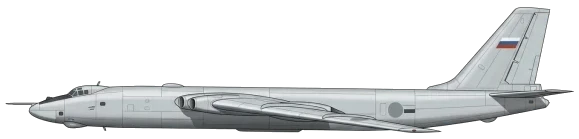
| Crew | 7 |
| Length | 47.2 m (154.9 ft) |
| Wingspan | 50.5 m (165.7 ft) |
| Height | 14.1 m (46.3 ft) |
| Wing area | 326.4 m² (3512.8 sqft) |
| Empty weight | 79,700 kg (175,708 lbs) |
| Max. takeoff weight | 181,500 kg (400,139 lbs) |
| Powerplant | 4 × turbojets Mikouline AM-3 9,525 kgf each |
| Maximum speed | 947 km/h (588 mph) |
| Operational range | 5,600 km (3,480 mi) |
| Service ceiling | 11,000 m (36,089 ft) |
- Low-Drag FAB-100
- Low-Drag FAB-250
- Low-Drag FAB-3000M-54
- Low-Drag FAB-5000M-54
- Low-Drag FAB-9000M-54
- Low-Drag JSC NPO Basalt FAB-500

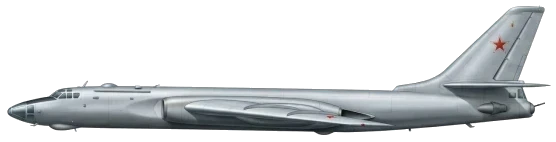
Description
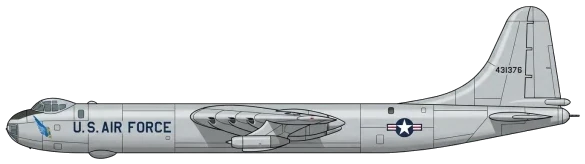
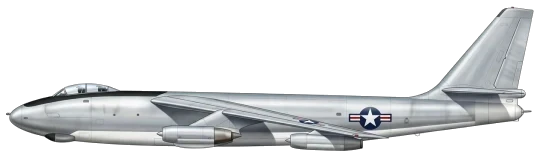
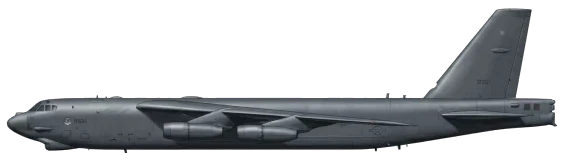
Designed as a strategic nuclear bomber in the 1950s, shortly after the B-52 Stratofortress, the M-4 Bison was a quadruplex bomber designed in response to the Soviet Union's need for a bomber force capable of reaching the continental United States. From the beginning, it was hindered by a range too short to carry out intercontinental missions for which it was intended.
Development
The first prototype of the M-4 made its first flight on January 20, 1953, and the state acceptance tests were conducted in March 1954. Serial production began the same year, and the aircraft entered service in 1955. A total of 34 aircraft were built, including two prototypes.
Design
The M-4 had a swept wing with a 35 degrees angle and was mainly constructed with aluminum alloys, with some steel and magnesium components. It was powered by four Mikulin AM-3A engines, later replaced by RD-3M-500 turbojet engines. Despite a fuel capacity of 123,600 liters, the range of the initial M-4/2M version was only 8,000 km due to fuel-thirsty engines, which prevented it from having strategic bombing capabilities. Even after engine changes, the M-4/2M version never managed to overcome this problem, and it was not until the 3M/M-6 (Bison B) version that the range increased to 11,800 km due to increased fuel capacity and new fuel-efficient and more powerful engines.
Armament
The bomber was equipped with 23mm AM-23 cannons for self-defense, with a dual-purpose tail turret and two remotely operated turrets located in the upper and lower parts of the fuselage. It could carry a payload of 24 tons in different configurations.
The M-4 Bison was operated by a crew of eight people, including a navigator/bombardier, a pilot, a co-pilot, a radar/navigator operator, a flight engineer/gunner, a radio operator/gunner, a dorsal turret gunner, and a tail turret gunner for self-defense.
Operational History
The M-4 was used by the Soviet Union for several decades, and 200 aircraft were reportedly built. The bombing versions were retired in the early 1980s in response to the START 1 agreements on nuclear disarmament. The aerial refueling versions remained in service until 1994.
Variants
Developed versions include:
-
Bison A - M-4/2M: Strategic nuclear bombing version.
-
Bison B - 3M/M-6: Improved version of the strategic nuclear bomber with increased fuel capacity and new engines, four VD-7 engines. Aerial refueling capability.
-
Bison B - 3MS/M-6: Strategic nuclear bombing version equipped with new RD-3M-500A engines. A version designated 3MS2 was specifically developed for aerial refueling, yet retained the NATO code Bison-B.
-
Bison C - 3MD/M-6/3MN: Strategic nuclear bombing version with new VD-7B engines. This version also had aerial refueling capability.
-
Bison C - 3MN-2: Aerial refueling version derived from the 3MD model.
-
Project 28: Study for a high-altitude bombing version. The project was not completed.
-
3M-T/BM-T "Atlant": An aircraft converted for the transport of Energia rocket components.
Frequently Asked Questions
What type of aircraft is the M-4 Bison?
What is the maximum speed of the M-4 Bison?
What is the range of the M-4 Bison?
When did the M-4 Bison first fly?
How many M-4 Bison have been built?
Which countries operate the M-4 Bison?
How much does a M-4 Bison cost?
What is the service ceiling of the M-4 Bison?
- AUG 12026 Updated Manufacturer updated
- JUL 232026 Updated Sources and cross-references refreshed
- APR 72026 Updated Sources and cross-references refreshed
- JAN 122026 Updated Range updated in a site-wide editorial pass