SH-2 Seasprite
American multi-purpose helicopter, known for major deployments during the Vietnam and Falklands Wars, particularly in anti-submarine warfare roles. Key figures: top speed 256 km/h, range 680 km, service ceiling 5,486 m, unit price $1.2M, built 184. In service with 3 air forces as of 2026 — Egypt (7), New Zealand (5), Peru (5).
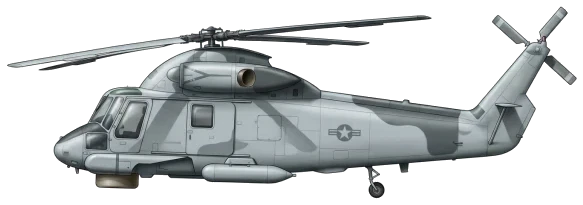
| Crew | 3 |
| Length | 16.1 m (52.9 ft) |
| Wingspan | 13.4 m (44.0 ft) |
| Height | 4.6 m (15.0 ft) |
| Empty weight | 4,173 kg (9,200 lbs) |
| Powerplant | 2 × turboshafts General Electric T700-GE-401C 1,342 kW each |
| Maximum speed | 256 km/h (159 mph) |
| Operational range | 680 km (423 mi) |
| Service ceiling | 5,486 m (17,999 ft) |
| Climb rate | 12.7 m/s (41.7 ft/s) |


Recent Events — SH-2 Seasprite
1 event →
Description
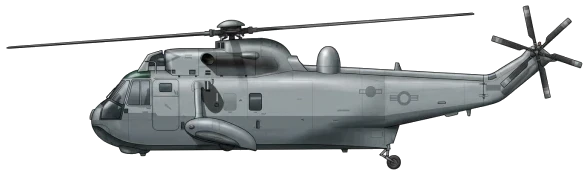
The Kaman SH-2 Seasprite is an American ship-based utility and anti-submarine warfare (ASW) helicopter developed and produced by the Kaman Aircraft Corporation. The aircraft entered operational service with the United States Navy in 1962 as a compact, fast-moving rotorcraft. It is primarily known for its compact physical footprint, which allowed it to operate from small flight decks on non-aviation surface vessels that could not accommodate larger naval helicopters.
Development
In 1956, the United States Navy launched a competition for a compact, all-weather multipurpose naval helicopter, selecting Kaman's K-20 design. The Navy initially ordered four prototypes and 12 production aircraft designated HU2K-1, which were redesignated UH-2A under the 1962 Tri-Service system. Production reached 184 H-2s before initial termination, but Kaman restarted the manufacturing line in 1971 to build the improved SH-2F. In October 1970, the Navy selected the type as its interim Light Airborne Multi-Purpose System (LAMPS) helicopter, resulting in extensive conversions of existing UH-2 airframes into SH-2D and SH-2F variants.
Design
The aircraft features a 44-foot four-bladed main rotor and a four-bladed tail rotor. Originally powered by a single General Electric T58 turboshaft engine, later variants were converted to a twin-engine layout using T58-GE-8F or T700-GE-401 engines. Tactical avionics include an LN 66HP radar, the LAMPS Mark I processing suite, and a chin-mounted forward-looking infrared sensor. Additional specialized equipment fitted to upgraded models includes chaff and flare launchers, dual rear-mounted infrared countermeasures, and missile and mine detection sensors.
Armament
The SH-2 features two fuselage-mounted stub pylon stations for external stores. For anti-submarine missions, the aircraft carries two Mk 46 or Mk 50 torpedoes. Non-U.S. variants can also deploy guided anti-ship munitions, including the AGM-65 Maverick missile.
Operational History
United States Navy Seasprites saw combat during the Vietnam War, performing combat search and rescue operations for downed aircrews. The fleet later conducted anti-surface warfare and combat support missions during Operation Earnest Will, Operation Praying Mantis, and Operation Desert Storm in the Persian Gulf. The SH-2 flew over 1.5 million flight hours across 600 deployments before its final retirement from U.S. service in 2001. Foreign operators of new-build or converted Seasprites include Egypt, New Zealand, Peru, Poland, and Australia. Poland retired its four SH-2Gs in November 2025 after more than two decades of service, leaving the Polish Navy without a shipborne helicopter pending the Kondor replacement programme.
Variants
-
UH-2A: Initial utility production version powered by a single General Electric T58-GE-8B turboshaft engine.
-
UH-2C: Conversion of single-engine UH-2A and UH-2B airframes into a twin-engine configuration using T58-GE-8B engines.
-
SH-2D: Anti-submarine warfare conversion fitted with the Light Airborne Multi-Purpose System (LAMPS Mark I) avionics suite.
-
SH-2F: Upgraded anti-submarine warfare variant equipped with twin T58-GE-8F engines, extended-life main rotors, and an increased takeoff weight.
-
SH-2G Super Seasprite: Final production variant powered by two General Electric T700-GE-401 turboshaft engines.
Frequently Asked Questions
What type of aircraft is the SH-2 Seasprite?
What is the maximum speed of the SH-2 Seasprite?
What is the range of the SH-2 Seasprite?
When did the SH-2 Seasprite first fly?
How many SH-2 Seasprite have been built?
Which countries operate the SH-2 Seasprite?
How much does a SH-2 Seasprite cost?
What is the service ceiling of the SH-2 Seasprite?
- AUG 102026 Updated Description updated
- AUG 62026 Updated Description updated
- AUG 52026 Updated Powerplant updated in a site-wide editorial pass
- APR 72026 Updated Sources and cross-references refreshed
- FEB 72026 Updated Wingspan added
- JAN 122026 Updated SH-2 Seasprite: range added; SH-2 Seasprite: price added