Yak-28 Brewer / Firebar
Soviet supersonic tactical bomber of the 1960s, also built as an interceptor, reconnaissance and electronic warfare aircraft, and never exported outside the USSR. Key figures: top speed 1,840 km/h, range 2,500 km, service ceiling 16,750 m, max takeoff weight 20,000 kg, unit price $3M, built 1,180.
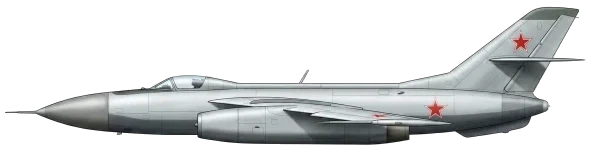
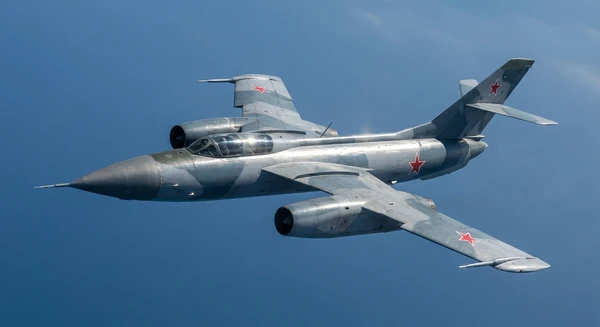
| Crew | 2 (pilot, WSO) |
| Length | 21.6 m (70.9 ft) |
| Wingspan | 12.5 m (41.0 ft) |
| Height | 4.0 m (13.0 ft) |
| Wing area | 37.6 m² (404.7 sqft) |
| Empty weight | 9,970 kg (21,980 lbs) |
| Max. takeoff weight | 20,000 kg (44,092 lbs) |
| Powerplant | 2 × turbojets Tumansky R-11AF2-300 6,322 kgf each |
| Ejection seat | Zvezda K-5MN / K-7MN |
| Maximum speed | 1840 km/h (Mach 1.7) |
| Operational range | 2,500 km (1,553 mi) |
| Service ceiling | 16,750 m (54,954 ft) |
| Takeoff distance | 1,430 m (4,692 ft) |
- Air-to-Air Medium-Range Bisnovat R-98 (AA-3 Anab)
- Air-to-Air Short-Range Vympel R-3 / K-13 (AA-2 Atoll)
- Low-Drag FAB-3000
Description
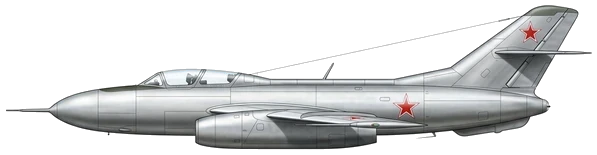
The Yakovlev Yak-28 is a Soviet twin-engine, swept-wing combat aircraft built in tactical bomber, interceptor, reconnaissance, electronic warfare and trainer versions, known to NATO as Brewer, Firebar and Maestro. It descends from the Yak-25 and Yak-26 family, first flew on 5 March 1958 as the Yak-129 prototype, and became the first Soviet supersonic front-line bomber produced in quantity. The Irkutsk aviation plant delivered 1,180 aircraft between 1960 and 1971. None were exported; the type served only with the Soviet Union and, after 1991, with four successor states. Bomber versions were assigned tactical nuclear delivery as their wartime task. Outside Russia the aircraft is remembered chiefly for an April 1966 crash into a West Berlin lake, where the crew stayed with a failing aircraft to steer it away from a housing estate.
Development
The Yak-28 grew out of the Yak-26, itself a development of the Yak-25 all-weather interceptor. As the Yak-26 finished its trials, the government issued a requirement for a jet bomber on the same airframe: two crew, a takeoff weight of 12 to 13 tonnes, 1,500 to 1,600 km/h, a range of 2,200 to 2,400 km with 1.2 tonnes of bombs (3 tonnes maximum), a ceiling of 16,000 to 17,000 m, and takeoff and landing runs of 1,000 and 1,100 m.
The first prototype, powered by R-11A-300 engines, was assembled in 1957 from production Yak-26 airframe components and flew on 5 March 1958. Factory trials showed it met the specification except in range, which fell 400 km short. A second prototype, also converted from a series Yak-26, introduced engines with higher afterburning thrust. Production was ordered at the Irkutsk plant and ran from 1960 to 1971. Of the 1,180 aircraft built, the Yak-28P interceptor was the most numerous single version, with 435 delivered.
A production Yak-28B was shown publicly at the Tushino air display in 1961. Western analysts read it at first as a fighter and a continuation of the Yak-25M; once the attack role was understood, the bomber series received the NATO name Brewer. Despite being built and flown in numbers, the Yak-28 was never formally accepted into service. One reason was an accident during a demonstration flight for the state commission, in which an aircraft broke up at supersonic speed.
Design
The fuselage is a semi-monocoque of circular section, becoming oval towards the tail, built on 42 frames and skinned in D16TV duralumin and V95TV high-strength alloy. The forward section houses the navigator's cabin, an equipment bay, the pilot's cabin and the nose gear well, the cabins and forward equipment bay forming a single pressurised compartment. The bomb bay sits between frames 17 and 29, flanked by the wing centre section, the rear gear well and the fuel tanks.
The wing is mid-mounted and swept 45 degrees at quarter chord, with three spars, 35 ribs, leading-edge slats and slotted flaps. A single aerodynamic fence is fitted between each engine nacelle and the fuselage. The swept tailplane is mounted halfway up the fin and is of variable incidence, trimmed manually by the pilot to balance the aircraft across the flight envelope and to compensate for the rearward shift of the aerodynamic centre in supersonic flight. Landing gear is of bicycle type: two twin-wheel units retracting into the fuselage, the rear one appreciably shorter than the front so that the aircraft sits at a positive ground angle, plus outrigger legs in wingtip fairings. The nose unit steers through ±40 degrees, the outrigger track is 10.72 m and the wheelbase 7.76 m. A PT-5510-58 slotted brake parachute of 19 m² is stowed in the tail.
Power comes from two Tumansky R-11AF-300 turbojets, later R-11AF2-300, from the same family as the early MiG-21 engines but with the accessory gearbox relocated to the top of the casing. They are carried in underwing pods fed by supersonic intakes with translating centre-body cones. Fuel is held in six internal tanks, 7,375 litres on the Yak-28L, with provision for two underwing drop tanks totalling 2,100 litres. Avionics include the Initsiativa-2 or Initsiativa-3 radar, RSBN-2S Svod short-range navigation and landing, an ARK-10 automatic direction finder, an RV-17 radio altimeter, a Sirena-3 radar warning receiver, an AP-28K1 autopilot and an AK-2A yaw compensator that deflects the rudder automatically if one engine fails. On every version except the interceptor the navigator sits ahead of the pilot in a glazed nose; on the Yak-28P the two sit in tandem under a common sliding canopy, with a radome replacing the glazing. Crew sit on K-5MN and K-7MN ejection seats with a minimum ejection altitude of 150 m, the navigator's seat carrying an inflatable cushion to raise them to the bombsight.
The airframe brought persistent constraints. It flexed under full load to the point that the canopies could not be closed, so crews boarded and shut up before the aircraft was fuelled and armed, a mandatory sequence when large-calibre bombs were carried. The low fuselage clearance also ruled out loading heavy bombs on a flat apron, and units either dug covered pits at the parking stands or raised the aircraft on jacks. Asynchronous afterburner lighting and occasional reheat shutdown made takeoff on afterburner dangerous, since the resulting thrust asymmetry was rarely recoverable, so takeoffs were flown at maximum dry thrust with reheat selected after unstick. The AK-2A intended to contain that asymmetry proved unreliable and was itself implicated in a number of accidents. Aerobatics and deliberate spinning were prohibited throughout the aircraft's career, and the flap actuation was underpowered until a stronger hydraulic drive was fitted. Aircrew nonetheless rated the type for its thrust-to-weight ratio: clean and with reheat lit, it could climb almost vertically.
Armament
The bomb bay is fitted with a temperature-control system for nuclear stores. Normal load is 1,200 kg and maximum 3,000 kg, the latter including a single FAB-3000. Small-calibre bombs hang on a KD3-226 cassette rack, those above 500 kg on a BD-4 beam. Aiming used the OPB-115 optical bombsight, later the OPB-116, with a PKI sight for the gun. Gun armament is one 23 mm NR-23 on the forward right fuselage with 50 rounds, later replaced by the GSh-23.
Interceptors carry no gun. The Yak-28P uses the Oriol-D radar with the K-8M-1 system and two R-8M-1 missiles, redesignated R-98 (AA-3 Anab) and normally carried as one infrared and one semi-active radar homing round; two R-3S (AA-2 Atoll) short-range missiles were added later.
The Yak-28PP carries no weapons and instead fits Fasol (SPS-5-28), Siren-FSh (SPS-141, SPS-142 and SPS-143) and Buket (SPS-22-28, SPS-44-28 and SPS-55-28) jammers. All but the Siren sets are mounted on a lowerable pallet in the weapons bay, with heat exchangers under the centre fuselage to dump the heat the transmitters generate. Passive countermeasures are the Avtomat-2I (KDS-19) chaff dispenser on two beams under the nacelles and the ASO-2I flare dispenser.
Reconnaissance aircraft carry one of five interchangeable equipment pallets: AFA-54 cameras in rocking mounts with an AFA-42/20 for low-level daylight work, AShchAFA-8 slit cameras, a TAU-M installation with an AFA-41/10 for topographic survey from medium and high altitude, a NAFA-Ya7 with an SOU-2 flash unit for night photography, and the Romb-4A ELINT station, which reaches 365 km from 10,000 m over a ±50 degree sector. The Yak-28BI carried a Bulat side-looking radar in a gondola that extended from the weapons bay to map a 15 km swath, and some aircraft replaced the Initsiativa-2 with the TARK-1 television reconnaissance system, which downlinked imagery to a ground command post while photographing on 190 mm film.
Operational History
Yak-28 variants equipped reconnaissance, fighter-bomber and air-defence units across the Soviet Union, in the Western Group of Forces in East Germany and in Poland, serving until 1992.
On 6 April 1966 a Yak-28 of the 668th Bomber Aviation Regiment, based at Finow in East Germany, suffered an engine failure while flying over the Soviet zone. Ordered to divert, the crew lost control and strayed into West Berlin airspace. Captain Boris Kapustin and Senior Lieutenant Yuri Yanov held the aircraft clear of a housing estate and crashed into Lake Stössensee without ejecting. Royal Navy divers flown in from Portsmouth raised the bodies and the wreckage; the engines were taken to RAF Gatow for examination by RAF and NATO engineers, and the Oriol-D radar antenna was removed and studied. The first engine was recovered on 18 April and the second a week later, both returned to the Soviet side on 2 May 1966. The bodies were repatriated with military honours from both armed forces and the two crew were posthumously awarded the Order of the Red Banner; the episode is the subject of the Soviet song "Ogromnoye nebo".
Other losses followed the same pattern. On 17 December 1968 a Yak-28 of the Lipetsk aviation centre lost both engines and crashed on waste ground at the edge of the city after its crew, S. M. Sherstobitov and L. A. Krivenkov, steered it away from the centre; on 9 September 1981 Major Anashkin and Captain Volkov were killed taking a failing aircraft clear of Arsenyev. A Yak-28P disappeared over the Khibiny mountains on 1 October 1974 with Senior Lieutenant Alexander Ledyaev and Captain Yuri Sayenko aboard, and the crash site was not found until 2011. In 1973 and 1974 the GK NII VVS reviewed every serious Yak-28 accident and flew a programme of experiments reproducing the circumstances, concluding that most were attributable to crew error.
On 9 November 1975 Yak-28 bombers of the 668th BAP, by then withdrawn from East Germany to Tukums in Latvia, were sent against the frigate Storozhevoy after its crew mutinied. Three aircraft attacked separate targets: one bombed a Soviet cargo ship bound from Ventspils to Finland by mistake and damaged it with splinters, while another put two bombs close astern of Storozhevoy, damaging the rudder and bringing the ship to a stop.
The reconnaissance version saw limited use in the Soviet-Afghan War. On 15 April 1987 a Yak-28R of the 87th Independent Reconnaissance Aviation Regiment, flown by Senior Lieutenant M. Chisteev with Captain S. V. Povarenkov as navigator, was hit by a Blowpipe missile near Rakhmat-Abad while surveying terrain south of Mazar-i-Sharif. Both crew ejected; the search was poorly coordinated and both were captured and killed, having been sent out without the sidearms regulations required.
The Yak-28P was withdrawn in the early 1980s, but trainers, reconnaissance aircraft and jammers outlived the Soviet Union. Russia kept about 40 Yak-28R and Yak-28PP until 1993. Ukraine operated 35 Yak-28PP and Yak-28U with the 118th Independent Electronic Warfare Regiment at Chortkiv until the second half of 1994, then flew them to the storage and scrapping base at Ovruch. Belarus held 26 Yak-28PP with the 151st Independent Electronic Warfare Regiment at Shchuchyn; the regiment disbanded in 1992 and the aircraft went to the 558th repair plant at Baranavichy. Turkmenistan inherited a number of Yak-28P with the 31st Independent Composite Aviation Squadron at Turkmenabat. Variants of the Sukhoi Su-24 eventually took over the reconnaissance and electronic warfare roles.
Variants
- Yak-28B / Yak-28L (Brewer-A / Brewer-B): Initial tactical bombers, the Yak-28B with a weapon-aiming radar and fittings for JATO bottles, the Yak-28L using a ground-controlled targeting system triangulating from ground transmitter sites; 111 Yak-28L were built.
- Yak-28I (Brewer-C): Tactical bomber with the Initsiativa-2 360-degree ground-mapping radar and an onboard targeting system, built in 223 examples.
- Yak-28R (Brewer-D): Tactical reconnaissance version of the Yak-28I with increased headroom, extended nose glazing and five interchangeable mission pallets; 183 built, some later converted to the Yak-28RR radiation-sampling configuration.
- Yak-28PP (Brewer-E): Electronic countermeasures aircraft deployed in 1970, the first Soviet type in the role, unarmed and fitted with jammers in the weapons bay and dielectric panels in place of the radome.
- Yak-28P (Firebar): Long-range interceptor developed from 1960 and operational from 1964, with the weapons bay replaced by fuel, Oriol-D radar and R-98 missiles; 435 were built until 1967, late aircraft receiving a longer conical radome.
- Yak-28U (Maestro): Dual-control trainer with a second cockpit in the nose for the student, prototyped in 1962 and built in 183 examples.
Frequently Asked Questions
What type of aircraft is the Yak-28 Brewer / Firebar?
What is the maximum speed of the Yak-28 Brewer / Firebar?
What is the range of the Yak-28 Brewer / Firebar?
When did the Yak-28 Brewer / Firebar first fly?
How many Yak-28 Brewer / Firebar have been built?
Which countries operate the Yak-28 Brewer / Firebar?
How much does a Yak-28 Brewer / Firebar cost?
What is the service ceiling of the Yak-28 Brewer / Firebar?
- AUG 52026 Updated Thrust updated
- JUL 282026 Updated Bombs added; description, service entry year and 7 more fields updated
- JUL 232026 Updated Sources and cross-references refreshed
- APR 72026 Updated Sources and cross-references refreshed
- APR 52026 Updated Ejection seat added
- FEB 72026 Updated Range added
- JAN 242026 Updated Thrust updated