A-10 Thunderbolt II vs A-4 Skyhawk
A-10 Thunderbolt II vs A-4 Skyhawk at a glance — top speed 675 vs 1,077 km/h, range 4,150 vs 4,063 km, max takeoff weight 22,680 vs 11,136 kg, built 716 vs 2,960 units.
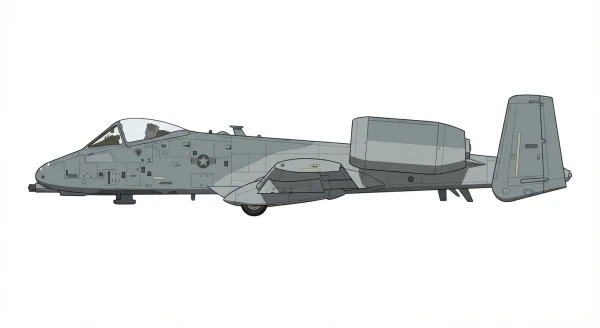
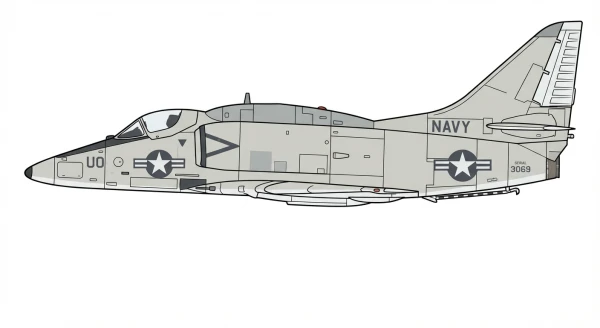
| A-10 Thunderbolt II | A-4 Skyhawk | |
|---|---|---|
| Origin country | 🇺🇸 United States | 🇺🇸 United States |
| Category | Combat Aircraft | Combat Aircraft |
| Manufacturer | Fairchild Republic | McDonnell Douglas |
| First flight | 10 May 1972 | 22 June 1954 |
| Year introduced | 1975 | 1956 |
| Number produced | 716 units | 2960 units |
| Average unit price | $12.1 million | $2 million |
| Wing area | 47.0 m² | 24.2 m² |
| Wingspan | 17.5 m | 8.4 m |
| Height | 4.5 m | 4.6 m |
| Length | 16.3 m | 12.2 m |
| Maximum speed | 675 km/h | 1077 km/h |
| Operational range | 4,150 km | 4,063 km |
| Service ceiling | 13,716 m | 12,880 m |
| Max. takeoff weight | 22,680 kg | 11,136 kg |
| Empty weight | 11,321 kg | 4,750 kg |
| Total thrust | 2 x 8,224 kgf | 1 x 4,100 kgf |
Detailed Comparison
The A-4 Skyhawk is a lightweight, carrier-capable attack aircraft from the 1950s, while the A-10 Thunderbolt II is a purpose-built, heavily armed and armored Close Air Support (CAS) platform from the 1970s. The Skyhawk's design prioritized simplicity and low weight for naval operations, whereas the A-10's development was singularly focused on battlefield survivability and overwhelming firepower in support of ground forces. This fundamental difference in design philosophy defines every aspect of their comparison, from performance to operational use.
Development and Design
The A-4 Skyhawk was born from designer Ed Heinemann's minimalist philosophy, resulting in a jet so compact (8.38 m wingspan) it did not require folding wings for carrier stowage. This was achieved through innovations like gravity-deployed leading-edge slats and a single-piece wing spar, which reduced weight and complexity. It was a conventional single-engine turbojet design, intended as a versatile, cost-effective replacement for piston-engined predecessors.
In contrast, the A-10 Thunderbolt II was the product of the US Air Force's A-X program, which sought a dedicated CAS aircraft after experiences in Vietnam. The aircraft was designed around its primary weapon: the GAU-8 Avenger 30mm rotary cannon. Survivability was paramount, leading to a design with:
- Two widely spaced high-bypass turbofan engines to reduce vulnerability.
- A titanium "bathtub" encasing the cockpit and flight-control systems.
- Redundant hydraulic and mechanical flight controls.
- A large, straight wing for excellent low-speed, low-altitude maneuverability.
Specifications and Performances
The performance metrics reflect their divergent roles. The Skyhawk is considerably faster, with a maximum speed of 1077 km/h compared to the A-10's 706 km/h. This agility made the A-4 effective for strike missions. The A-10's lower speed is a deliberate feature, enabling it to loiter over target areas and engage ground targets effectively. The Thunderbolt II is a substantially larger and heavier aircraft, with a maximum takeoff weight (22,680 kg) more than double that of the Skyhawk (11,136 kg). This allows the A-10 to carry a significantly larger ordnance load of up to 7,200 kg on 11 hardpoints, versus the A-4's 3,900 kg on five hardpoints.
Deployment and usage
The A-4 Skyhawk saw extensive and varied service. The US Navy used it as a primary light attack aircraft in Vietnam, and it was a key asset for numerous international air forces, including Israel during the Yom Kippur War and Argentina in the Falklands War. Its ability to carry a wide range of munitions, from AGM-65 Maverick missiles to B61 nuclear bombs, made it a versatile platform for strike, anti-shipping, and ground attack missions.
The A-10's operational history is one of specialization. It has been used almost exclusively by the U.S. Air Force in the CAS role. It proved its worth in Operation Desert Storm, destroying over 900 Iraqi tanks, and has since been a vital asset in the Balkans, Afghanistan, and Iraq. Its reputation is built on its ability to absorb significant damage and deliver precise, devastating fire in close proximity to friendly forces, making it a highly valued platform by ground troops.
Conclusion
The A-4 Skyhawk stands as a testament to efficient, multi-role design from the early jet age, a lightweight and adaptable asset operated by navies and air forces globally. The A-10 Thunderbolt II represents a different paradigm: a highly specialized weapon system engineered for a single, brutal mission. While the Skyhawk offered versatility and performance, the A-10 sacrificed speed and multi-role capability for unparalleled survivability and ground-attack lethality. Each aircraft is an effective product of its respective operational doctrine and technological era.