A-10 Thunderbolt II vs Su-25 Frogfoot
A-10 Thunderbolt II vs Su-25 Frogfoot at a glance — top speed 675 vs 970 km/h, range 4,150 vs 1,000 km, max takeoff weight 22,680 vs 17,600 kg, built 716 vs 1,000 units.
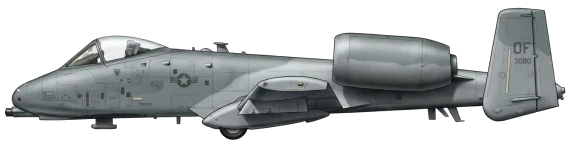
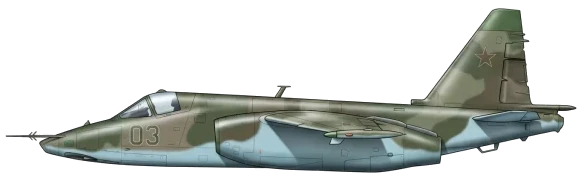
| A-10 Thunderbolt II | Su-25 Frogfoot | |
|---|---|---|
| Origin country | 🇺🇸 United States | 🇷🇺 Ex-USSR |
| Category | Combat Aircraft | Combat Aircraft |
| Manufacturer | Fairchild Republic | Sukhoi |
| First flight | 10 May 1972 | 22 February 1975 |
| Year introduced | 1975 | 1981 |
| Number produced | 716 units | 1000 units |
| Average unit price | $12.1 million | $11 million |
| Wing area | 47.0 m² | 30.1 m² |
| Wingspan | 17.5 m | 14.4 m |
| Height | 4.5 m | 4.8 m |
| Length | 16.3 m | 15.5 m |
| Maximum speed | 675 km/h | 970 km/h |
| Operational range | 4,150 km | 1,000 km |
| Service ceiling | 13,716 m | 7,000 m |
| Max. takeoff weight | 22,680 kg | 17,600 kg |
| Empty weight | 11,321 kg | 9,500 kg |
| Total thrust | 2 x 8,224 kgf | 2 x 4,505 kgf |
Detailed Comparison
Born from the Cold War need for a dedicated close air support (CAS) aircraft, the American A-10 Thunderbolt II and Soviet Su-25 Frogfoot are defined by their shared mission but diverge in critical design aspects. The A-10 was built around its formidable GAU-8 Avenger 30mm cannon, prioritizing firepower and pilot survivability through features like a titanium "bathtub" cockpit. In contrast, the Su-25 emphasized operational simplicity and ruggedness for deployment from austere forward bases, equipped with a GSh-30-2 30mm cannon.
Development and Design
The A-10's design originated from the U.S. Air Force's A-X program, a direct response to shortcomings in CAS capabilities observed during the Vietnam War. The chief designer prioritized a durable, straightforward airframe capable of sustaining significant damage, incorporating redundant systems and high-bypass turbofan engines for long loiter times. The Su-25 followed a parallel Soviet design philosophy, aiming to provide robust support for ground forces. Its development focused on ruggedness, with a simpler airframe, basic turbojet engines, and a welded steel armored cockpit, all intended to facilitate operations from unprepared airstrips with minimal support. Both aircraft feature a straight-wing design to optimize low-speed, low-altitude maneuverability.
Specifications and Performances
The A-10 is a considerably larger and heavier aircraft, with a maximum takeoff weight of 22,680 kg versus the Su-25's 17,600 kg. This allows the A-10 to carry a much larger external ordnance load of up to 7,257 kg on its 11 hardpoints. While the Su-25 is faster (max speed 970 km/h vs. 706 km/h for the A-10), the A-10's lower speed is a deliberate choice for its role, enhancing target acquisition and engagement time. The A-10’s GAU-8 cannon is its defining weapon, possessing a higher rate of fire (3,900 rpm) and a larger ammunition drum than the Su-25's GSh-30-2. Furthermore, the A-10's much higher service ceiling (13,716 m vs. 7,000 m) provides greater operational flexibility.
Deployment and usage
The A-10 proved its value during Operation Desert Storm in 1991, destroying vast numbers of Iraqi armored vehicles. It has since served extensively in the Balkans, Afghanistan, and Iraq. The introduction of the A-10C variant, with its digital avionics and ability to deploy precision-guided munitions, has ensured its continued effectiveness in modern conflicts. The Su-25's combat debut was in the Soviet-Afghan War, and it has since become a fixture in numerous conflicts, including in Chechnya, Georgia, Syria, and most notably by both sides in the 2022 Russian invasion of Ukraine. Its widespread use highlights its robust design, but has also exposed its vulnerabilities in high-threat environments saturated with modern air defenses.
Conclusion
Both aircraft successfully demonstrated the military value of a purpose-built, heavily armored ground-attack platform. The A-10's design philosophy, centered on pilot survivability and overwhelming cannon-based firepower, has made it an unparalleled CAS asset, particularly when operating under conditions of air superiority. The Su-25's emphasis on ruggedness and operational simplicity led to a prolific and cost-effective aircraft used by numerous air forces, often in high-intensity conflicts. While both platforms face increasing challenges from sophisticated air defense systems, their specialized capabilities ensure they remain operationally relevant.

-
 Russia
183
Russia
183
-
 Belarus
55
Belarus
55
-
 North Korea
34
North Korea
34
- All 19 operators →