A-4 Skyhawk vs Harrier
A-4 Skyhawk vs Harrier at a glance — top speed 1,077 vs 1,183 km/h, range 4,063 vs 1,500 km, max takeoff weight 11,136 vs 11,500 kg, built 2,960 vs 380 units.
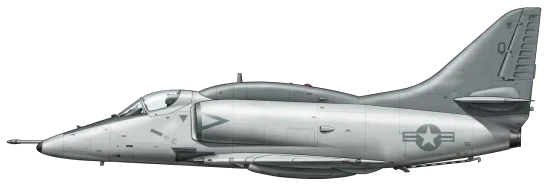
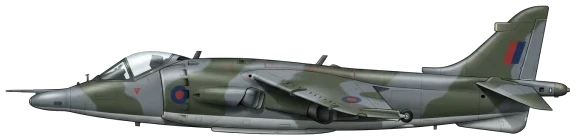
| A-4 Skyhawk | Harrier | |
|---|---|---|
| Origin country | 🇺🇸 United States | 🇬🇧 United Kingdom |
| Category | Combat Aircraft | Combat Aircraft |
| Manufacturer | McDonnell Douglas | British Aerospace |
| First flight | 22 June 1954 | 28 December 1968 |
| Year introduced | 1956 | 1969 |
| Number produced | 2960 units | 380 units |
| Average unit price | $2 million | $24 million |
| Wing area | 24.2 m² | 18.7 m² |
| Wingspan | 8.4 m | 7.7 m |
| Height | 4.6 m | 3.5 m |
| Length | 12.2 m | 13.9 m |
| Maximum speed | 1077 km/h | 1183 km/h |
| Operational range | 4,063 km | 1,500 km |
| Service ceiling | 12,880 m | 14,996 m |
| Max. takeoff weight | 11,136 kg | 11,500 kg |
| Empty weight | 4,750 kg | 5,530 kg |
| Total thrust | 1 x 4,100 kgf | 1 x 8,618 kgf |
Detailed Comparison
Douglas Aircraft’s A-4 Skyhawk and British Aerospace’s Harrier II attack aircraft were engineered under opposed procurement paradigms. The A-4 was designed in 1952 around aggressive weight reduction to replace piston-engine aircraft on conventional aircraft carriers. The Harrier II emerged in the late 1970s from a US-UK partnership focused on expanding the vertical/short takeoff and landing (V/STOL) envelope of the first-generation AV-8A, requiring composite materials and complex vectored-thrust engineering to operate from austere bases.
Development and Design
Ed Heinemann’s A-4 design minimized mass at every structural point. By adopting a short-span delta wing, Douglas eliminated the weight and hydraulic complexity of wing-folding mechanisms, bringing the prototype in at half the US Navy’s specified weight limit. Gravity-operated slats further reduced actuation hardware. The Harrier II’s development was dictated by the requirement to overcome the payload and range limitations of the original Hawker Siddeley Harrier. British Aerospace and McDonnell Douglas replaced the aluminum fuselage with composites and integrated a 14 percent larger wing with leading-edge root extensions. This added 3,035 kg of payload capacity over a 300-meter takeoff roll, but inherently increased airframe complexity and maintenance hours per flight hour compared to the A-4.
Specifications and Performances
Both airframes cap at roughly 11,500 kg maximum takeoff weight, achieved through vastly different thrust-to-weight ratios. The Harrier relies on a single 8,618 kgf Rolls-Royce Pegasus vectored-thrust turbofan to lift a 5,530 kg empty airframe. The A-4 weighs just 4,750 kg empty and utilizes a 4,100 kgf Pratt & Whitney J52-P8A turbojet. Consequently, the A-4 lifts 1.3 times its empty weight in fuel and ordnance, carrying up to 3,900 kg. The Harrier II carries up to 3,650 kg but extracts a severe financial penalty: at $24 million per unit, it cost twelve times the A-4’s historical price tag. The Harrier maintains a slight speed edge (1,183 km/h versus the A-4’s 1,077 km/h), but the Skyhawk out-ranges the Harrier II by 367 kilometers.
Deployment and usage
The A-4 accumulated thousands of combat hours across multiple theaters:
- Vietnam, conducting initial US Navy light attack strikes.
- The Middle East, sustaining Israeli ground offensives during the War of Attrition and Yom Kippur War.
- The Falklands, where Argentine pilots penetrated British naval air defenses at sea level to sink HMS Coventry and HMS Ardent.
US pilots later adopted the A-4 as a dissimilar air combat training (DACT) aggressor due to its high roll rate. The Harrier II operated under Joint Force Harrier in Kosovo, Iraq (Operations Northern Watch and Telic), and Afghanistan (Operation Herrick). It provided close air support from forward operating bases, relying on targeting pods like Sniper and TIALD to drop Paveway laser-guided munitions. High operating costs drove the UK Ministry of Defence to retire the fleet in 2010.
Conclusion
The Harrier II holds the absolute advantage only when conventional runways are unavailable. Its V/STOL capability and modern sensor integration allow for precise interdiction from small-deck carriers and austere forward operating bases. In all other conventional strike scenarios, the A-4 Skyhawk is the superior platform. Its 2,960 production run and continued service into the 2020s validate Heinemann’s stripped-down design. When runway independence is not the primary requirement, the A-4 delivers heavier relative payloads, higher sortie generation rates, and vastly lower maintenance overhead.