A400M Atlas vs C-390 Millennium
A400M Atlas vs C-390 Millennium at a glance — top speed 780 vs 980 km/h, range 3,300 vs 6,240 km, max takeoff weight 141,000 vs 72,000 kg, built 174 vs 15 units.
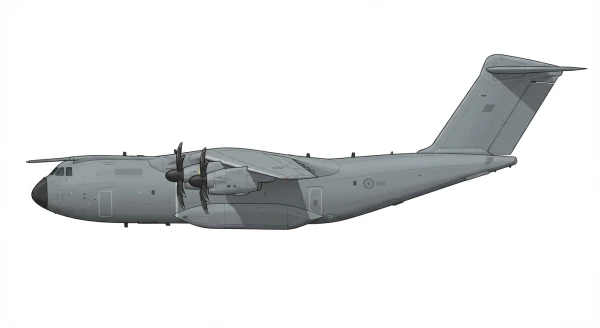
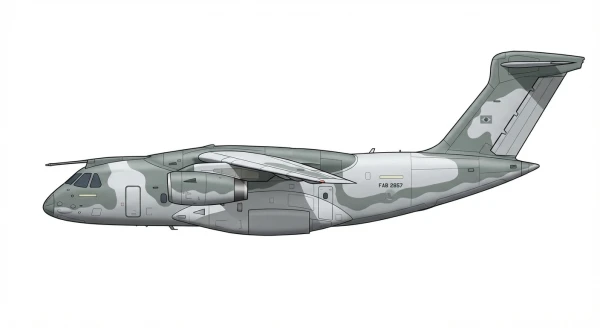
| A400M Atlas | C-390 Millennium | |
|---|---|---|
| Origin country | 🇪🇺 Europe | 🇧🇷 Brazil |
| Category | Military Transport Aircraft | Military Transport Aircraft |
| Manufacturer | Airbus | Embraer |
| First flight | 11 December 2009 | 30 August 2025 |
| Year introduced | 2013 | 2019 |
| Number produced | 174 units | 15 units |
| Average unit price | $152 million | $140 million |
| Wing area | 221.5 m² | -- m² |
| Wingspan | 42.4 m | 35.1 m |
| Height | 14.7 m | 10.3 m |
| Length | 45.1 m | 33.9 m |
| Maximum speed | 780 km/h | 980 km/h |
| Operational range | 3,300 km | 6,240 km |
| Service ceiling | 12,500 m | 11,000 m |
| Max. takeoff weight | 141,000 kg | 72,000 kg |
| Empty weight | 66,500 kg | 35,000 kg |
| Total thrust | 4 x 8,203 kW | 2 x 13,154 kgf |
Detailed Comparison
The Embraer C-390 Millennium and the Airbus A400M Atlas represent two distinct approaches to modern military airlift. The C-390 is a twin-engine, turbofan-powered tactical transport positioned as a direct competitor and potential successor to legacy C-130 Hercules fleets. The A400M is a larger, four-engine turboprop designed to bridge the capability gap between tactical airlifters like the C-130 and strategic transports like the C-17, offering greater payload and range.
Development and Design
The C-390’s design philosophy leverages proven commercial technology for military application. Its development from an E190 jetliner concept resulted in the selection of IAE V2500 turbofan engines and Rockwell Collins Pro Line Fusion avionics, aiming for reliability and efficiency. It incorporates modern military systems like fly-by-wire controls, a self-defense suite, and wing-mounted refueling pods. In contrast, the A400M was a purpose-built military project from its inception by a European consortium (OCCAR). This led to the development of the bespoke Europrop TP400-D6, one of the most powerful turboprop engines produced, featuring counter-rotating propellers to enhance lift. The A400M also makes extensive use of composite materials in its airframe, particularly its wings, a feature of its advanced, military-specific design.
Specifications and Performances
The A400M is a substantially larger and more capable aircraft in terms of payload and volume. It can carry a maximum payload of 37 tonnes, significantly more than the C-390's 26 tonnes. This is reflected in their respective Maximum Takeoff Weights (MTOW) of 141,000 kg for the A400M and 72,000 kg for the C-390. The A400M's larger cargo hold (17.71m x 4.00m x 3.85m) accommodates outsized cargo that the C-390 cannot. However, the C-390's turbofan engines give it a significant speed advantage, with a maximum speed of 980 km/h compared to the A400M's 780 km/h, enabling faster deployment over long distances. The A400M's four powerful turboprops provide it with excellent takeoff performance from shorter and unprepared runways.
Deployment and usage
Both aircraft have proven their utility in diverse operational environments. The A400M, having entered service earlier, has seen extensive use, including combat deployments to Mali and Afghanistan, sustained logistical support for operations like Barkhane, and international humanitarian missions. It has demonstrated its core capabilities in real-world scenarios. The C-390 has established a strong operational record with the Brazilian Air Force, achieving high availability (around 80%) and mission completion (99.5%) rates. It has been deployed for domestic crises (COVID-19), international humanitarian aid (Beirut, Haiti), and has participated in joint exercises with the USAF, showcasing its tactical versatility and interoperability. Both aircraft can be configured for aerial refueling missions.
Conclusion
The C-390 Millennium and A400M Atlas cater to different operational requirements and budgets. The C-390 is a modern, fast, and efficient tactical airlifter well-suited for nations seeking to replace aging medium-transport fleets with a versatile, jet-powered platform. Its lower acquisition cost ($120M vs. A400M's $152M) and use of commercial-derivative components present an economical value proposition. The A400M is a more capable strategic/tactical airlifter, offering superior payload, volume, and range. It serves nations that require a single airframe to perform missions that might otherwise require two separate types of aircraft, justifying its higher cost and complexity. The choice between them depends on a nation's strategic airlift needs, fiscal constraints, and desired force structure.