A-6 Intruder vs A-7 Corsair II
A-6 Intruder vs A-7 Corsair II at a glance — top speed 1,040 vs 1,123 km/h, range 5,219 vs 2,485 km, max takeoff weight 27,500 vs 19,050 kg, built 693 vs 1,545 units.
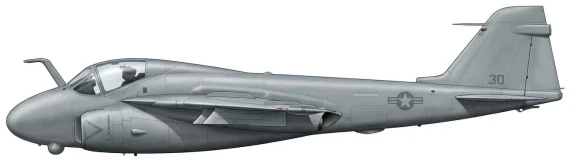

| A-6 Intruder | A-7 Corsair II | |
|---|---|---|
| Origin country | 🇺🇸 United States | 🇺🇸 United States |
| Category | Combat Aircraft | Combat Aircraft |
| Manufacturer | Grumman | Vought |
| First flight | 19 April 1960 | 27 September 1965 |
| Year introduced | 1963 | 1966 |
| Number produced | 693 units | 1545 units |
| Average unit price | $25 million | $2 million |
| Wing area | 49.1 m² | 34.8 m² |
| Wingspan | 16.2 m | 11.8 m |
| Height | 4.8 m | 4.9 m |
| Length | 16.6 m | 14.1 m |
| Maximum speed | 1040 km/h | 1123 km/h |
| Operational range | 5,219 km | 2,485 km |
| Service ceiling | 12,400 m | 12,800 m |
| Max. takeoff weight | 27,500 kg | 19,050 kg |
| Empty weight | 11,630 kg | 8,840 kg |
| Total thrust | 2 x 8,436 kgf | 1 x 6,795 kgf |
Detailed Comparison
The Grumman A-6 Intruder and LTV A-7 Corsair II divided the U.S. Navy’s strike mission into two tiers based on procurement cost, aircrew configuration, and avionics architecture. The A-6 was a $25 million twin-engine, two-seat platform engineered for deep, radar-guided night interdiction. The A-7 emerged from the VAL requirement as a $2 million single-seat derivative of the F-8 Crusader, built to replace the A-4 Skyhawk in volume.
Development and Design
Grumman optimized the A-6 around the DIANE suite, pairing a pilot and bombardier/navigator side-by-side to process analog computing data and terrain-mapping radar for blind-bombing. This mandated a wide, drag-inducing fuselage. LTV bypassed radar complexity in the A-7 to minimize R&D risk, shortening the F-8 airframe and replacing the variable-incidence wing with a fixed structure. Where the A-6 relied on a second crew member, the A-7 shifted the pilot's workload to early head-up displays and a continuous-solution navigation and weapons delivery computer. The A-7 also transitioned from turbojets to turbofans, adopting the TF30 and later TF41 for unrefueled endurance, while the A-6 retained less fuel-efficient J52 turbojets.
Specifications and Performances
The structural and aerodynamic differences between the two airframes dictated their operating parameters:
- The A-6 carried an 18,000 lb payload, enabled by a 27,500 kg maximum takeoff weight.
- The A-7 lifted a 15,000 lb payload, constrained by a 19,050 kg MTOW.
- The A-7 extracted a 279 km range advantage (1,981 km versus 1,702 km) over the A-6, utilizing a single turbofan engine and a low-drag frontal profile.
The A-7’s TF41 engine struggled with thrust generation in high-temperature, high-humidity environments, extending takeoff rolls when fully laden. The A-6 compensated for the poor fuel fraction of its J52 turbojets through volume, accommodating large internal tanks and up to five 300-gallon external drops.
Deployment and usage
Both airframes sustained heavy exposure during the Vietnam War. The A-6 executed night and monsoon-weather strikes along the Ho Chi Minh Trail. This profile forced low-altitude ingress and resulted in 84 combat losses to conventional ground fire. The A-7, arriving in theater later, executed daylight interdiction. The A-7’s digital weapons delivery computer generated hit rates that prompted the U.S. Air Force to procure the A-7D, bypassing their traditional preference for supersonic fighters. In operations over Lebanon, Libya, and Iraq, the A-6 functioned as the primary deep-strike asset and organic aerial tanker, while the A-7 specialized in defense suppression, launching AGM-88 HARMs.
Conclusion
The A-6 Intruder holds the absolute edge in deep, all-weather strike and maritime interdiction. Its twin-engine redundancy, payload capacity, and dedicated bombardier/navigator enabled blind-bombing profiles that single-seat aircraft of the era could not execute. Conversely, the A-7 Corsair II was the better platform for force structure economics and daytime tactical strike. By carrying 80% of the Intruder's payload at less than 10% of the unit cost, the A-7 allowed the Pentagon to generate sortie volume and shift the single-seat attack doctrine toward digital computer-aided precision.