AH-64 Apache vs Mi-24 Hind
AH-64 Apache vs Mi-24 Hind at a glance — top speed 293 vs 330 km/h, range 480 vs 450 km, max takeoff weight 10,107 vs 11,500 kg, built 2,400 vs 2,648 units.
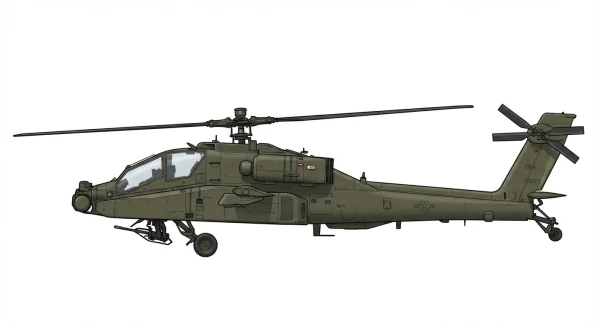
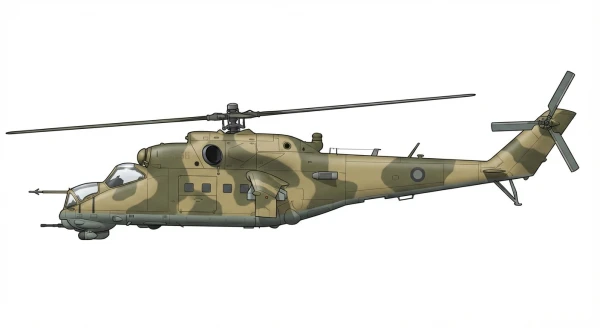
| AH-64 Apache | Mi-24 Hind | |
|---|---|---|
| Origin country | 🇺🇸 United States | 🇷🇺 Ex-USSR |
| Category | Military Helicopters | Military Helicopters |
| Manufacturer | Boeing | Mil |
| First flight | 30 September 1975 | 19 September 1969 |
| Year introduced | 1984 | 1972 |
| Number produced | 2400 units | 2648 units |
| Average unit price | $33 million | $12 million |
| Wingspan | 14.6 m | 6.5 m |
| Height | 5.0 m | 5.5 m |
| Length | 17.7 m | 21.4 m |
| Maximum speed | 293 km/h | 330 km/h |
| Operational range | 480 km | 450 km |
| Service ceiling | 5,670 m | 5,120 m |
| Max. takeoff weight | 10,107 kg | 11,500 kg |
| Empty weight | 5,352 kg | 7,792 kg |
| Total thrust | 2 x 1,208 kW | 2 x 1,641 kW |
Detailed Comparison
The Mi-24 Hind was conceived as a dual-role "flying infantry fighting vehicle" for Soviet forces, capable of both engaging ground targets and transporting an eight-person squad. This design is fundamentally different from the purpose-built AH-64 Apache, which the U.S. Army developed specifically as a dedicated anti-tank platform without any troop-carrying capacity. This distinction in mission philosophy dictates their respective designs, capabilities, and operational employment.
Development and Design
The Mi-24 is a product of Cold War-era Soviet doctrine, emphasizing mass, firepower, and survivability through heavy armor. Its most unique feature is the passenger cabin, making it a hybrid assault transport. Its design includes stub wings that provide approximately 25% of its lift in forward flight and serve as hardpoints for a heavy weapon load. The Apache's design, originating from the U.S. Army's Advanced Attack Helicopter program, prioritized technological superiority for destroying Warsaw Pact armor. It features a narrow fuselage, a tandem cockpit with advanced pilot night vision and target acquisition systems (TADS/PNVS), and redundant systems for battle resilience. Later AH-64D Longbow variants integrated a mast-mounted fire-control radar, allowing the helicopter to detect and engage targets while remaining behind cover—a significant tactical advantage the Hind lacks.
Specifications and Performances
While the Hind is notably faster with a maximum speed of 330 km/h compared to the Apache's 265 km/h, this performance comes with a larger and heavier airframe (11,500 kg max takeoff weight vs. the Apache's 10,107 kg). The most critical performance differences lie in their sensor and armament suites. The Apache’s 30mm M230 Chain Gun provides substantially more firepower than the high-rate-of-fire 12.7mm machine gun on most Hind variants. Furthermore, the Apache’s primary armament, the AGM-114 Hellfire missile, especially when paired with the Longbow radar, provides "fire-and-forget" capabilities that are technologically superior to the Hind's laser-guided systems like the 9M114 Shturm (AT-6). This allows the Apache greater standoff range and survivability.
Deployment and usage
The Mi-24 gained its reputation during the Soviet-Afghan War, where its firepower was effective but its vulnerability to shoulder-fired missiles like the Stinger was exposed. It remains a workhorse in numerous conflicts across the globe, valued for its ruggedness and versatility by many air forces. The AH-64 Apache's combat debut in the 1991 Gulf War defined its role as a premier tank-killer, where it was responsible for destroying hundreds of Iraqi armored vehicles. In subsequent conflicts in Iraq and Afghanistan, it has proven its value in close air support and precision strike missions, operating in complex, high-threat environments where its advanced systems provide a decisive edge.
Conclusion
The Mi-24 Hind remains a formidable and cost-effective multi-role combat helicopter, embodying a philosophy of a versatile, heavily armed assault transport. Its durability and widespread proliferation ensure its continued relevance. The AH-64 Apache, however, represents a more specialized and technologically sophisticated design. Its advanced sensors, integrated avionics, and superior precision-guided munitions make it a more lethal anti-armor platform. The choice between them reflects a clear doctrinal and budgetary trade-off: the Hind’s rugged versatility versus the Apache’s specialized, technological dominance on the modern battlefield.