AH-64 Apache vs Mi-28 Havoc
AH-64 Apache vs Mi-28 Havoc at a glance — top speed 293 vs 324 km/h, range 480 vs 1,100 km, max takeoff weight 10,107 vs 12,000 kg, built 2,400 vs 126 units.
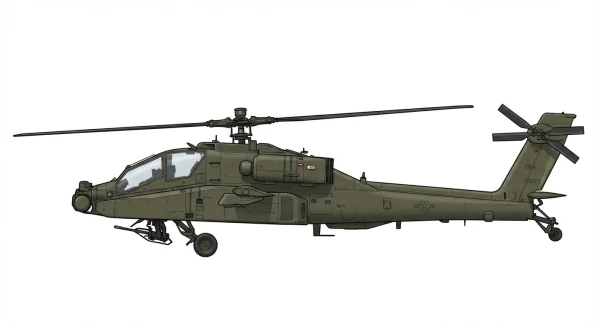
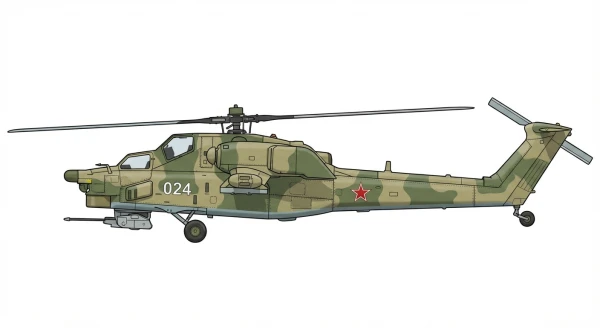
| AH-64 Apache | Mi-28 Havoc | |
|---|---|---|
| Origin country | 🇺🇸 United States | 🇷🇺 Ex-USSR |
| Category | Military Helicopters | Military Helicopters |
| Manufacturer | Boeing | Mil |
| First flight | 30 September 1975 | 10 November 1982 |
| Year introduced | 1984 | 2006 |
| Number produced | 2400 units | 126 units |
| Average unit price | $33 million | $15 million |
| Wingspan | 14.6 m | 17.2 m |
| Height | 5.0 m | 4.7 m |
| Length | 17.7 m | 17.0 m |
| Maximum speed | 293 km/h | 324 km/h |
| Operational range | 480 km | 1,100 km |
| Service ceiling | 5,670 m | 5,700 m |
| Max. takeoff weight | 10,107 kg | 12,000 kg |
| Empty weight | 5,352 kg | 8,590 kg |
| Total thrust | 2 x 1,208 kW | 2 x 1,641 kW |
Detailed Comparison
The Mi-28 Havoc and AH-64 Apache are contemporaries born from Cold War requirements for dedicated anti-tank helicopters, yet they reflect different paths in development and operational maturity. The Apache, with a first flight in 1975 and over 2,400 units built, is a globally deployed and battle-proven system. The Mi-28, first flown in 1982, had a protracted development, entering service in 2006 with far fewer units produced, resulting in a less extensive operational record.
Development and Design
The design philosophy behind the Mi-28 prioritized crew survivability through heavy armor, evident in its heavily protected cockpit and an empty weight of 8,590 kg. It was conceived as a specialized successor to the multi-role Mi-24 Hind, focusing purely on the attack role. The Apache, while also designed for survivability with redundant systems, was built around a sophisticated sensor and avionics suite from its inception. Its lower empty weight (5,352 kg) contributes to greater agility. A key differentiator is the Apache's early integration of advanced systems, culminating in the AH-64D's mast-mounted Longbow fire-control radar, which provides a "fire-and-forget" capability. The Mi-28N "Night Hunter" later incorporated a similar mast-mounted radar, but the Apache platform has had a significant lead in deploying and refining this technology.
Specifications and Performances
Analysis of performance metrics reveals distinct operational strengths. The Mi-28 possesses a notable speed advantage, with a maximum speed of 324 km/h compared to the Apache's 265 km/h, enabled by its more powerful Klimov engines. This allows for faster ingress and egress from combat zones. Conversely, the Apache demonstrates superior agility with a higher climb rate (15.7 m/s vs. 13.6 m/s). While the Mi-28 has a higher maximum takeoff weight (12,000 kg vs. 10,107 kg), indicating a large potential payload, the Apache's slightly longer range (485 km vs. 450 km) offers a marginal advantage in mission endurance. Their service ceilings are nearly identical, rendering them comparable in high-altitude performance.
Deployment and usage
The Apache's operational history is far more extensive, having been a central element in U.S. and allied operations since the 1991 Gulf War. It is a mature system with a well-established global logistics and support network. Its armament suite has been continuously refined, incorporating advanced munitions like the APKWS guided rockets and various Hellfire missile variants. The Mi-28's combat experience is more recent, primarily with Russian forces in Syria and the Iraqi army against ISIS. Its primary armaments, the Shipunov 2A42 30mm cannon and ATAKA ATGMs, are effective, but the platform lacks the breadth of integrated, precision-guided options and network-centric capabilities that define modern Apache variants like the AH-64E Guardian.
Conclusion
The AH-64 Apache stands as a highly refined, technologically advanced, and battle-hardened attack helicopter. Its strength lies in its integrated sensor suites, network-centric warfare capabilities, and a diverse, proven arsenal, supported by decades of operational deployment. The Mi-28 Havoc is a formidable platform, designed with an emphasis on speed and survivability, reflecting a philosophy of a heavily armored "flying tank." While newer variants like the Mi-28NM are closing the technological gap, the Apache maintains a significant advantage in terms of system maturity, interoperability, and combat-proven effectiveness across a wider range of scenarios. The significant price difference—$33 million for an Apache versus $15 million for a Havoc—reflects this disparity in technology, combat experience, and global support infrastructure.