AH-1 Cobra vs AH-64 Apache
AH-1 Cobra vs AH-64 Apache at a glance — top speed 277 vs 293 km/h, range 570 vs 480 km, max takeoff weight 8,391 vs 10,107 kg, built 1,116 vs 2,400 units.
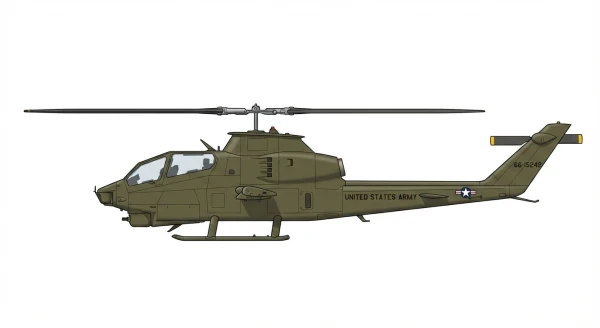
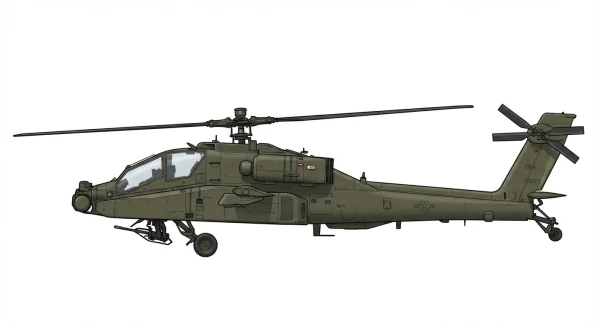
| AH-1 Cobra | AH-64 Apache | |
|---|---|---|
| Origin country | 🇺🇸 United States | 🇺🇸 United States |
| Category | Military Helicopters | Military Helicopters |
| Manufacturer | Bell | Boeing |
| First flight | 7 September 1965 | 30 September 1975 |
| Year introduced | 1967 | 1984 |
| Number produced | 1116 units | 2400 units |
| Average unit price | $13 million | $33 million |
| Wingspan | 13.4 m | 14.6 m |
| Height | 4.4 m | 5.0 m |
| Length | 17.8 m | 17.7 m |
| Maximum speed | 277 km/h | 293 km/h |
| Operational range | 570 km | 480 km |
| Service ceiling | 6,096 m | 5,670 m |
| Max. takeoff weight | 8,391 kg | 10,107 kg |
| Empty weight | 5,579 kg | 5,352 kg |
| Total thrust | 2 x 1,342 kW | 2 x 1,208 kW |
Detailed Comparison
The AH-1 Cobra, derived from the UH-1 transport, pioneered the dedicated attack helicopter concept with a design focused on speed and a minimal profile for close support and escort missions. In contrast, the AH-64 Apache was a purpose-built, "clean sheet" design intended to be a heavily armed and survivable tank-killer, reflecting a generational leap in technology and combat doctrine focused on high-intensity conflict.
Development and Design
The AH-1's development was an exercise in expediency, adapting the engine, transmission, and rotor system of the existing UH-1 Iroquois into a new, slender fuselage with a tandem cockpit. This approach accelerated its entry into service during the Vietnam War. Its defining features were its narrow profile, reducing its vulnerability, and a two-blade rotor system (on early models) optimized for speed. Later variants, like the twin-engine AH-1W and the four-bladed AH-1Z Viper, represent a complete modernization, incorporating advanced sensors and weapon systems that parallel the Apache's.
The Apache originated from the US Army's Advanced Attack Helicopter (AAH) program, which specifically sought a replacement for the AH-1. Its design prioritized crew survivability with extensive armor and redundant systems, and superior lethality through an advanced sensor suite and a heavier weapons load. Key innovations include the Target Acquisition and Designation Sight/Pilot Night Vision Sensor (TADS/PNVS) and, most notably, the mast-mounted AN/APG-78 Longbow fire-control radar on the AH-64D/E, allowing it to detect and engage targets from behind cover.
Specifications and Performances
While physical dimensions are similar, the Apache is a heavier and more robust aircraft, with a maximum takeoff weight of 10,107 kg compared to the AH-1Z's 8,391 kg. This weight difference accommodates more armor and fuel. Consequently, the Apache possesses a far greater operational range (485 km vs. 232 km for the Cobra), a critical advantage for deep strike missions and loiter time. The Cobra, a legacy of its streamlined design, maintains a slight speed advantage at 277 km/h versus the Apache's 265 km/h. The Apache's four-blade main rotor and more advanced flight controls, however, provide superior agility in low-level flight. Armament is broadly similar on modern variants, with both capable of fielding Hellfire missiles and rockets, but the Apache's primary gun is a heavier 30mm M230 Chain Gun compared to the 20mm Gatling gun on the Cobra.
Deployment and usage
The Cobra's operational history is defined by its pioneering role in Vietnam, where it established the doctrine for helicopter gunships. It excelled at close air support and armed escort for troop transports. While largely replaced by the Apache in the US Army, modernized variants like the AH-1Z Viper remain the backbone of the U.S. Marine Corps' attack helicopter fleet, valued for its smaller maritime footprint and suitability for expeditionary operations.
The Apache's combat debut in the 1991 Gulf War cemented its reputation as a premier anti-armor platform, where it was instrumental in destroying Iraqi radar sites and armored columns. Its design is optimized for this role, using its advanced sensors and standoff range to engage multiple targets with precision. It has served as the US Army's primary attack helicopter in every major conflict since, from the Balkans to Afghanistan and Iraq, undertaking armed reconnaissance and precision strike missions.
Conclusion
The AH-1 Cobra and AH-64 Apache represent different solutions to the attack helicopter requirement, shaped by the eras in which they were conceived. The Cobra was a revolutionary, fast-moving gunship, while the Apache was designed from the outset as a heavily armed, survivable, and technologically superior hunter-killer. While the modernized AH-1Z Viper has dramatically closed the performance and technology gap, the Apache remains the heavier, more heavily protected platform with a greater payload and range, optimized for high-intensity, peer-level conflict. The Cobra offers a comparably lethal but more agile platform with a reduced logistical footprint, making it an effective and more cost-efficient choice for expeditionary forces.