Alpha Jet vs F-5 Freedom Fighter
Alpha Jet vs F-5 Freedom Fighter at a glance — top speed 1,000 vs 1,700 km/h, range 2,940 vs 2,806 km, max takeoff weight 7,500 vs 11,187 kg, built 480 vs 1,204 units.
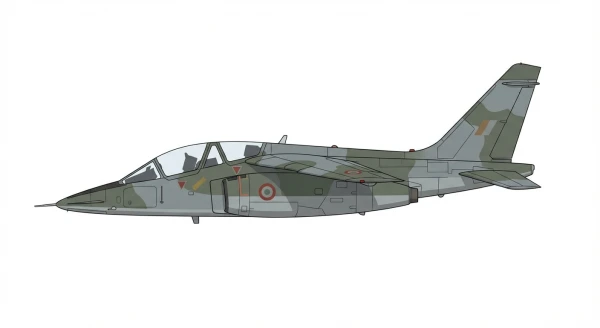
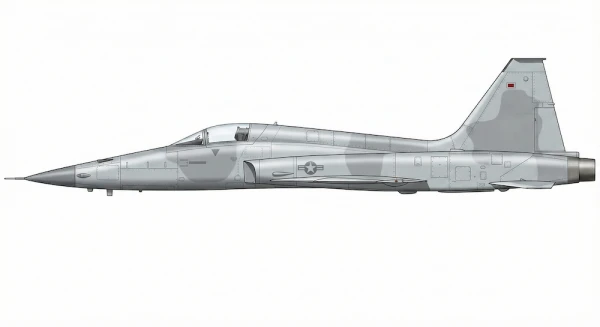
| Alpha Jet | F-5 Freedom Fighter | |
|---|---|---|
| Origin country | 🇩🇪 Germany🇫🇷 France | 🇺🇸 United States |
| Category | Combat Aircraft | Combat Aircraft |
| Manufacturer | Dassault/Dornier | Northrop |
| First flight | 26 October 1973 | 30 July 1959 |
| Year introduced | 1978 | 1965 |
| Number produced | 480 units | 1204 units |
| Average unit price | $8 million | $2 million |
| Wing area | 17.5 m² | 17.3 m² |
| Wingspan | 9.1 m | 8.1 m |
| Height | 4.2 m | 4.1 m |
| Length | 13.2 m | 14.5 m |
| Maximum speed | 1000 km/h | 1700 km/h |
| Operational range | 2,940 km | 2,806 km |
| Service ceiling | 14,630 m | 15,789 m |
| Max. takeoff weight | 7,500 kg | 11,187 kg |
| Empty weight | 3,515 kg | 4,349 kg |
| Total thrust | 2 x 2,700 kgf | 2 x 3,176 kgf |
Detailed Comparison
The Franco-German Alpha Jet and the American Northrop F-5 originated from distinct military requirements, resulting in two very different light twin-engine jets. The F-5 was conceived as a low-cost, high-performance supersonic fighter, while the Alpha Jet was developed as a dedicated subsonic advanced trainer with a secondary light attack capability. This fundamental difference in purpose defines their design, performance, and operational history.
Development and Design
The F-5 was a private Northrop initiative to reverse the trend of increasingly large and expensive fighters. Its design prioritized simplicity, maneuverability, and cost-effectiveness, built around two compact General Electric J85 turbojets. The airframe is small and highly aerodynamic, later evolving into the F-5E Tiger II with more powerful engines, a larger wing, and crucially, an air-to-air radar, which the original F-5A lacked. In contrast, the Alpha Jet was a government-led collaborative program between France and Germany to replace aging trainers. Its design emphasized flight safety, ease of maintenance, and training effectiveness. Features like the high-set wing, pressurized tandem cockpit, and systems designed for rapid turnaround reflect its primary role. While the F-5 was built as a fighter first, the Alpha Jet was built as a trainer first, with its attack capabilities being a secondary, albeit important, consideration.
Specifications and Performances
Performance metrics clearly reflect their divergent design philosophies. The F-5 is a superior combat aircraft in raw kinematics, boasting a maximum speed of 1700 km/h and a service ceiling of 15,789 m. Its climb rate of 175 m/s is triple that of the Alpha Jet's 57 m/s. This performance advantage is a direct result of its fighter design and more powerful J85-GE-21B engines. The F-5 also has a greater combat potential with a higher maximum takeoff weight (11,187 kg vs. 7,500 kg) and a larger ordnance capacity of 3,200 kg across seven hardpoints. The Alpha Jet, while a highly agile aircraft, is limited to a subsonic speed of 1000 km/h and carries a lighter load of approximately 2,268 kg on five hardpoints. Its Larzac engines were selected for reliability and fuel efficiency in the training role, not for outright performance.
Deployment and usage
The F-5 has a far more extensive combat record as a frontline fighter. It was deployed by the USAF in Vietnam (Skoshi Tiger program), served as the primary air superiority fighter for Ethiopia in the Ogaden War, and has been operated by dozens of air forces. Its agility made it a benchmark aggressor aircraft for dissimilar air combat training in the US. In contrast, the Alpha Jet's combat use has been in the light attack and counter-insurgency roles, notably by Nigeria and Morocco. For its primary users, France adopted it as a trainer (Alpha Jet E), while Germany used it mainly as a light strike aircraft (Alpha Jet A) to replace the Fiat G91. The F-5’s armament options, particularly on upgraded models with radar-guided AIM-120 AMRAAMs, give it a beyond-visual-range capability the Alpha Jet lacks.
Conclusion
The F-5 Freedom Fighter/Tiger II is a true lightweight multirole fighter, whose success stemmed from offering supersonic performance and credible combat capability at a low cost. It proved adaptable enough to serve as an effective fighter, attacker, and advanced trainer. The Alpha Jet is an exemplary advanced jet trainer, lauded for its handling, safety, and operational economy. While it developed into a competent light attack platform, it was never intended to be a frontline fighter. For an air force seeking an affordable, multi-role supersonic combatant, the F-5 was the superior choice. For those needing a dedicated, world-class subsonic trainer with a useful secondary strike role, the Alpha Jet provided an optimal solution.