Bayraktar TB2 vs Hermes 900
Bayraktar TB2 vs Hermes 900 at a glance — top speed 222 vs 220 km/h, range 300 vs 1,000 km, max takeoff weight 1,200 vs 1,400 kg, built 600 vs 200 units.

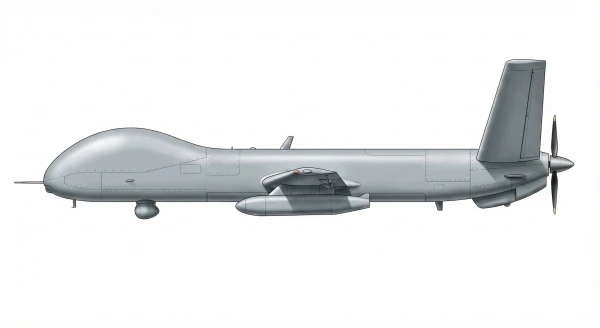
| Bayraktar TB2 | Hermes 900 | |
|---|---|---|
| Origin country | 🇹🇷 Turkey | 🇮🇱 Israel |
| Category | Military Drones | Military Drones |
| Manufacturer | Baykar | Elbit |
| First flight | 1 August 2014 | 9 December 2009 |
| Year introduced | 2014 | 2012 |
| Number produced | 600 units | 200 units |
| Average unit price | $5 million | $6.8 million |
| Wingspan | 12.0 m | 15.0 m |
| Length | 6.5 m | 8.3 m |
| Maximum speed | 222 km/h | 220 km/h |
| Operational range | 300 km | 1,000 km |
| Service ceiling | 8,239 m | 9,100 m |
| Max. takeoff weight | 1,200 kg | 1,400 kg |
| Empty weight | 650 kg | 950 kg |
| Total thrust | -- | 1 x 160 kW |
Detailed Comparison
The Bayraktar TB2 and Elbit Hermes 900 represent two distinct classes within the Medium Altitude Long Endurance (MALE) drone category. The Hermes 900 is a larger, more endurance-focused platform designed primarily for intelligence, surveillance, and reconnaissance (ISR) with a significant strike capability. In contrast, the TB2 is a lighter, more affordable, and combat-proven system that has excelled as a tactical strike and reconnaissance asset. This difference is reflected in their core specifications: the Hermes 900 offers double the payload capacity of the TB2 (300 kg vs. 150 kg) and 50% greater endurance (36 hours vs. 24 hours), positioning it as a more strategic ISR platform.
Development and Design
The TB2's development was driven by Turkey's need for an indigenous armed drone following a U.S. export ban. This resulted in a design philosophy centered on cost-effectiveness, modularity, and rapid production. Its blended wing body and V-tail are built primarily from carbon fiber composites, creating a platform that is affordable and relatively simple to manufacture. The Hermes 900 follows a more conventional development path, evolving from Elbit's successful Hermes 450. Its design prioritizes performance and multi-mission flexibility, incorporating a more powerful Rotax 916 engine (vs. the TB2's Rotax 912) to support a higher Maximum Takeoff Weight (1400 kg vs. 1200 kg), a larger 15 m wingspan, and a broader suite of high-end ISR payloads, including electronic intelligence and hyperspectral sensors.
Specifications and Performances
While both aircraft have similar maximum speeds of around 220 km/h, their operational performance differs significantly. The Hermes 900's primary advantages are its superior endurance and payload. This allows it to loiter over target areas for longer periods while carrying more sophisticated sensor packages or heavier ordnance like Spike missiles. Its higher service ceiling (9,100 m vs. 8,239 m) provides a greater margin of safety from certain ground threats and improves sensor line-of-sight. The baseline TB2 is limited by a line-of-sight control range of approximately 150-300 km, requiring the TB2S variant for satellite communication, a feature inherent to the Hermes 900's design for long-range strategic missions.
Deployment and usage
The Bayraktar TB2 has an extensive and well-documented combat record. It proved decisive in conflicts such as the Second Nagorno-Karabakh War and the initial stages of the war in Ukraine, where it was effective against conventional forces with limited or poorly integrated air defenses. Its low cost makes it an attritable asset, enabling commanders to take risks that would be unacceptable with more expensive platforms. However, its vulnerability to sophisticated, modern air defense systems has been clearly demonstrated. The Hermes 900's deployment has been more focused on traditional ISR roles for state actors like Israel, Azerbaijan, and Brazil. While used for strikes, its primary value lies in persistent surveillance, as demonstrated during Israel's Operation Protective Edge. Its reported losses to surface-to-air missiles in Lebanon confirm that even more capable drones remain vulnerable in contested airspace.
Conclusion
The choice between these two platforms reflects a divergence in military doctrine and budget. The Bayraktar TB2 is a tactical asset that has democratized armed drone warfare through its affordability and proven effectiveness in asymmetric or low-to-medium intensity environments. The Hermes 900 is a strategic ISR platform, offering superior persistence, sensor capacity, and payload flexibility for militaries requiring high-end intelligence-gathering capabilities. The TB2 is a volume-based strike weapon, whereas the Hermes 900 is a higher-value, multi-mission intelligence asset.