E-2 Hawkeye vs Saab 340 AEW&C
E-2 Hawkeye vs Saab 340 AEW&C at a glance — top speed 648 vs 522 km/h, range 2,708 vs 1,300 km, max takeoff weight 57,500 vs 13,155 kg, built 313 vs 12 units.
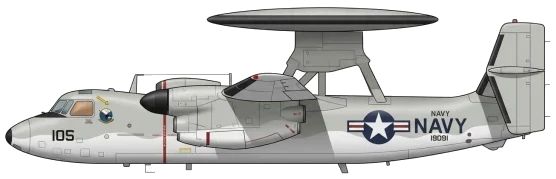
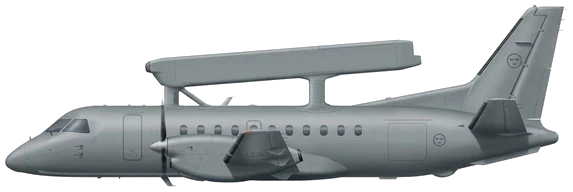
| E-2 Hawkeye | Saab 340 AEW&C | |
|---|---|---|
| Origin country | 🇺🇸 United States | 🇸🇪 Sweden |
| Category | Military Special Mission Aircraft | Military Special Mission Aircraft |
| Manufacturer | Grumman | Saab |
| First flight | 21 October 1960 | 1 January 1994 |
| Year introduced | 1964 | 1997 |
| Number produced | 313 units | 12 units |
| Average unit price | $232 million | -- |
| Wing area | 65.0 m² | 42.0 m² |
| Wingspan | 24.6 m | 21.4 m |
| Height | 5.6 m | 7.0 m |
| Length | 17.6 m | 20.6 m |
| Maximum speed | 648 km/h | 522 km/h |
| Operational range | 2,708 km | 1,300 km |
| Service ceiling | 10,577 m | 7,620 m |
| Max. takeoff weight | 57,500 kg | 13,155 kg |
| Empty weight | 19,536 kg | 10,300 kg |
| Total thrust | 2 x 3,803 kW | 2 x 1,390 kW |
Detailed Comparison
The US Navy’s Grumman E-2 Hawkeye and Sweden’s Saab 340 AEW&C execute the airborne early warning and control mission through opposing doctrinal frameworks. The E-2 is a carrier-capable, heavy fleet defense asset built around a 360-degree rotating radar, while the Saab 340 is a land-based adaptation of a civilian commuter airframe using a fixed dorsal AESA radar.
Development and Design
Grumman designed the E-2 from the keel up for CATOBAR operations, integrating a reinforced airframe, folding wings, and a tailhook. Its design centers on a 24-foot rotating radome housing UHF-band radars (currently the AN/APY-9 in the E-2D). This mechanical rotation, combined with electronic scanning, provides true 360-degree coverage, while the UHF frequency physically counters stealth aircraft geometries and penetrates dense coastal clutter.
Saab took a commercial-off-the-shelf approach to lower procurement and operating costs. The Saab 340 AEW&C mounts the PS-890 Erieye AESA radar in a fixed dorsal ski-box configuration. This eliminates the aerodynamic drag and mechanical complexity of a rotodome but creates 60-degree blind zones directly fore and aft. Operators must fly continuous racetrack patterns to maintain persistent lateral coverage.
Specifications and Performances
The performance metrics expose the divide between a purpose-built military platform and a converted regional airliner:
- E-2 Hawkeye MTOW: 57,500 kg
- Saab 340 AEW&C MTOW: 13,155 kg
To manage its mass and carrier launch requirements, the E-2 utilizes twin Rolls-Royce T56 turboprops producing 3,803 kW each, dwarfing the 1,390 kW output of the Saab’s civilian General Electric CT7-9Bs. The E-2 reaches a top speed of 648 km/h and a range of 2,708 km, outpacing the Saab’s 522 km/h limit and 1,300 km range. Both airframes natively max out at 5 to 6 hours of endurance, though the E-2D variant incorporates aerial refueling to break this ceiling.
Deployment and usage
With 313 units built, the E-2 has dictated Western air combat doctrine for decades. During the 1982 Lebanon War, Israeli E-2s orchestrated the destruction of Syrian surface-to-air missile batteries and fighter screens in the Bekaa Valley. US Navy Hawkeyes directed F-14 engagements against Libyan Su-22s in 1981 and managed strike packages during Operation Desert Storm.
Production of the Saab 340 AEW&C capped at 12 units. It operates as a localized gap-filler for nations like Thailand, Poland, and Sweden. The 2024 transfer of two ASC 890 airframes to Ukraine represents the platform's first insertion into a high-intensity, contested electromagnetic environment, testing the Erieye's survivability against Russian aerospace forces.
Conclusion
The E-2 Hawkeye holds the definitive edge in peer-level conflicts and theater-level battlespace management. Its 360-degree coverage, anti-stealth UHF radar, and deep operational integration make it a superior command node. The Saab 340 AEW&C remains an economical defensive tool; its fore/aft radar blind spots, short range, and low top speed restrict it to localized border patrol for air forces lacking the budget to sustain a dedicated military AEW platform.