Saab 340 AEW&C
Swedish twin-engine airborne early warning and control platform produced since late 1990s. Key figures: top speed 522 km/h, range 1,300 km, service ceiling 7,620 m, max takeoff weight 13,155 kg, built 12. In service with 5 air forces as of 2026 — Pakistan (14), Thailand (7), Poland (2) and 2 others.
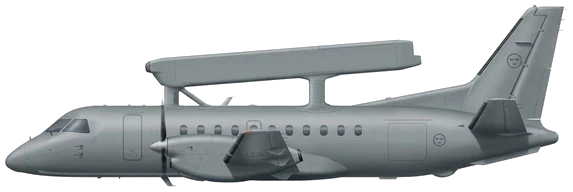
| Crew | 6 |
| Length | 20.6 m (67.5 ft) |
| Wingspan | 21.4 m (70.3 ft) |
| Height | 7.0 m (22.9 ft) |
| Wing area | 42 m² (452.1 sqft) |
| Empty weight | 10,300 kg (22,708 lbs) |
| Max. takeoff weight | 13,155 kg (29,002 lbs) |
| Powerplant | 2 × General Electric CT7-9B 1,390 kW each |
| Maximum speed | 522 km/h (324 mph) |
| Operational range | 1,300 km (808 mi) |
| Endurance | 5 hours |
| Service ceiling | 7,620 m (25,000 ft) |
| Climb rate | 10.2 m/s (33.5 ft/s) |


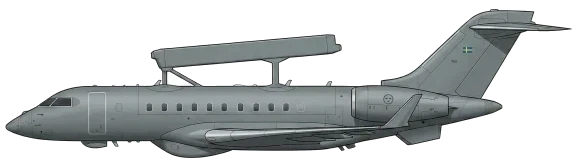
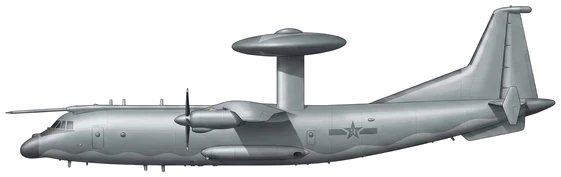
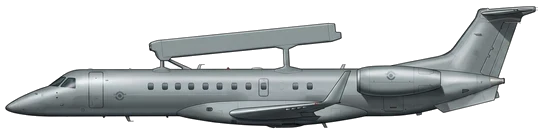
Description
Developed as a Swedish airborne early warning and control (AEW&C) platform, the Saab 340 AEW&C is a military variant of the Saab 340 regional airliner. Manufactured by Saab AB, the aircraft was designed to provide an advanced surveillance and control capability. It undertook its first flight in 1994 and was formally introduced into service in 1997. Production ran from 1994 until 1999, resulting in a total of 12 aircraft being built. The aircraft is designated S 100B Argus within the Swedish Air Force.
Design
The design of the Saab 340 AEW&C is distinguished by its unique radar system, which eschews a traditional rotating radome. Instead, it utilizes the Erieye system, which features a non-movable, dorsal-mounted PS-890 Active Electronically Scanned Array (AESA) radar. This fixed radar offers reduced aerodynamic drag but creates blind zones directly forward and aft of the aircraft, providing a 120-degree field of view on each side. Operating at an altitude of up to 6,100 meters, the radar is capable of tracking aircraft, missiles, and ships at ranges between 300 and 400 kilometers. The aircraft is powered by two General Electric CT7-9B turboprop engines and has an operational endurance of over five hours.
Operational History
The Saab 340 AEW&C has seen service with several air forces globally. The Swedish Air Force initially operated six aircraft, four of which were dedicated AEW&C platforms, while two were configured for transport roles in peacetime. In 2006, two of the Swedish aircraft were upgraded to the Saab 340 AEW-300 standard for enhanced surveillance and compatibility with multinational operations. The platform has also been operated by the Royal Thai Air Force and was formerly loaned to the Hellenic Air Force. The United Arab Emirates retired its fleet in 2020 after acquiring the GlobalEye platform. In 2023, Poland purchased two ex-UAE aircraft, receiving them in 2024. In May 2024, Sweden announced the transfer of two ASC 890 aircraft to the Ukrainian Air Force.
Variants
- Saab 340B AEW / S 100B Argus (FSR-890): This variant, equipped with the Erieye radar system, serves as the basis for the aircraft supplied to the Thai Air Force.
- Saab 340B AEW-200 (IS-340): A designation for a variant fitted with the Erieye airborne early warning radar system.
- Saab 340B AEW-300 / S 100D Argus (ASC-890): An upgraded version for the Swedish Air Force with enhanced capabilities for deployment in multi-national operations.
- B.K.1: This is the official designation for the Saab 340 AEW&C aircraft in service with the Royal Thai Armed Forces.
- Saab 2000: fuselage-stretched variant fitted with Erieye active electronically scanned array radar and associated mission systems.
Frequently Asked Questions
What type of aircraft is the Saab 340 AEW&C?
What is the maximum speed of the Saab 340 AEW&C?
What is the range of the Saab 340 AEW&C?
When did the Saab 340 AEW&C first fly?
How many Saab 340 AEW&C have been built?
Which countries operate the Saab 340 AEW&C?
What is the service ceiling of the Saab 340 AEW&C?
- JUL 272026 Updated Name updated
- APR 72026 Updated Picture credits updated in a site-wide editorial pass
- JUL 142025 Updated Specifications and description reviewed