E-3 Sentry AWACS vs E-7 Wedgetail
E-3 Sentry AWACS vs E-7 Wedgetail at a glance — top speed 853 vs 853 km/h, range 7,400 vs 6,500 km, max takeoff weight 147,417 vs 77,600 kg, built 68 vs 15 units.
| E-3 Sentry AWACS | E-7 Wedgetail | |
|---|---|---|
| Origin country | 🇺🇸 United States | 🇺🇸 United States |
| Category | Military Special Mission Aircraft | Military Special Mission Aircraft |
| Manufacturer | Boeing | Boeing |
| First flight | 9 February 1972 | 1 January 2004 |
| Year introduced | 1977 | 2010 |
| Number produced | 68 units | 15 units |
| Average unit price | $270 million | $400 million |
| Wing area | 283.0 m² | 91.0 m² |
| Wingspan | 44.4 m | 35.8 m |
| Height | 12.6 m | 12.5 m |
| Length | 46.6 m | 33.6 m |
| Maximum speed | 853 km/h | 853 km/h |
| Operational range | 7,400 km | 6,500 km |
| Service ceiling | 10,668 m | 12,500 m |
| Max. takeoff weight | 147,417 kg | 77,600 kg |
| Empty weight | 83,915 kg | 46,606 kg |
| Total thrust | 4 x 9,752 kgf | 2 x 121 kN |
Detailed Comparison
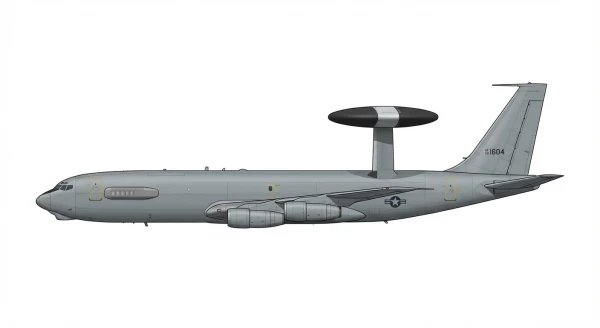
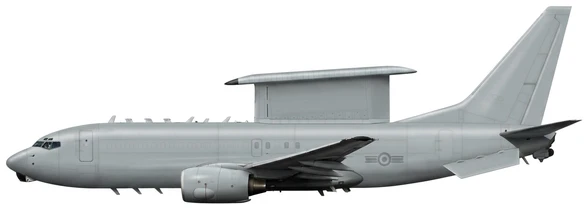
The transition from the Boeing E-3 Sentry to the E-7 Wedgetail replaces a mechanical, heavy-lift approach to airborne early warning and control (AEW&C) with a commercial-derivative, active electronically scanned array (AESA) architecture. The E-3 relies on a rotating mechanical radome and four TF33 turbojets, demanding heavy maintenance and large crew footprints. The E-7 utilizes a twin-engine Boeing 737 baseline carrying a fixed sensor, fundamentally altering sortie generation rates and radar refresh capabilities.
Development and Design
The E-3 originated in the 1960s to replace the EC-121, utilizing the Boeing 707-320B airframe to house Westinghouse's AN/APY-1/2 pulse-Doppler radar inside a 30-foot rotating unpressurized dome. This mechanical rotation physically sweeps the battlespace, dictating a fixed 10-second refresh rate. The E-7 Wedgetail, born from Australia’s Project AIR 5077 in 1999, uses a 737-700ER frame mounting Northrop Grumman’s Multi-role Electronically Scanned Array (MESA). The fixed MESA electronically steers its beams, allowing operators to dynamically allocate radar energy through specific components:
- Two broadside electronic manifold arrays covering 120 degrees laterally
- Front and aft end-fire arrays covering 60 degrees longitudinally
Instead of waiting for a physical sweep, E-7 operators can instantly revisit high-priority tracks or heavily jammed sectors, marking a fundamental shift in battle management doctrine.
Specifications and Performances
Both airframes max out at 853 km/h, but their baseline aerodynamics dictate different operational economics. The E-3's four TF33-PW-100A turbojets generate 9,752 kgf of thrust each but consume fuel at rates limiting unrefueled endurance to 8 hours. The E-7 leverages two modern CFM56-7B27A turbofans. Operating data indicates an endurance of up to 17 hours for the E-7, enabled by the 737's efficiency and a maximum takeoff weight (77,600 kg) nearly half of the E-3's 147,417 kg bulk. The E-7's radar pushes look-up ranges beyond 600 km and functions as an ELINT array effective out to 850 km at altitude, condensing multiple intelligence-gathering roles into a smaller footprint.
Deployment and usage
The E-3 established the baseline for late-20th-century air command. During the 1991 Persian Gulf War, E-3s orchestrated 38 of 41 coalition air-to-air kills, later directing airspace during Operations Allied Force and Inherent Resolve. Today, E-3 mission capable rates suffer due to airframe fatigue and obsolete analog components. Allied forces are standardizing on the E-7. RAAF Wedgetails sustained 17-hour command sorties during Iraq operations in 2014 and deployed to Europe in 2023. While the USAF cancelled its planned 26-aircraft E-7 procurement in June 2025 to focus on two prototypes, export operators like the UK, South Korea, and Turkey rely heavily on the platform for primary AEW&C tasking.
Conclusion
The E-7 Wedgetail holds the absolute edge in high-intensity, contested environments. The E-3's mechanical radar scan rate is obsolete against hypersonic missiles and low-observable aircraft, which require instantaneous track updates and concentrated electronic staring. The aging 707 airframe also imposes high downtime. By providing rapid target revisit rates, embedded ELINT, and the high sortie generation inherent to the 737 airframe, the E-7 outpaces the E-3 in raw electronic warfare capability and operational availability.