A-50 Mainstay vs E-3 Sentry AWACS
A-50 Mainstay vs E-3 Sentry AWACS at a glance — top speed 900 vs 853 km/h, range 7,500 vs 7,400 km, max takeoff weight 190,000 vs 147,417 kg, built 42 vs 68 units.
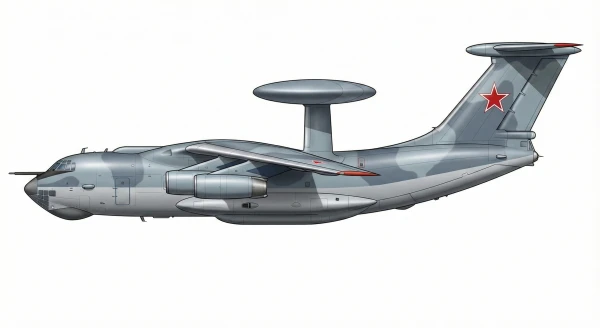
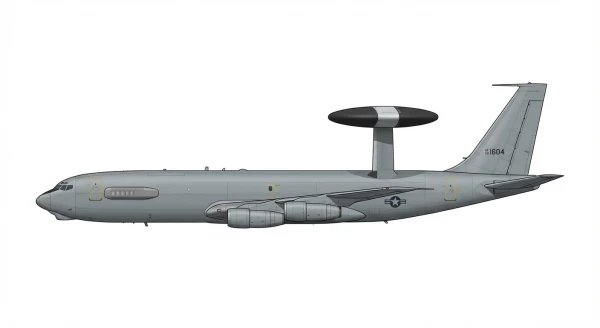
| A-50 Mainstay | E-3 Sentry AWACS | |
|---|---|---|
| Origin country | 🇷🇺 Russia | 🇺🇸 United States |
| Category | Military Special Mission Aircraft | Military Special Mission Aircraft |
| Manufacturer | Beriev | Boeing |
| First flight | 19 December 1978 | 9 February 1972 |
| Year introduced | 1985 | 1977 |
| Number produced | 42 units | 68 units |
| Average unit price | $300 million | $270 million |
| Wing area | 300.0 m² | 283.0 m² |
| Wingspan | 50.6 m | 44.4 m |
| Height | 14.8 m | 12.6 m |
| Length | 46.6 m | 46.6 m |
| Maximum speed | 900 km/h | 853 km/h |
| Operational range | 7,500 km | 7,400 km |
| Service ceiling | 15,500 m | 10,668 m |
| Max. takeoff weight | 190,000 kg | 147,417 kg |
| Empty weight | 61,000 kg | 83,915 kg |
| Total thrust | 4 x 12,000 kgf | 4 x 9,752 kgf |
Detailed Comparison
The E-3 Sentry and A-50 Mainstay are Cold War-era airborne early warning and control (AEW&C) platforms developed from fundamentally different airframes—the E-3 from the Boeing 707 airliner and the A-50 from the Ilyushin Il-76 military transport. This divergence influences their design, performance, and operational doctrine. The E-3, first flown in 1972, became a ubiquitous asset for the USAF and NATO allies, while the A-50, which followed in 1978, was developed to succeed the Tu-126 for Soviet forces.
Development and Design
The E-3's design leverages the efficiencies of a commercial airframe, modified for military duty with a 30-foot rotodome housing its AN/APY-1/2 pulse-Doppler radar. Its development saw extensive Western collaboration, resulting in variants for NATO, the UK, and France. With 68 units built, it achieved significant export success and has undergone continuous upgrades, such as the Block 40/45 standard. In contrast, the A-50's design prioritizes ruggedness, using the high-wing Il-76 capable of operating from less-prepared airfields. Its 9-meter rotodome contains the Liana surveillance radar. Production was limited to approximately 42 aircraft, with modernization efforts like the A-50U attempting to bridge the technological gap with Western systems. Unlike the unarmed E-3, the A-50 retains a vestigial tail turret with two 23mm cannons, a feature of its military transport heritage.
Specifications and Performances
While their maximum speeds are comparable at around 850 km/h, their performance characteristics diverge. The E-3 boasts a greater unrefueled range (9,250 km vs. the A-50's 7,500 km), facilitating longer-range deployments. Conversely, the A-50 has a significantly higher service ceiling (15,500 m vs. 10,668 m), offering a potential advantage in radar line-of-sight. The A-50's Il-76 airframe gives it a much higher maximum takeoff weight (190,000 kg vs. 147,417 kg) and more powerful engines. The E-3 accommodates a larger mission crew (15 operators vs. 10), suggesting a greater capacity for command, control, and data processing. The A-50's listed endurance of four hours is for unrefueled time on station; both platforms are equipped for air-to-air refueling to extend mission duration significantly.
Deployment and usage
The E-3 Sentry has an extensive and well-documented combat record. It was a critical command-and-control node during the 1991 Gulf War, directing coalition airpower with high effectiveness, and has been a constant presence in NATO operations, including over the Balkans and in support of anti-ISIL campaigns. Its integration into the NATO Airborne Early Warning and Control Force highlights its role as a key multinational asset. The A-50's operational use has been more limited, primarily in support of Russian operations in Syria and, more recently, the Russo-Ukrainian War. Its deployment has been marked by significant setbacks, including the confirmed loss of two modernized A-50U aircraft in early 2024, exposing its vulnerability in contested airspace.
Conclusion
The E-3 Sentry is a highly successful, widely adopted, and combat-proven AEW&C platform that has defined the role for Western air forces for decades. Its strengths lie in its systems maturity, multinational integration, and continuous upgrades. The A-50 Mainstay is a capable, rugged counterpart built for a different operational context. While it possesses some superior flight performance metrics like service ceiling, its smaller fleet size, limited export record, and recent combat losses underscore the challenges it faces against modern air defense systems. The E-3 represents the benchmark for large-scale, integrated air battle management, whereas the A-50 serves as a critical but more vulnerable asset for Russian forces.