F-104 Starfighter vs MiG-21 Fishbed
F-104 Starfighter vs MiG-21 Fishbed at a glance — top speed 2,500 vs 2,175 km/h, range 2,623 vs 793 km, max takeoff weight 13,170 vs 10,400 kg, built 2,578 vs 11,496 units.
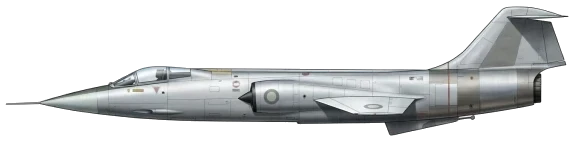
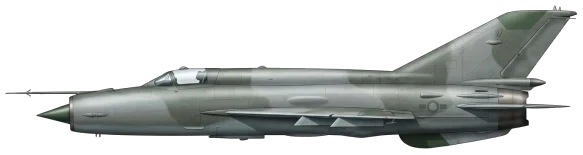
| F-104 Starfighter | MiG-21 Fishbed | |
|---|---|---|
| Origin country | 🇺🇸 United States | 🇷🇺 Ex-USSR |
| Category | Combat Aircraft | Combat Aircraft |
| Manufacturer | Lockheed | Mikoyan-Gurevich |
| First flight | 4 March 1954 | 16 June 1955 |
| Year introduced | 1958 | 1958 |
| Number produced | 2578 units | 11496 units |
| Average unit price | $1.4 million | $2 million |
| Wing area | 18.2 m² | 23.0 m² |
| Wingspan | 6.4 m | 7.2 m |
| Height | 4.1 m | 4.1 m |
| Length | 16.7 m | 14.7 m |
| Maximum speed | 2500 km/h | 2175 km/h |
| Operational range | 2,623 km | 793 km |
| Service ceiling | 15,240 m | 17,500 m |
| Max. takeoff weight | 13,170 kg | 10,400 kg |
| Empty weight | 6,350 kg | 4,871 kg |
| Total thrust | 1 x 7,076 kgf | 1 x 7,095 kgf |
Detailed Comparison
The Lockheed F-104 Starfighter and Mikoyan-Gurevich MiG-21 emerged in the mid-1950s as the definitive lightweight, supersonic interceptors of the Cold War. While both prioritized speed and climb rate to counter strategic bombers, their aerodynamic solutions diverged radically: the F-104 utilized a long fuselage with thin, trapezoidal wings, whereas the MiG-21 adopted a tailed delta-wing configuration.
Development and Design
Lockheed designer Kelly Johnson prioritized altitude and climb performance for the F-104, resulting in a radically thin, straight trapezoidal wing with a thickness-to-chord ratio of only 3.36%. This design required complex engineering, including a T-tail and a boundary layer control system (BLCS) to mitigate dangerous landing characteristics. Conversely, the MiG-21 favored a delta-wing design with a conventional tail, balancing supersonic speed with better maneuverability and structural simplicity. While the Starfighter relied on complex materials like titanium and stainless steel to manage kinetic heating, the MiG-21 focused on ruggedness and ease of mass production. Both designs compromised fuel capacity, cockpit visibility, and payload to achieve their specific kinematic goals.
Specifications and Performances
Kinematically, the aircraft are near-peers in top speed, with the F-104 reaching 2,137 km/h and the MiG-21 2,125 km/h. However, the Starfighter possesses a superior climb rate of 244 m/s due to the thrust of the General Electric J79 engine and low drag airframe. The MiG-21 offers a distinct weight advantage, with an empty weight of 4,871 kg compared to the F-104's 6,350 kg, contributing to better instantaneous turn rates and handling. The Soviet design also boasts a higher service ceiling of 19,000 m against the F-104's 15,240 m. Both platforms suffer from severely limited operational range—under 700 km without external tanks—which restricted them to point-defense interception or close air support.
Deployment and Usage
The F-104 served primarily within NATO, evolved from a pure day-interceptor into an all-weather fighter-bomber (F-104G). This role shift exposed the airframe to low-altitude turbulence and high wing loading, contributing to a notoriously high accident rate, particularly in Luftwaffe service where 292 aircraft were lost. In Vietnam, the USAF used it for deterrence and support rather than direct dogfighting.
The MiG-21 proved more adaptable and ubiquitous, with 11,496 units produced compared to 2,578 Starfighters. It served as the primary interceptor for North Vietnam, utilizing GCI-controlled "hit-and-run" tactics against heavier US fighters, and saw extensive combat in the Middle East and Indian subcontinent. While the F-104 required sophisticated maintenance infrastructure, the MiG-21's rugged nature allowed for operation from austere airfields with minimal support.
Conclusion
The F-104 Starfighter was an aerodynamic triumph but an operational challenge; its intolerance of pilot error and high maintenance requirements limited its combat effectiveness outside of specific intercept scenarios. The MiG-21, while technologically cruder, offered a superior balance of cost, maintainability, and combat utility. Its longevity is evidenced by modernized variants like the MiG-21 "Bison" remaining in service decades after the F-104's retirement, marking the Fishbed as the more successful implementation of the lightweight supersonic fighter concept.


