F-105 Thunderchief vs F-4 Phantom II
F-105 Thunderchief vs F-4 Phantom II at a glance — top speed 2,208 vs 2,370 km/h, range 3,550 vs 2,699 km, max takeoff weight 23,834 vs 28,030 kg, built 833 vs 5,195 units.
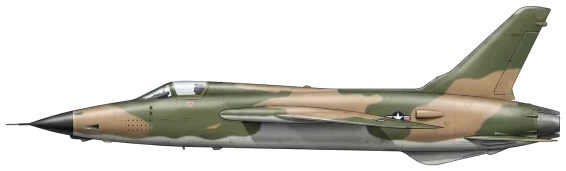
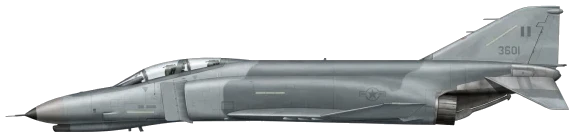
| F-105 Thunderchief | F-4 Phantom II | |
|---|---|---|
| Origin country | 🇺🇸 United States | 🇺🇸 United States |
| Category | Combat Aircraft | Combat Aircraft |
| Manufacturer | Republic | McDonnell |
| First flight | 22 October 1955 | 27 May 1958 |
| Year introduced | 1958 | 1962 |
| Number produced | 833 units | 5195 units |
| Average unit price | $2.7 million | $2.4 million |
| Wing area | 35.8 m² | 49.2 m² |
| Wingspan | 10.7 m | 11.7 m |
| Height | 6.0 m | 5.0 m |
| Length | 19.6 m | 19.0 m |
| Maximum speed | 2208 km/h | 2370 km/h |
| Operational range | 3,550 km | 2,699 km |
| Service ceiling | 14,783 m | 18,288 m |
| Max. takeoff weight | 23,834 kg | 28,030 kg |
| Empty weight | 12,470 kg | 13,757 kg |
| Total thrust | 1 x 12,020 kgf | 2 x 8,094 kgf |
Detailed Comparison
Republic’s F-105 Thunderchief and McDonnell’s F-4 Phantom II emerged from opposite ends of US Cold War procurement. The Thunderchief was a dedicated low-altitude, high-speed nuclear strike platform born from internal USAF requirements, whereas the Phantom originated as a fleet-defense interceptor for the US Navy. Both became primary bomb haulers of the Vietnam War, but their divergent origins dictated entirely different aerodynamic and doctrinal trajectories.
Development and Design
Republic designed the F-105 around a singular mission: penetrating Soviet airspace at low altitude to deliver a tactical nuclear weapon. Alexander Kartveli’s team prioritized a low drag profile, integrating an internal bomb bay and employing the area rule—giving the aircraft its wasp waist—to minimize transonic drag. Agility was secondary to straight-line speed. McDonnell approached the F-4 from a fleet defense perspective. Navy doctrine demanded an interceptor to destroy incoming bombers beyond visual range using radar-guided AIM-7 Sparrow missiles. This required a second crew member to operate the Westinghouse radar and twin General Electric J79 engines for survivability over water. McDonnell entirely discarded an internal gun in initial variants, assuming missiles rendered cannon obsolete.
Specifications and Performances
The F-4 holds a kinetic advantage over the F-105. Powered by twin J79 turbojets producing 16,186 kgf of thrust, the F-4 reaches 2,370 km/h and climbs at 210 m/s. The single-engine F-105, utilizing a J75 generating 7,798 kgf, peaks at 2,208 km/h. Ordnance capacities dictate their offensive profiles:
- F-105: 14,000 lb maximum capacity, typically relying on a central internal bay and five external pylons.
- F-4: 18,650 lb maximum capacity across nine external hardpoints, integrating guided munitions like the AGM-65 Maverick.
The F-4's wing loading and thrust-to-weight ratio provide better vertical energy retention, though both airframes suffer from high drag bleed rates in horizontal turns.
Deployment and usage
During Operation Rolling Thunder, the F-105 executed the majority of tactical strikes against North Vietnam. Its low-altitude stability made it an effective bomber, but the loss rate was severe: 382 of the 833 produced airframes were destroyed. USAF pilots repurposed the F-105's internal M61 cannon for close-range defense, achieving 27.5 MiG kills, but the airframe could not consistently dogfight. The F-4 replaced the F-105 in the strike role while serving as the theater's primary air superiority fighter. All five US Vietnam aces flew the F-4. McDonnell's airframe secured heavy export orders, seeing combat with the Israeli Air Force in the Yom Kippur War and the Iranian Air Force during the Iran-Iraq War. F-105Gs carved out a niche in the Suppression of Enemy Air Defenses (SEAD) mission, actively hunting S-75 surface-to-air missile sites until 1984.
Conclusion
The F-4 Phantom II is doctrinally superior for multirole theater operations. Its twin-engine redundancy, two-man crew for workload distribution, and higher thrust-to-weight ratio allow it to pivot between fleet defense, ground attack, and air superiority. The F-105 Thunderchief holds the edge strictly in low-altitude, high-speed penetration. For a dedicated strike or SEAD mission profile where the objective is to ingress below radar coverage, deliver ordnance, and egress in a straight line, the F-105's aerodynamic stability at the deck outpaces the F-4.


