F-14 Tomcat vs F-4 Phantom II
F-14 Tomcat vs F-4 Phantom II at a glance — top speed 2,485 vs 2,370 km/h, range 3,000 vs 2,699 km, max takeoff weight 33,724 vs 28,030 kg, built 712 vs 5,195 units.
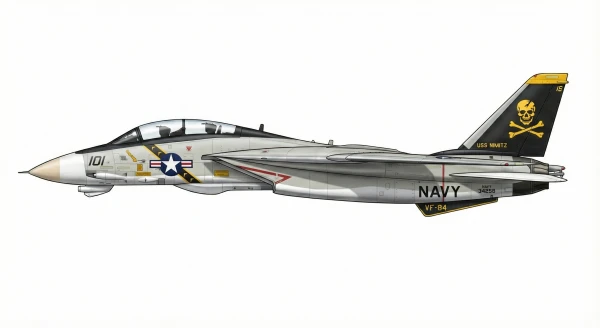
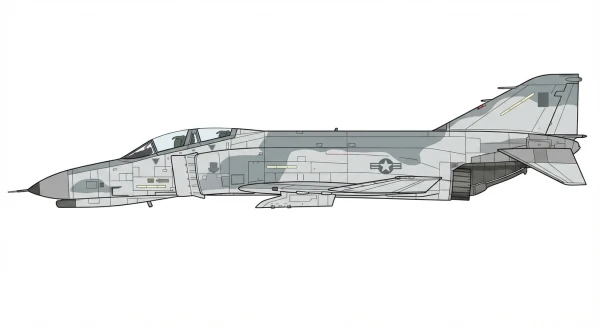
| F-14 Tomcat | F-4 Phantom II | |
|---|---|---|
| Origin country | 🇺🇸 United States | 🇺🇸 United States |
| Category | Combat Aircraft | Combat Aircraft |
| Manufacturer | Grumman | McDonnell |
| First flight | 21 December 1970 | 27 May 1958 |
| Year introduced | 1972 | 1962 |
| Number produced | 712 units | 5195 units |
| Average unit price | $38 million | $3 million |
| Wing area | 52.5 m² | 49.2 m² |
| Wingspan | 19.6 m | 11.7 m |
| Height | 4.9 m | 5.0 m |
| Length | 19.1 m | 19.0 m |
| Maximum speed | 2485 km/h | 2370 km/h |
| Operational range | 3,000 km | 2,699 km |
| Service ceiling | 17,069 m | 18,288 m |
| Max. takeoff weight | 33,724 kg | 28,030 kg |
| Empty weight | 18,191 kg | 13,757 kg |
| Total thrust | 2 x 12,224 kgf | 2 x 8,094 kgf |
Detailed Comparison
Entering service in 1962, the McDonnell F-4 Phantom II introduced twin-engine, radar-guided interception to the US Navy, prioritizing engine thrust and payload over aerodynamic maneuverability. Twelve years later, the Grumman F-14 Tomcat entered the fleet specifically to correct the Phantom's turning deficits and beyond-visual-range (BVR) limitations, trading the F-4's massive 5,195-unit production run for a highly specialized, 712-unit interceptor force.
Development and Design
The F-4 evolved from a revised F3H Demon requirement, resulting in an interceptor powered by J79-GE-17A turbojets. McDonnell designed the F-4 around missile combat, initially omitting an internal cannon. The airframe relied on blown flaps and a 12° upward angle on the outer wings to correct lateral instability. Combat in Vietnam forced a design correction, resulting in the F-4E’s internal 20mm M61 Vulcan.
The F-14 was purpose-built to address the F-4's aerodynamic limits and replace the canceled F-111B. Grumman incorporated variable-sweep wings, automatically managed by the Central Air Data Computer (CADC) to sweep between 20° and 68°, maximizing the lift-to-drag ratio across all flight envelopes. This allowed the Tomcat to dogfight effectively while housing the heavy Hughes AN/AWG-9 radar required to track 24 targets simultaneously.
Specifications and Performances
When comparing their physical constraints and flight envelopes, several metrics separate the airframes:
- The F-14 offers a 3,000 km range, dwarfing the F-4’s 680 km radius.
- The F-4 generates a higher initial climb rate of 210 m/s compared to the Tomcat’s 152 m/s.
- The F-14 carries a higher maximum takeoff weight at 33,724 kg against the F-4's 28,030 kg.
The disparity in range reflects the Tomcat’s primary mission: loitering hundreds of miles from the carrier group to intercept Soviet aviation. The F-14's higher empty weight (18,191 kg versus 13,757 kg) is compensated by its titanium-reinforced wing box and variable geometry, which yield tighter turning radii than the F-4’s rigid, swept-wing design.
Deployment and usage
In Vietnam, the F-4 served as the primary US air superiority fighter but suffered early losses due to restrictive rules of engagement and unreliable AIM-7 Sparrow missiles. It later transitioned to ground-attack and Wild Weasel roles, heavily used in the 1991 Gulf War.
The F-14 recorded US Navy air-to-air kills against Libyan Su-22s and MiG-23s. Both aircraft saw heavy use in the Iran-Iraq War. Iranian F-14s utilized AIM-54 Phoenix missiles to down at least 55 Iraqi aircraft, validating the AWG-9 system. The Iranian F-14 fleet operated until a 2026 Israeli strike on Isfahan’s 8th Tactical Fighter Base destroyed the remaining functional airframes on the ground. The F-4 continues active service in Iran, Greece, and Turkey today.
Conclusion
The F-14 Tomcat holds the absolute edge in fleet defense and BVR air-to-air combat. Its AN/AWG-9 radar and AIM-54 missiles allow target engagement at ranges the F-4 cannot detect, while its variable-sweep wings provide superior kinematics in close-range engagements.
The F-4 Phantom II retains the advantage in mass procurement and dedicated ground-attack operations. At $3.0 million per unit versus the F-14's $38.0 million, the Phantom was affordable enough to equip 11 allied nations and absorb high combat attrition. For targeted air superiority, the Tomcat is the superior platform; for outfitting a standardized, multi-national strike force, the Phantom remains the historical standard.