F-14 Tomcat vs F-16 Fighting Falcon
F-14 Tomcat vs F-16 Fighting Falcon at a glance — top speed 2,485 vs 2,178 km/h, range 3,000 vs 4,217 km, max takeoff weight 33,724 vs 19,200 kg, built 712 vs 4,604 units.
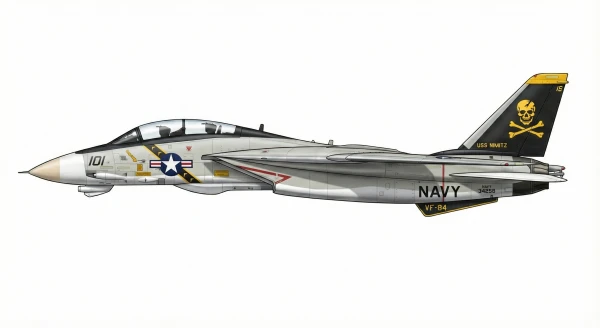
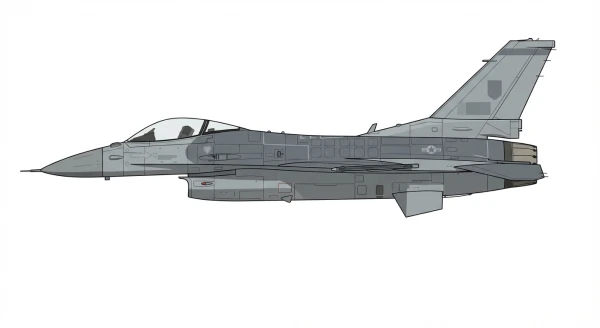
| F-14 Tomcat | F-16 Fighting Falcon | |
|---|---|---|
| Origin country | 🇺🇸 United States | 🇺🇸 United States |
| Category | Combat Aircraft | Combat Aircraft |
| Manufacturer | Grumman | General Dynamics |
| First flight | 21 December 1970 | 2 February 1974 |
| Year introduced | 1972 | 1979 |
| Number produced | 712 units | 4604 units |
| Average unit price | $38 million | $18.8 million |
| Wing area | 52.5 m² | 27.9 m² |
| Wingspan | 19.6 m | 10.0 m |
| Height | 4.9 m | 4.9 m |
| Length | 19.1 m | 15.1 m |
| Maximum speed | 2485 km/h | 2178 km/h |
| Operational range | 3,000 km | 4,217 km |
| Service ceiling | 17,069 m | 15,240 m |
| Max. takeoff weight | 33,724 kg | 19,200 kg |
| Empty weight | 18,191 kg | 8,570 kg |
| Total thrust | 2 x 12,224 kgf | 1 x 12,701 kgf |
Detailed Comparison
The Grumman F-14 Tomcat was procured to defend US Navy carrier strike groups against Soviet bombers using long-range interception, while the General Dynamics F-16 Fighting Falcon originated as a lightweight, high-g dogfighter meant to counter the rising weight and cost of tactical aircraft. Grumman produced 712 F-14s before closing the line in 1991. Lockheed Martin sustains F-16 production today with over 4,600 airframes built.
Development and Design
Following the canceled F-111B, the Navy ordered the F-14 to field the AWG-9 radar and AIM-54 Phoenix missile. Its variable-sweep wings, shifting from 20° to 68°, maximized lift for carrier recovery and minimized drag for Mach 2 interception. Managing the radar intercept geometry required a dedicated radar intercept officer in the rear seat. The USAF Lightweight Fighter program produced the F-16 to complement the heavier F-15. The F-16 utilized a relaxed static stability profile controlled by early fly-by-wire computers, a side-mounted stick, and a frameless canopy. The F-14 used 25% titanium in its structure to withstand carrier landing stresses and wing-pivot loads, driving high maintenance demands, whereas the F-16 prioritized simplicity and high sortie generation rates.
Specifications and Performances
The twin-engine F-14 has a maximum takeoff weight of 33,724 kg, nearly double the F-16's 19,200 kg. This mass enables a 3,000 km range and a 14,500 lb payload capacity. Powered by twin TF30 (and later F110) engines, the F-14 reaches 2,485 km/h. The single-engine F-16 is slightly slower at 2,410 km/h but generates a climb rate of 254 m/s, thoroughly outpacing the F-14's 152 m/s.
Weapon architectures dictated their distinct tactical profiles:
- The F-14 relied on the AIM-54 Phoenix for beyond-visual-range interceptions, guided by an AWG-9 radar capable of engaging six targets simultaneously.
- The F-16 transitioned from daytime dogfighting to all-weather multirole, carrying AIM-120 AMRAAMs for air-to-air alongside heavy air-to-ground ordnance like the AGM-88 HARM and JDAMs.
Deployment and usage
US Navy F-14s recorded kills against Libyan Su-22s and MiG-23s in the 1980s. During the Iran-Iraq War, Iranian F-14s claimed at least 55 confirmed Iraqi aircraft kills. The Tomcat finished its US service dropping precision munitions over Iraq and Afghanistan before its 2006 retirement. On March 7, 2026, Israeli strikes on Isfahan destroyed the remaining active Iranian airframes on the ground.
The F-16 operates across more than 25 nations. USAF F-16s destroyed over 30 Iraqi aircraft during Desert Storm and executed widespread SEAD missions. Israeli F-16s secured dozens of air-to-air kills against Syrian fighters in the Bekaa Valley. Upgrades like the Litening pod and AESA radars shifted the F-16’s primary usage to ground attack across NATO operations in the Balkans and the Middle East.
Conclusion
The F-14 holds the edge in fleet air defense and long-range interception. Its heavy payload, radar tracking capacity, and long loiter times allowed it to control vast airspace expanses far from the carrier deck. The F-16 dominates in close-in air combat and multirole strike. Its 254 m/s climb rate and fly-by-wire agility make it a more lethal within-visual-range dogfighter, while its single-engine efficiency makes it superior for sustaining high sortie rates in prolonged air-to-ground campaigns. The F-16's modular single-engine architecture ensured its survival into the 21st century, whereas the maintenance-heavy variable-sweep wing condemned the F-14 to early retirement.