F-14 Tomcat vs MiG-23 Flogger
F-14 Tomcat vs MiG-23 Flogger at a glance — top speed 2,485 vs 2,500 km/h, range 3,000 vs 2,360 km, max takeoff weight 33,724 vs 17,800 kg, built 712 vs 5,047 units.
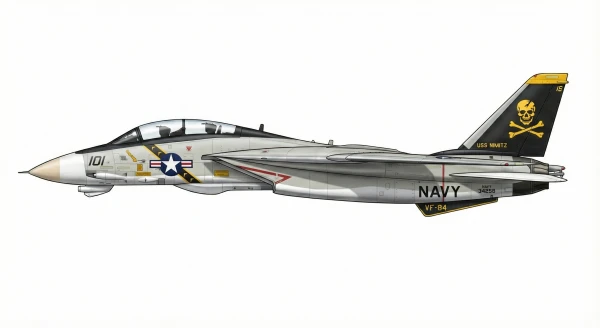
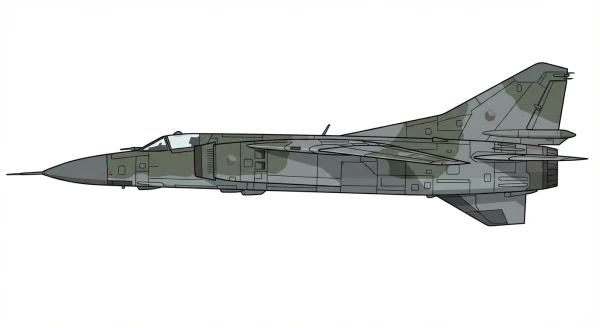
| F-14 Tomcat | MiG-23 Flogger | |
|---|---|---|
| Origin country | 🇺🇸 United States | 🇷🇺 Ex-USSR |
| Category | Combat Aircraft | Combat Aircraft |
| Manufacturer | Grumman | Mikoyan-Gurevich |
| First flight | 21 December 1970 | 10 June 1967 |
| Year introduced | 1972 | 1970 |
| Number produced | 712 units | 5047 units |
| Average unit price | $38 million | $4 million |
| Wing area | 52.5 m² | 37.0 m² |
| Wingspan | 19.6 m | 14.0 m |
| Height | 4.9 m | 4.8 m |
| Length | 19.1 m | 16.7 m |
| Maximum speed | 2485 km/h | 2500 km/h |
| Operational range | 3,000 km | 2,360 km |
| Service ceiling | 17,069 m | 18,000 m |
| Max. takeoff weight | 33,724 kg | 17,800 kg |
| Empty weight | 18,191 kg | 10,230 kg |
| Total thrust | 2 x 12,224 kgf | 1 x 12,996 kgf |
Detailed Comparison
The Grumman F-14 Tomcat and Mikoyan-Gurevich MiG-23 emerged in the late 1960s as variable-geometry solutions to the limitations of their predecessors, yet they reflect opposing procurement models. The US Navy invested $38 million per unit to build 712 heavy, radar-centric fleet defense interceptors. The Soviet Union optimized for mass, churning out over 5,000 single-engine tactical fighters at $4 million apiece to equip the Warsaw Pact and export clients.
Development and Design
The F-14 originated from the collapse of the F-111B program. Grumman retained the variable-sweep concept but integrated it into a dedicated air-superiority airframe heavily utilizing titanium and an automated Garrett AiResearch Central Air Data Computer (CADC) to manage wing sweep between 20° and 68°. The MiG-23 required manual wing-sweep inputs from the pilot (16°, 45°, or 72°) and was designed primarily to out-range and out-accelerate the MiG-21. Mikoyan-Gurevich centralized the design around the Tumansky R-29 (later R-35) turbojet, accepting poor rearward visibility and high pilot workload to achieve raw speed.
Specifications and Performances
The Tomcat operates in a heavier weight class, with a 33,724 kg maximum takeoff weight nearly double the MiG-23’s 17,800 kg. This mass accommodates the AN/AWG-9 X-band radar, a two-man crew, and up to six AIM-54 Phoenix missiles, giving the F-14 a 3,000 km range and a beyond-visual-range (BVR) engagement envelope exceeding 160 km. The Flogger sacrifices range (1,150 km) and payload for short-field capability—requiring only 450 meters for takeoff—and raw acceleration. Its 240 m/s climb rate outpaces the 152 m/s of TF30-powered F-14As. However, the MiG-23's Sapfir-23 radar and R-23/24 missiles restrict its effective engagement range to under 50 km.
Deployment and usage
In combat, the F-14's sensor and weapons range dictated outcomes. During the Iran-Iraq War, Iranian F-14As utilized their AWG-9 radars to destroy Iraqi strike packages, logging 55 confirmed kills. US Navy F-14s similarly defeated Libyan Su-22s and MiG-23s in the 1980s. The MiG-23’s combat record was largely defined by heavy attrition. While Soviet pilots valued its acceleration, Syrian and Iraqi MiG-23s suffered heavy losses against Western-built F-15s, F-16s, and F-14s in the Bekaa Valley and Desert Storm. The Flogger's lack of a competent look-down/shoot-down radar rendered it vulnerable to low-altitude ambushes and electronic countermeasures.
Conclusion
The F-14 categorically defeats the MiG-23 in the air superiority role. The AWG-9/Phoenix combination determines the engagement timeline long before the Flogger is within firing range.
Comparing their operational utility yields definitive results:
- Beyond-Visual-Range (BVR) Intercept: The F-14 dominates with its long-range AIM-54 envelope, negating the MiG-23's limited radar and R-24 missiles.
- Point-Defense Scrambles: The MiG-23 holds a narrow edge due to its 240 m/s climb rate compared to the 152 m/s of early F-14As.
- Close-in Dogfighting: The F-14 wins through its automated CADC wing sweep, which manages energy bleed better than the MiG-23's manual sweep and heavy control stick forces.
For localized, ground-controlled interception in numbers, the $4 million MiG-23 fulfilled Warsaw Pact doctrine. For autonomous air dominance, the Tomcat justified its price tag.