F-4 Phantom II vs Mirage F1
F-4 Phantom II vs Mirage F1 at a glance — top speed 2,370 vs 2,350 km/h, range 2,699 vs 3,300 km, max takeoff weight 28,030 vs 15,200 kg, built 5,195 vs 726 units.
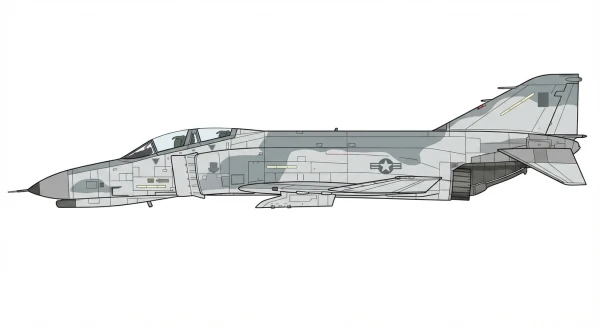
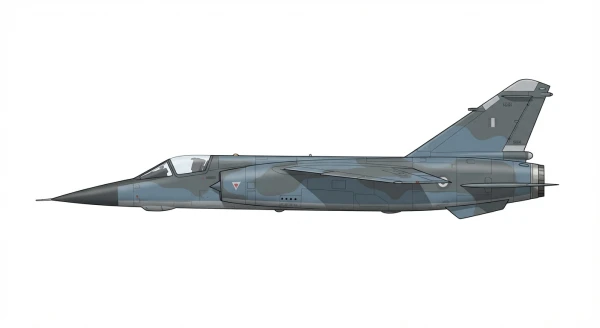
| F-4 Phantom II | Mirage F1 | |
|---|---|---|
| Origin country | 🇺🇸 United States | 🇫🇷 France |
| Category | Combat Aircraft | Combat Aircraft |
| Manufacturer | McDonnell | Dassault |
| First flight | 27 May 1958 | 23 December 1966 |
| Year introduced | 1962 | 1973 |
| Number produced | 5195 units | 726 units |
| Average unit price | $2.4 million | $8 million |
| Wing area | 49.2 m² | 25.0 m² |
| Wingspan | 11.7 m | 8.5 m |
| Height | 5.0 m | 4.6 m |
| Length | 19.0 m | 15.5 m |
| Maximum speed | 2370 km/h | 2350 km/h |
| Operational range | 2,699 km | 3,300 km |
| Service ceiling | 18,288 m | 20,000 m |
| Max. takeoff weight | 28,030 kg | 15,200 kg |
| Empty weight | 13,757 kg | 8,024 kg |
| Total thrust | 2 x 8,094 kgf | 1 x 7,199 kgf |
Detailed Comparison
McDonnell Douglas built the F-4 Phantom II around twin-engine thrust and radar-guided beyond-visual-range (BVR) engagements, requiring a two-man crew to manage complex avionics and targeting systems. Dassault Aviation engineered the Mirage F1 as a lightweight, single-engine interceptor prioritizing short-field performance, aerodynamic efficiency, and single-pilot operation.
Development and Design
The F-4 originated from a 1953 U.S. Navy requirement for a fleet defense interceptor. McDonnell adopted a twin-engine design using J79 turbojets, incorporating blown flaps and a dogtooth leading edge to force the heavy 28,030 kg airframe into carrier limits. Its reliance on the Sparrow missile led designers to omit an internal cannon until the F-4E variant. Dassault developed the Mirage F1 to replace the Mirage III, abandoning the traditional delta wing for a shoulder-mounted swept wing. This change increased internal fuel capacity and reduced takeoff distances. Powered by a single SNECMA Atar 9K-50 turbojet and carrying the Thomson-CSF Cyrano IV monopulse radar, the F1 was optimized for quick-reaction interception and low-altitude strike without the logistical footprint of the Phantom.
Specifications and Performances
The F-4 and Mirage F1 operate in different weight classes. The F-4's maximum takeoff weight of 28,030 kg nearly doubles the Mirage F1's 15,200 kg limit.
- The F-4 carries up to 8,480 kg of ordnance across nine hardpoints, supporting heavy conventional and nuclear loads.
- The Mirage F1 is restricted to a practical external load of 4,000 kg.
The Phantom’s twin J79 engines generate 16,186 kgf of thrust, pushing it to Mach 2.23 (2,370 km/h) compared to the F1's Mach 2.2 (2,350 km/h). The lighter Mirage F1 achieves a higher initial climb rate at 242 m/s versus the F-4's 210 m/s and reaches a higher service ceiling (20,000 m vs 18,288 m). The F-4's two-seat configuration distributes task loading for ground-mapping and BVR targeting, while the F1 mandates high pilot automation for similar combat tasks.
Deployment and usage
The F-4 defined U.S. air operations in Vietnam, executing both air superiority and close air support. Combat feedback forced the integration of an internal M61 cannon and maneuvering slats after early dogfight losses against agile MiGs. Israeli F-4s executed deep strikes and SEAD missions during the Yom Kippur War, operating effectively against integrated air defense networks. The Mirage F1 saw intense combat via its export operators. South African F1CZ and AZ variants fought MiG-21s and MiG-23s during the Border War, relying on their maneuverability and Matra Magic missiles. Iraqi F1EQs executed anti-shipping strikes with Exocet missiles and directly engaged Iranian F-4s during the Iran-Iraq War.
Conclusion
The F-4 Phantom II commands the advantage in heavy strike, SEAD, and fleet defense, where payload capacity and a dedicated Weapons System Officer dictate mission success. Its 8,480 kg ordnance limit and radar range allow it to execute complex, long-range strike packages. The Mirage F1 holds the edge in point-defense interception and austere deployments. Its lighter weight, 242 m/s climb rate, and reduced runway requirements make it the more effective choice for rapid-response intercepts and air forces unable to sustain a heavy, twin-engine strike fleet.