F-4 Phantom II vs MiG-21 Fishbed
F-4 Phantom II vs MiG-21 Fishbed at a glance — top speed 2,370 vs 2,125 km/h, range 2,699 vs 660 km, max takeoff weight 28,030 vs 8,625 kg, built 5,195 vs 11,496 units.
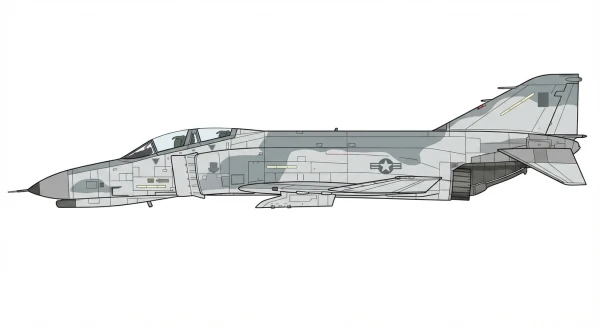
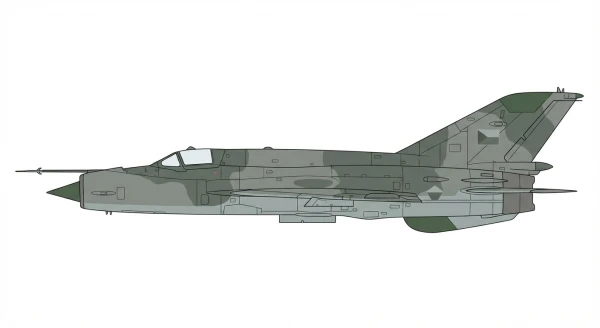
| F-4 Phantom II | MiG-21 Fishbed | |
|---|---|---|
| Origin country | 🇺🇸 United States | 🇷🇺 Ex-USSR |
| Category | Combat Aircraft | Combat Aircraft |
| Manufacturer | McDonnell | Mikoyan-Gurevich |
| First flight | 27 May 1958 | 16 June 1955 |
| Year introduced | 1962 | 1958 |
| Number produced | 5195 units | 11496 units |
| Average unit price | $2.4 million | $2 million |
| Wing area | 49.2 m² | 23.0 m² |
| Wingspan | 11.7 m | 7.2 m |
| Height | 5.0 m | 4.1 m |
| Length | 19.0 m | 13.5 m |
| Maximum speed | 2370 km/h | 2125 km/h |
| Operational range | 2,699 km | 660 km |
| Service ceiling | 18,288 m | 19,000 m |
| Max. takeoff weight | 28,030 kg | 8,625 kg |
| Empty weight | 13,757 kg | 4,871 kg |
| Total thrust | 2 x 8,094 kgf | 1 x 4,689 kgf |
Detailed Comparison
The McDonnell F-4 Phantom II and the Mikoyan-Gurevich MiG-21 emerged during the late 1950s as the definitive frontline fighters for the United States and the Soviet Union, respectively. While the F-4 was designed as a heavy, twin-engine, two-seat fleet defense interceptor and fighter-bomber capable of carrying massive payloads, the MiG-21 was built as a lightweight, single-engine, point-defense interceptor emphasizing speed, maneuverability, and simplicity.
Development and Design
The F-4 evolved from a US Navy requirement for an all-weather fleet defense interceptor. Its large airframe accommodated a Westinghouse APQ-72 radar (later APQ-120) and a second crewman (WSO) to manage complex avionics, specifically targeting Beyond Visual Range (BVR) engagements. Its design utilized aerodynamic brute force—including blown flaps and variable intake ramps—to manage a Max Takeoff Weight (MTOW) of 28,030 kg.
Conversely, the MiG-21 prioritized low production costs and ease of maintenance. Utilizing a tailed delta-wing configuration, it minimized drag to achieve Mach 2 performance with a single Tumansky turbojet. However, this design compromised combat persistence; the MiG’s small internal volume severely restricted fuel capacity and avionics space compared to the American counterpart. While the Phantom was built with extensive titanium and complex alloys, the MiG-21 favored a simpler construction suitable for mass production, resulting in over 11,000 units built.
Specifications and Performances
Performance metrics highlight the disparity in doctrine. The Phantom II leverages two General Electric J79 engines producing 8,093 kgf of thrust each to propel a massive airframe to 2,370 km/h. Its defining characteristic is payload capability: with nine hardpoints, the F-4 can deliver 8,480 kg of ordnance—nearly double the MiG-21’s entire empty weight of 4,871 kg.
The MiG-21, while slower at 2,125 km/h, offered a smaller visual and radar cross-section. The F-4's climb rate of 210 m/s and service ceiling of 18,288 m compare closely to the MiG's 19,000 m ceiling. However, the Phantom's sustained energy retention in vertical maneuvers generally surpassed the delta-winged Fishbed, which bled energy rapidly during hard turns, a critical factor in dogfighting.
Deployment and usage
In Vietnam, the F-4 served as the principal air superiority fighter and strike aircraft for the USAF, Navy, and Marines. Its initial reliance on air-to-air missiles (Sparrow/Sidewinder) without an internal gun hampered success rates in close combat, leading to the integration of an internal M61 Vulcan cannon in the F-4E variant. The Phantom was a true multi-role platform, delivering everything from napalm and cluster bombs to laser-guided munitions like the GBU-10.
The MiG-21, utilized by the North Vietnamese, employed "hit-and-run" tactics to exploit the F-4's size. It functioned primarily as a clear-skies interceptor, armed with K-13 (Atoll) missiles and internal cannons. Both aircraft saw extensive export success; the F-4 served 12 nations, while the MiG-21 was exported to over 60 countries. Modernized variants of both (e.g., F-4 Terminator 2020, MiG-21 Bison) remain in limited service today.
Conclusion
The F-4 Phantom II and MiG-21 illustrate the divergence of Cold War aviation strategy: the American preference for heavy, technologically complex multi-role systems versus the Soviet doctrine of specialized, mass-producible localized defense. While the Phantom's raw power and payload defined the heavy fighter-bomber class, the MiG-21 remains the most produced supersonic jet in history, proving that quantity and simplicity possess their own strategic quality.