F-5 Freedom Fighter vs Mirage III / 5 / 50
F-5 Freedom Fighter vs Mirage III / 5 / 50 at a glance — top speed 1,700 vs 2,350 km/h, range 2,806 vs 3,335 km, max takeoff weight 11,187 vs 12,000 kg, built 1,204 vs 1,422 units.
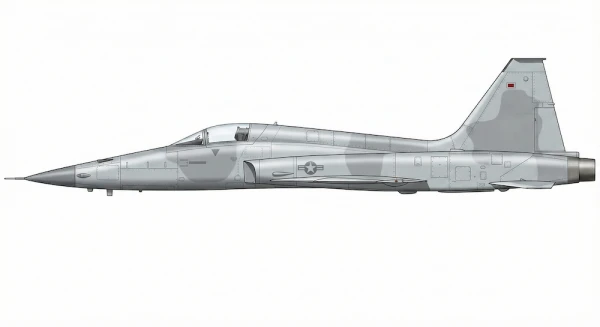
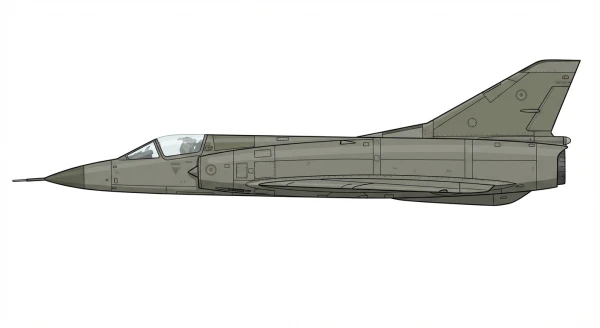
| F-5 Freedom Fighter | Mirage III / 5 / 50 | |
|---|---|---|
| Origin country | 🇺🇸 United States | 🇫🇷 France |
| Category | Combat Aircraft | Combat Aircraft |
| Manufacturer | Northrop | Dassault |
| First flight | 30 July 1959 | 17 November 1956 |
| Year introduced | 1965 | 1961 |
| Number produced | 1204 units | 1422 units |
| Average unit price | $2 million | $5 million |
| Wing area | 17.3 m² | 34.8 m² |
| Wingspan | 8.1 m | 8.2 m |
| Height | 4.1 m | 4.5 m |
| Length | 14.5 m | 15.3 m |
| Maximum speed | 1700 km/h | 2350 km/h |
| Operational range | 2,806 km | 3,335 km |
| Service ceiling | 15,789 m | 17,000 m |
| Max. takeoff weight | 11,187 kg | 12,000 kg |
| Empty weight | 4,349 kg | 6,740 kg |
| Total thrust | 2 x 3,176 kgf | 1 x 6,200 kgf |
Detailed Comparison
The Northrop F-5 Freedom Fighter and the Dassault Mirage III are iconic lightweight export fighters of the Cold War era, yet they address different tactical requirements through divergent engineering philosophies. While the F-5 prioritized low acquisition costs, maintenance simplicity, and maneuverability through a twin-engine design, the Mirage III focused on high-speed interception and advanced delta-wing aerodynamics. Both platforms achieved massive global proliferation, serving as the primary combat aircraft for nations unable to sustain heavier systems like the F-4 Phantom II.
Development and Design
Northrop developed the F-5 to reverse the trend of increasing fighter weight, adhering to NATO's NBMR-1 specification for a lightweight tactical fighter. Its design integrates two compact General Electric J85 turbojets, optimizing the airframe for aerodynamic efficiency and high sortie generation rates from austere airfields. The later F-5E Tiger II incorporated radar and maneuvering flaps to enhance air-to-air capabilities.
Conversely, the Mirage III emerged from a French requirement for an all-weather Mach 2 interceptor. Dassault utilized a tailless delta-wing configuration, providing excellent high-speed stability and internal volume but necessitating higher landing speeds. The design evolved into the Mirage 5, a simplified ground-attack variant that removed the radar to increase fuel and ordnance capacity, and the Mirage 50, which integrated updated avionics and canards to modernize the aging airframe.
Specifications and Performance
The Mirage III holds a distinct kinematic advantage, capable of 2,350 km/h (Mach 2.2) and reaching a service ceiling of 17,000 m, compared to the F-5's 1,700 km/h and 15,789 m ceiling. This reflects the Mirage's interceptor lineage powered by the massive SNECMA Atar turbojet. However, the F-5 offers superior handling in the subsonic regime. With an empty weight of only 4,349 kg—significantly lighter than the Mirage's 6,740 kg—the F-5 exploits its twin J85 engines for agility, though it suffers from lower acceleration. Range favors the French design (2,400 km vs 891 km), allowing for deeper strike profiles, whereas the F-5 requires external tanks for extended operations.
Deployment and Usage
Operational history underscores their divergent strengths. The Mirage III achieved prominence during the Six-Day War (1967), where Israeli pilots utilized its high-speed 30mm DEFA cannons and missiles to dismantle the Egyptian Air Force. It proved vulnerable, however, in the Falklands due to range limitations against naval air defense. The Mirage 5 found a niche as a dedicated ground-attack platform in various regional conflicts.
The F-5 saw combat validation in Vietnam ("Skoshi Tiger") as a ground-attack platform and excelled in the Ogaden War, securing air superiority for Ethiopia against Somali forces. Notably, the F-5's small cross-section and maneuverability led to its widespread adoption as an "aggressor" aircraft by the USAF to simulate MiG-21 threats, a role the delta-winged Mirage was less suited for due to high energy bleed in sustained turns.
Conclusion
Ultimately, the F-5 and Mirage III series addressed the needs of secondary air powers through different engineering solutions. The F-5 succeeded as a low-cost, high-reliability platform ideal for defensive counter-air and close air support. The Mirage III offered near-peer performance to superpowers, delivering Mach 2 interception and strategic strike potential, albeit with higher logistical demands. Both remain definitive case studies in successful export-oriented fighter design.