G-2 Galeb vs L-29 Delfin
G-2 Galeb vs L-29 Delfin at a glance — top speed 812 vs 655 km/h, range 669 vs 894 km, max takeoff weight 4,300 vs 3,540 kg, built 248 vs 3,665 units.
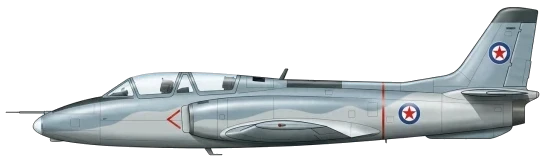
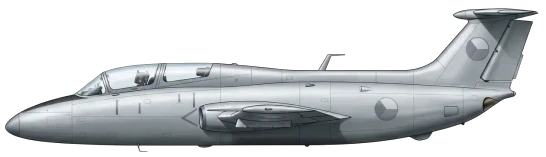
| G-2 Galeb | L-29 Delfin | |
|---|---|---|
| Origin country | 🇷🇸 Ex-Yugoslavia | 🇨🇿 Czechia |
| Category | Military Training Aircraft | Military Training Aircraft |
| Manufacturer | Soko | Aero |
| First flight | 31 July 1961 | 5 April 1959 |
| Year introduced | 1965 | 1961 |
| Number produced | 248 units | 3665 units |
| Average unit price | $180K | $200K |
| Wing area | 19.4 m² | 20.0 m² |
| Wingspan | 11.6 m | 10.3 m |
| Height | 3.3 m | 3.1 m |
| Length | 10.3 m | 10.8 m |
| Maximum speed | 812 km/h | 655 km/h |
| Operational range | 669 km | 894 km |
| Service ceiling | 12,000 m | 11,500 m |
| Max. takeoff weight | 4,300 kg | 3,540 kg |
| Empty weight | 2,620 kg | 2,280 kg |
| Total thrust | 1 x 1,134 kgf | 1 x 890 kgf |
Detailed Comparison
The SOKO G-2 Galeb and Aero L-29 Delfin represent parallel jet trainer developments from Yugoslavia and Czechoslovakia, respectively, during the Cold War. The Galeb, a product of Yugoslavia's non-aligned status, incorporated significant Western technology, notably its British Armstrong Siddeley Viper engine. The Delfin was a purely Eastern Bloc aircraft, designed for simplicity and mass production to become the standard trainer for the Warsaw Pact, a role it secured over competing Soviet and Polish designs. This fundamental difference in origin and strategic purpose dictated their design, performance, and operational history.
Development and Design
The G-2 Galeb was developed to replace the American-made T-33, reflecting a design philosophy geared towards a versatile trainer with a credible light-attack capability. Its construction involved a significant partnership with British firms for its engine, ejection seats, and avionics. Key features include a conventional stressed-skin structure, integral nose-mounted 12.7 mm machine guns, and a higher-thrust engine, pointing to a more performance-oriented design.
In contrast, the L-29 Delfin's design was driven by the Warsaw Pact's requirement for a rugged, easy-to-maintain trainer capable of operating from unprepared airstrips. This led to a simple airframe with manual flight controls, reinforced undercarriage, and a T-tail. Its success is marked by its selection as the standard alliance trainer and its vast production run of over 3,600 units, compared to the Galeb's 248. The Delfin's armament was secondary and pod-based, underscoring its primary role as an instructional aircraft.
Specifications and Performances
The Galeb's more powerful Viper engine gives it a distinct performance advantage. It produces 1134 kgf of thrust, enabling a maximum speed of 812 km/h and a climb rate of 22.8 m/s. The Delfin’s Motorlet M-701 engine, with 890 kgf of thrust, results in a lower maximum speed of 655 km/h and a climb rate of 14.0 m/s. While both aircraft feature straight wings suitable for training, the Galeb's superior thrust-to-weight ratio and aerodynamics made it a more agile platform. The Galeb’s armament is also more substantial, with two built-in machine guns and a 300 kg payload capacity on four hardpoints, compared to the Delfin's more limited, pod-based options.
Deployment and usage
The L-29 Delfin saw far more widespread service, becoming the foundational jet trainer for the Soviet Union and nearly all other Warsaw Pact nations, in addition to numerous Soviet-aligned countries. It was used in combat during the Yom Kippur War, the Nigerian Civil War, and the Nagorno-Karabakh War, where its use in ground-attack roles often resulted in significant losses to air defenses. The G-2 Galeb’s service was primarily with the Yugoslav Air Force, with limited exports to Libya and Zambia. It also saw combat, notably during the Bosnian War and the Libyan Civil Wars, where its dual-role capability was utilized for ground-attack missions.
Conclusion
The G-2 Galeb was a technically more advanced and higher-performance aircraft, a capable trainer and light-attack platform built in limited numbers to meet a national requirement with Western technological assistance. The L-29 Delfin, while inferior in performance, was a strategic success defined by its alignment with Warsaw Pact doctrine: it was a simple, rugged, and cost-effective trainer produced on a massive scale. Its purpose was to standardize pilot training across an entire military alliance, a role it fulfilled effectively for decades. The Galeb represents a more specialized, capable design, while the Delfin is a case study in utilitarian mass production for a specific, widespread need.


