G.91 Gina
Italian light fighter-bomber from the Cold War era, prominently deployed by NATO countries for close air support roles. Key figures: top speed 1,075 km/h, range 1,150 km, service ceiling 13,106 m, max takeoff weight 5,500 kg, unit price $1.6M, built 770.
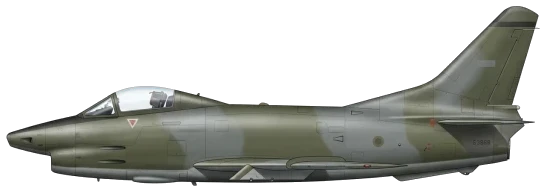
| Crew | 1 |
| Length | 10.3 m (33.8 ft) |
| Wingspan | 8.6 m (28.1 ft) |
| Height | 4 m (13.1 ft) |
| Wing area | 16.4 m² (176.5 sqft) |
| Empty weight | 3,100 kg (6,834 lbs) |
| Max. takeoff weight | 5,500 kg (12,125 lbs) |
| Powerplant | 1 × turbojet Bristol-Siddeley Orpheus 803 2,268 kgf each |
| Ejection seat | Martin-Baker Mk 6 |
| Maximum speed | 1075 km/h (668 mph) |
| Operational range | 1,150 km (715 mi) |
| Service ceiling | 13,106 m (42,999 ft) |
| Climb rate | 30.0 m/s (98.4 ft/s) |
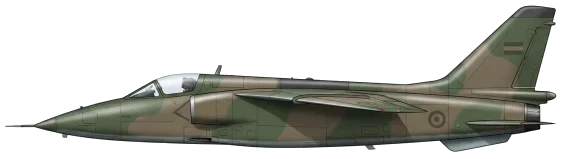
Description
The Fiat G.91 emerged from the NATO-organized NBMR-1 competition of 1953, which sought a light fighter-bomber for standardization among NATO air forces. Fiat Aviazione, later Aeritalia, designed the G.91 to meet these requirements, emphasizing lightweight construction and the ability to operate from austere airstrips, while remaining affordable compared to frontline fighters. The specified technical requirements included short takeoff distance, operation from semi-prepared surfaces, Mach 0.95 maximum speed, and a specified range while carrying armor and armament. A crucial element was the Bristol Siddeley Orpheus turbojet engine, selected for its balance of lightness, power, reliability, and ease of maintenance, with its development supported by the US Mutual Weapons Development Programme. The G.91 prototype achieved its maiden flight on 9 August 1956 and, after thorough evaluations, was declared the winner of the NBMR-1 competition, leading to initial orders for prototypes and pre-production aircraft. The G.91 remained in production for 19 years, totaling 756 aircraft.
Design
The Fiat G.91 is a lightweight tactical ground attack aircraft designed for simplicity and agility, capable of short-field operations from semi-prepared airstrips thanks to its rugged airframe and low-pressure tires on the undercarriage. The aircraft features an all-metal, semi-monocoque fuselage constructed in three sections. It houses radio navigation and communication equipment in the forward section. The armament bay, located beneath the cockpit, could accommodate up to four 12.7 mm M2 Browning machine guns with 300 rounds per gun, or alternatively, up to two 30 mm DEFA cannons with 120 rounds per cannon. Seven split fuel tanks are protected by armor plating. The cockpit is armored on three sides, equipped with a Martin-Baker Mk.4 ejector seat, and features both pressurization and manually controlled climate controls. Rockets and bombs could be carried, while gun pods and external drop tanks could be installed on hardpoints fitted on the wing. The G.91R/3 and R/4 variants had four under-wing pylon stations with a capacity of 680 kg, while the G.91R/1 variant could carry 500 kg. Provisions were made to carry combinations of 2× Matra rocket pods (each with 19× SNEB 68 mm rockets) or 18× Hispano SURA R80 80 mm rockets, 4× Nord AS-20 air-to-ground missiles or 4× AIM-9 Sidewinder air-to-air missiles, and a wide variety of air-to-ground ordnance including unguided iron bombs.
Operational History
The G.91 entered operational service with the Italian Air Force in 1961, followed by the West German Luftwaffe in 1962. The Portuguese Air Force also adopted the type, deploying it extensively during the Portuguese Colonial War in Angola and Mozambique for reconnaissance and close air support, employing rockets, napalm, and bombs against nationalist movements. Faced with arms embargoes, Portugal struggled to acquire further aircraft and even attempted a covert acquisition of G.91s through Switzerland and Spain, which was ultimately vetoed by Germany. The Luftwaffe, while initially intending to equip four wings with the G.91R/3, reportedly grew disillusioned with the aircraft's performance, leading to curtailed orders. The G.91 served until the early 1980s in Germany, when it was replaced by the Dassault/Dornier Alpha Jet. Italy phased out its last G.91 in 1995, while Portugal retired its fleet in 1993, marking the end of its operational use.
Variants
Main Variants:
-
G.91R/1: A light attack/reconnaissance aircraft, fitted with a modified nose housing three cameras.
-
G.91R/3: A single-seat ground-attack and reconnaissance version for the Luftwaffe, armed with two 30 mm DEFA cannons.
-
G.91R/4: Similar to the G.91R/3, but armed with four 12.7 mm Colt-Browning machine guns.
-
G.91T/1: A trainer version of the G.91R/1 developed for the Italian Air Force.
-
G.91PAN: An aerobatic display aircraft for the Frecce Tricolori, converted from pre-production G.91s.
Frequently Asked Questions
What type of aircraft is the G.91 Gina?
What is the maximum speed of the G.91 Gina?
What is the range of the G.91 Gina?
When did the G.91 Gina first fly?
How many G.91 Gina have been built?
Which countries operate the G.91 Gina?
How much does a G.91 Gina cost?
What is the service ceiling of the G.91 Gina?
- AUG 12026 Updated Manufacturer updated
- APR 72026 Updated Sources and cross-references refreshed