L-29 Delfin
Czechoslovakian jet trainer, utilized extensively during the Cold War, and exported broadly to Warsaw Pact and other nations. Key figures: top speed 655 km/h, range 894 km, service ceiling 11,500 m, max takeoff weight 3,540 kg, unit price $0.2M, built 3,665.
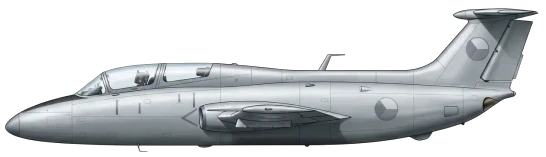
| Crew | 2 |
| Length | 10.8 m (35.5 ft) |
| Wingspan | 10.3 m (33.8 ft) |
| Height | 3.1 m (10.3 ft) |
| Wing area | 20 m² (215.3 sqft) |
| Empty weight | 2,280 kg (5,027 lbs) |
| Max. takeoff weight | 3,540 kg (7,804 lbs) |
| Powerplant | 1 × turbojet Motorlet M-701C 500 890 kgf each |
| Ejection seat | VS-1 BRI |
| Maximum speed | 655 km/h (407 mph) |
| Operational range | 894 km (556 mi) |
| Service ceiling | 11,500 m (37,730 ft) |
| Climb rate | 14.0 m/s (45.9 ft/s) |
Description
In the late 1950s, motivated by the Soviet Air Force's need for a jet-powered replacement for its piston-engine trainers and a goal to standardize a trainer aircraft across the Eastern Bloc, Aero initiated the design of a new jet. Led by Z. Rublič and K. Tomáš, the design aimed to fulfill both basic and advanced pilot training requirements within a single airframe, preparing pilots for contemporary frontline combat aircraft. Simplicity and ruggedness were central to the design philosophy, resulting in manual flight controls, large flaps, and perforated airbrakes on the fuselage sides. The L-29 was engineered with stable and docile flight characteristics and designed to operate from grass, sand, or unprepared fields.
Development
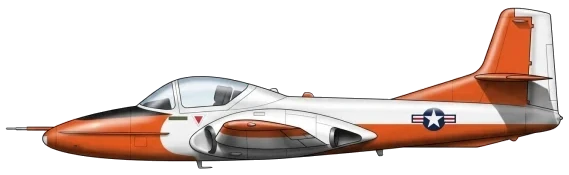
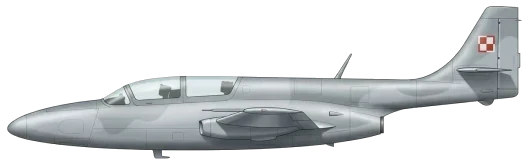
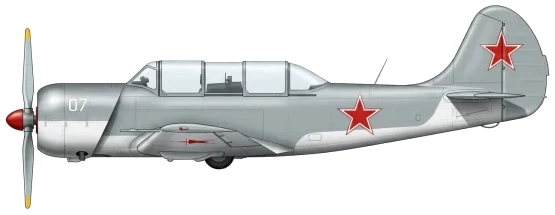
The XL-29 prototype first flew on 5 April 1959, initially powered by a British Bristol Siddeley Viper turbojet. Production aircraft were equipped with the Czech-designed Motorlet M701 engine. In 1961, the L-29 participated in an evaluation alongside the Polish PZL TS-11 Iskra and the Russian Yakovlev Yak-30 for selection as the standard Warsaw Pact trainer. The L-29 was selected, leading to its adoption by most Warsaw Pact countries, although Poland continued with the TS-11. Full-scale production commenced in April 1963 and ran for 11 years, yielding approximately 3,600 aircraft.
Design
The Aero L-29 Delfín features a straightforward design and construction with a mid-wing configuration and a T-tail arrangement. Its wings are unswept, and the engine air intakes are located within the wing roots. The undercarriage is reinforced for operations from austere surfaces. The aircraft's primary flying controls are manually operated, while the flaps and fuselage airbrakes are hydraulically actuated. Production models were powered by the Motorlet M-701 turbojet engine, which provides up to 1,960 lbf of thrust.
The cockpit is arranged in a tandem seating configuration for student and instructor, with each occupant having a separate canopy. The instructor's rear seat is slightly elevated to enhance forward visibility. Both seats are fitted with interlinked ejection systems designed to ensure synchronized operation.
Armament
Certain models of the L-29 could be equipped with external stores on underwing hardpoints. These could accommodate detachable pods, such as 7.62mm machine gun pods or pods containing up to four unguided rockets. Alternative weapon configurations included eight air-to-ground rockets or two 100 kg bombs.
Operational History
More than 2,000 L-29 Delfins were supplied to the Soviet Air Force, where it received the NATO reporting name "Maya." Serving as a foundational jet trainer, the aircraft enabled air forces to implement "all-through" jet training regimes, encompassing basic, intermediate, and weapons training roles. The type saw combat use, including attack missions by Egyptian L-29s during the Yom Kippur War in 1973 and deployment in the Nigerian Civil War in the late 1960s. Azeri forces utilized the type extensively for ground attack during the First Nagorno-Karabakh War, where they experienced significant losses to air defenses. The L-29 was eventually succeeded in service by the Aero L-39 Albatros, although both types were frequently operated concurrently for a period.
Variants
Main Variants:
-
L-29: The standard two-seat jet trainer variant.
-
L-29A Akrobat: A single-seat version specifically designed for aerobatic flight.
-
L-29R: An armed reconnaissance variant featuring downward-looking cameras in the rear cockpit, development of which was terminated in 1965.
Frequently Asked Questions
What type of aircraft is the L-29 Delfin?
What is the maximum speed of the L-29 Delfin?
What is the range of the L-29 Delfin?
When did the L-29 Delfin first fly?
How many L-29 Delfin have been built?
Which countries operate the L-29 Delfin?
How much does a L-29 Delfin cost?
What is the service ceiling of the L-29 Delfin?
- APR 72026 Updated Sources and cross-references refreshed
- APR 52026 Updated Ejection seat added
- JAN 122026 Updated Range updated in a site-wide editorial pass