Hawker 800 vs King Air 90
Hawker 800 vs King Air 90 at a glance — top speed 830 vs 494 km/h, range 5,232 vs 2,446 km, max takeoff weight 12,701 vs 5,352 kg, built 650 vs 3,100 units.
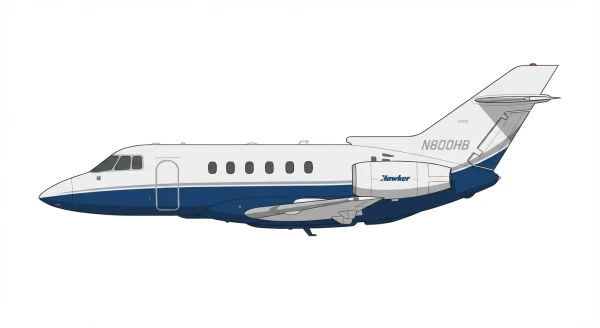
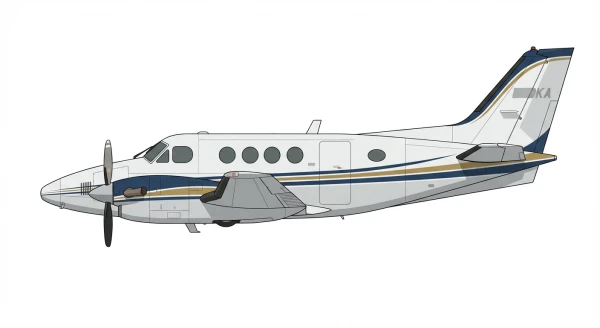
| Hawker 800 | King Air 90 | |
|---|---|---|
| Origin country | 🇺🇸 United States | 🇺🇸 United States |
| Category | Military Special Mission Aircraft | Military Special Mission Aircraft |
| Manufacturer | Hawker Beechcraft | Beechcraft |
| First flight | 26 June 1983 | 1 January 1964 |
| Year introduced | 1983 | 1964 |
| Number produced | 650 units | 3100 units |
| Average unit price | $13.8 million | -- |
| Wing area | -- m² | 26.0 m² |
| Wingspan | 16.6 m | 13.8 m |
| Height | 5.5 m | 4.7 m |
| Length | 15.6 m | 11.9 m |
| Maximum speed | 830 km/h | 494 km/h |
| Operational range | 5,232 km | 2,446 km |
| Service ceiling | 12,497 m | 7,574 m |
| Max. takeoff weight | 12,701 kg | 5,352 kg |
| Empty weight | 7,108 kg | 3,217 kg |
| Total thrust | 2 x 2,114 kgf | 2 x 626 kW |
Detailed Comparison
The Hawker 800 and King Air 90 occupy opposite ends of the special mission spectrum: one provides a high-altitude, pressurized sanctuary for strategic sensor suites, while the other serves as a tactical mule for austere environments. While both originated as civilian executive transports, their military adaptations reveal divergent operational priorities. The Hawker focuses on standoff capability and speed, whereas the King Air prioritizes rough-field accessibility and logistical footprint.
Development and Design
The Hawker 800 lineage, derived from the de Havilland/BAe 125, emphasizes transcontinental range and cruise efficiency. Its monocoque structure and swept-wing design were optimized for the civilian mid-size jet market. However, the military value lies in the BAe 125-800's internal volume and payload capacity (907 kg), allowing integration of heavy distinct consoles for SIGINT or SAR equipment without compromising the center of gravity. The transition to glass cockpits and TFE731 turbofans in the 800 series reduced pilot workload, a critical factor for long-endurance ISR missions.
Conversely, the King Air 90 evolved from the piston-engined Queen Air, inheriting a rugged, straight-wing design. Beechcraft’s decision to mate the airframe with turboprops—predominantly the Pratt & Whitney PT6A (though the provided data references Garrett TPE331s, the PT6 remains the fleet standard)—created the definitive utility turboprop. The cabin cross-section is smaller than the Hawker's, but the design philosophy favors modularity. Features like the cargo door and heavy-duty floor structure in later Model 90 variants allow for rapid reconfiguration between personnel transport, medical evacuation, and sensor operation, a flexibility the dedicated Hawker configuration lacks.
Specifications and Performance
The performance gap dictates mission profiles. The Hawker 800’s service ceiling of 12,497 m (41,000 ft) and max speed of 830 km/h allow it to operate above most commercial traffic and weather, providing line-of-sight advantages for SIGINT interceptors and radar horizons. Its 5,232 km range enables loitering capabilities required for border surveillance, such as the ROKAF’s operations along the DMZ.
The King Air 90 trails significantly in kinematics, with a ceiling of 7,574 m and speed of 494 km/h. However, these metrics are irrelevant for its primary tactical role. The King Air's advantage is field performance. It operates from runways shorter than 4,000 feet, often unpaved, where the Hawker’s swept wings and lower-slung engines would risk FOD ingestion or runway overrun.
Deployment and Usage
Operational history favors the Hawker 800 for strategic, high-value asset roles. The Republic of Korea Air Force (ROKAF) utilizes the RC-800 specifically for tactical aerial reconnaissance and SIGINT, leveraging its altitude to peer deep into North Korean territory. Similarly, the Japan Air Self-Defense Force (JASDF) employs the U-125A variant for maritime search and rescue, where speed is essential to reach casualty sites before surface vessels.
The King Air 90’s military pedigree was forged in Vietnam with the U-21 Ute (unpressurized Model 90 derivative). These aircraft conducted direction-finding and signal interception missions (Project Left Bank) in active combat zones. The platform's survivability and ease of maintenance led to widespread proliferation, including the JMSDF’s TC-90 trainer fleet and transfer of LC-90s to the Philippines for maritime patrol. The King Air is utilized where the risk of ground fire or primitive infrastructure prohibits the use of jet assets.
Conclusion
The Hawker 800 is the superior platform for dedicated Intelligence, Surveillance, and Reconnaissance (ISR) and maritime patrol where standoff range and time-on-station are paramount. Its ability to carry complex sensor suites to 41,000 feet makes it indispensable for national-level strategic monitoring.
The King Air 90 holds the edge in tactical utility and counter-insurgency support. For operators requiring a multi-role airframe capable of landing on dirt strips in the Pacific or Africa, the Hawker’s runway requirements are a liability. The King Air remains the cost-effective choice for air forces needing a rugged, deployable asset for logistics and tactical electronic warfare.