J-35 Draken vs MiG-21 Fishbed
J-35 Draken vs MiG-21 Fishbed at a glance — top speed 2,120 vs 2,125 km/h, range 2,750 vs 660 km, max takeoff weight 16,000 vs 8,625 kg, built 651 vs 11,496 units.
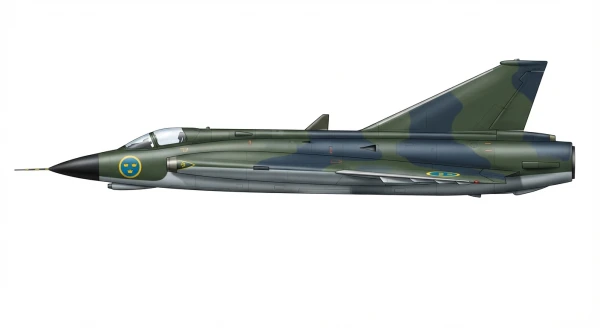
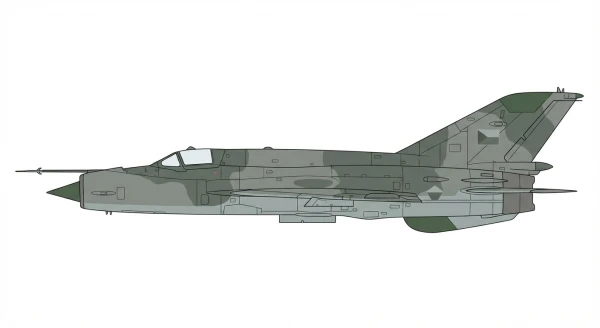
| J-35 Draken | MiG-21 Fishbed | |
|---|---|---|
| Origin country | 🇸🇪 Sweden | 🇷🇺 Ex-USSR |
| Category | Combat Aircraft | Combat Aircraft |
| Manufacturer | Saab | Mikoyan-Gurevich |
| First flight | 25 October 1955 | 16 June 1955 |
| Year introduced | 1959 | 1958 |
| Number produced | 651 units | 11496 units |
| Average unit price | $2.5 million | $2 million |
| Wing area | 49.2 m² | 23.0 m² |
| Wingspan | 9.4 m | 7.2 m |
| Height | 3.9 m | 4.1 m |
| Length | 15.3 m | 13.5 m |
| Maximum speed | 2120 km/h | 2125 km/h |
| Operational range | 2,750 km | 660 km |
| Service ceiling | 20,000 m | 19,000 m |
| Max. takeoff weight | 16,000 kg | 8,625 kg |
| Empty weight | 7,865 kg | 4,871 kg |
| Total thrust | 1 x 7,995 kgf | 1 x 4,689 kgf |
Detailed Comparison
The Saab J-35 Draken and Mikoyan-Gurevich MiG-21 Fishbed emerged simultaneously in the mid-1950s as second-generation supersonic interceptors designed to counter the threat of high-altitude strategic bombers. While both utilized delta wing configurations to achieve Mach 2 speeds, they diverged significantly in operational doctrine: the Draken prioritized dispersed operations and ruggedness for Swedish neutrality, whereas the MiG-21 focused on mass producibility, lightweight interception, and exportability for the Soviet sphere of influence.
Development and Design
Saab’s primary innovation was the double-delta wing, a distinct configuration where the inner wing (80° sweep) housed fuel and landing gear, while the outer wing (57° sweep) provided lift for low-speed handling. This design was specifically engineered for Sweden's BAS 60 doctrine, allowing the J-35 to operate from 650-meter reinforced road sections while maintaining supersonic capabilities.
In contrast, the MiG-21 employed a traditional tailed delta planform with a nose shock cone intake. It was designed as a "pencil with wings"—lightweight and minimal drag. While this allowed for exceptional agility and speed, the small airframe restricted cockpit visibility and resulted in difficult handling during takeoff and landing due to high landing speeds. The Draken eventually integrated complex fire-control systems (J-35F), whereas early MiG-21s relied on ground-controlled interception (GCI) with relatively austere onboard avionics.
Specifications and Performance
While both aircraft achieve comparable maximum speeds near 2,120 km/h (Mach 2), their endurance profiles differ drastically. The J-35 demonstrates superior operational range at 2,750 km, facilitated by the large internal fuel volume inherent to its blended body design and a higher maximum takeoff weight of 16,000 kg.
The MiG-21, limited by a compact 8,625 kg MTOW and small airframe, suffers from a short combat radius of roughly 660 km, categorizing it strictly as a point-defense interceptor. The Draken’s Volvo RM6C engine provided higher dry thrust (5,759 kgf) compared to the MiG's Tumansky R-11 (4,689 kgf), though the MiG's lighter weight preserved a competitive thrust-to-weight ratio for climbing intercepts.
Deployment and usage
The MiG-21 became the most produced supersonic jet in history (over 11,000 units), seeing extensive combat in Vietnam, the Middle East, and the Indo-Pakistani wars. Its usage spanned from air superiority to ground attack, utilizing "hit-and-run" tactics effectively against technically superior US fighters like the F-4 Phantom. It became the standard fighter for over 60 nations.
The Draken saw no active combat. Its deployment was limited to Sweden, Denmark, Finland, and Austria. Its service life was defined by armed neutrality, patrolling Baltic airspace, and conducting specialized reconnaissance (S-35E). However, the Draken’s ability to operate from road bases validated a dispersed air force concept that remains central to Swedish defense strategy.
Conclusion
The MiG-21 Fishbed succeeded through ubiquity and cost-efficiency ($2.0 million), offering a reliable, upgradeable platform that democratized supersonic flight for the Eastern Bloc and non-aligned nations. The J-35 Draken ($2.5 million), while aerodynamically superior and possessing better endurance and avionics, remained a high-end, niche solution tailored specifically to the unique logistical and geographical constraints of Scandinavian defense.