J-7 Fishcan vs J-8 Finback
J-7 Fishcan vs J-8 Finback at a glance — top speed 2,200 vs 2,300 km/h, range 2,200 vs 1,000 km, max takeoff weight 9,100 vs 18,879 kg, built 2,400 vs 408 units.
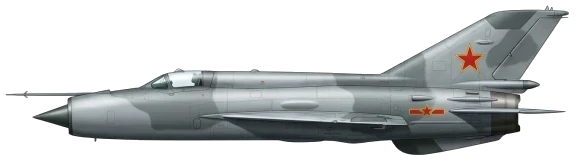
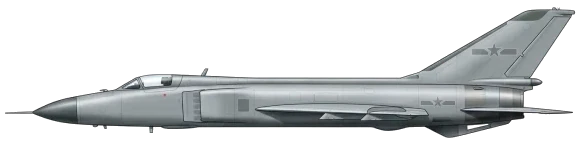
| J-7 Fishcan | J-8 Finback | |
|---|---|---|
| Origin country | 🇨🇳 China | 🇨🇳 China |
| Category | Combat Aircraft | Combat Aircraft |
| Manufacturer | Chengdu | Shenyang |
| First flight | 17 January 1966 | 5 July 1969 |
| Year introduced | 1966 | 1980 |
| Number produced | 2400 units | 408 units |
| Average unit price | $2 million | $15 million |
| Wing area | 24.9 m² | -- m² |
| Wingspan | 8.3 m | 9.3 m |
| Height | 4.1 m | 5.4 m |
| Length | 14.0 m | 21.5 m |
| Maximum speed | 2200 km/h | 2300 km/h |
| Operational range | 2,200 km | 1,000 km |
| Service ceiling | 17,500 m | 18,000 m |
| Max. takeoff weight | 9,100 kg | 18,879 kg |
| Empty weight | 5,292 kg | 10,371 kg |
| Total thrust | 1 x 6,598 kgf | 2 x 6,999 kgf |
Detailed Comparison
The Chengdu J-7 Fishcan and Shenyang J-8 Finback illustrate two distinct stages in China's combat aircraft development, originating from the same Soviet MiG-21 design but fulfilling different operational requirements. The J-7 is a direct, license-produced copy of the MiG-21, serving as a low-cost, mass-produced point-defense interceptor and light fighter. In contrast, the J-8 is a more ambitious, indigenous Chinese design that enlarged the MiG-21 airframe and incorporated a twin-engine configuration to create a specialized high-altitude, long-range interceptor.
Development and Design
The J-7's development was a straightforward reverse-engineering and licensed production of the Soviet MiG-21F-13. Its design is characterized by simplicity and function: a single-engine, delta-wing airframe with a nose intake cone housing a small ranging radar. This configuration, while effective for a light fighter, severely limited its avionics and growth potential. The J-8 program began because the J-7 was deemed insufficient for long-range interception. Its key design evolution was the transition from the initial J-8 "Finback-A," which retained the J-7's nose intake, to the substantially redesigned J-8B "Finback-B". This later variant featured lateral air intakes and a solid ogival radome, allowing for the installation of a much larger and more capable Type 208 pulse-Doppler radar. This shift enabled true all-weather, beyond-visual-range (BVR) engagements, a capability the J-7's airframe could never effectively accommodate.
Specifications and Performances
The J-8’s larger, twin-engine design yields superior performance in metrics crucial for an interceptor. It is significantly heavier, with an empty weight of 10,371 kg compared to the J-7's 5,292 kg. This allows it to carry more fuel and a heavier payload. Consequently, the J-8 achieves a higher maximum speed (2,300 km/h vs. 2,200 km/h), service ceiling (18,000 m vs. 17,500 m), and a considerably faster rate of climb (224 m/s vs. 195 m/s). While the J-7 is agile, its operational reach is limited by its 850 km combat range. The J-8 was explicitly designed to exceed this limitation. Furthermore, the J-8B's seven hardpoints and more advanced radar allowed it to carry a more versatile and potent weapon load, including semi-active radar-homing BVR missiles like the PL-11, which were beyond the capabilities of most J-7 variants.
Deployment and usage
The two aircraft had vastly different service profiles. With over 2,400 units built, the J-7 was the workhorse of the PLAAF for decades and was widely exported, serving primarily in an air defense role. It has seen limited combat with various export customers. The J-8, with approximately 408 units produced, was a more specialized asset retained almost exclusively for domestic use by the PLAAF and PLANAF. It was tasked with intercepting strategic bombers and reconnaissance aircraft over China's territory and maritime claims. The J-8 is most noted for the 2001 incident involving a collision with a U.S. Navy EP-3 aircraft, which underscored its role as a frontline national defense interceptor.
Conclusion
The J-7 Fishcan was a pragmatic and successful solution that provided China with a massive fleet of capable second-generation fighters. The J-8 Finback, however, represents a more significant technological and strategic undertaking. While derived from the same lineage, it was an indigenous effort to create a higher-tier platform to address specific national security challenges that the J-7 could not. Although both designs are now largely relegated to secondary roles, the J-7’s legacy is its mass production and proliferation, while the J-8 stands as a critical stepping stone in China’s path toward developing more complex and independent combat aircraft.


