J-7 Fishcan vs MiG-21 Fishbed
J-7 Fishcan vs MiG-21 Fishbed at a glance — top speed 2,200 vs 2,125 km/h, range 2,200 vs 660 km, max takeoff weight 9,100 vs 8,625 kg, built 2,400 vs 11,496 units.
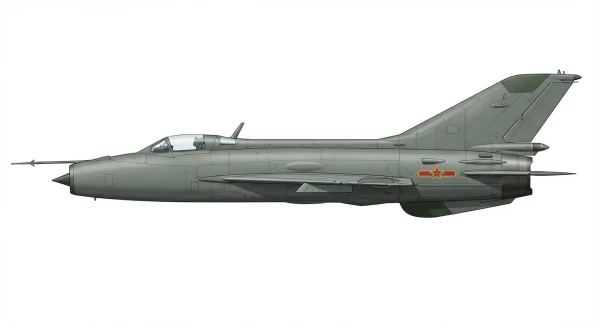
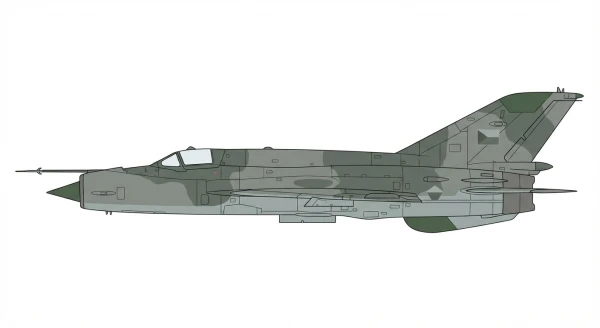
| J-7 Fishcan | MiG-21 Fishbed | |
|---|---|---|
| Origin country | 🇨🇳 China | 🇷🇺 Ex-USSR |
| Category | Combat Aircraft | Combat Aircraft |
| Manufacturer | Chengdu | Mikoyan-Gurevich |
| First flight | 17 January 1966 | 16 June 1955 |
| Year introduced | 1966 | 1958 |
| Number produced | 2400 units | 11496 units |
| Average unit price | $2 million | $2 million |
| Wing area | 24.9 m² | 23.0 m² |
| Wingspan | 8.3 m | 7.2 m |
| Height | 4.1 m | 4.1 m |
| Length | 14.0 m | 13.5 m |
| Maximum speed | 2200 km/h | 2125 km/h |
| Operational range | 2,200 km | 660 km |
| Service ceiling | 17,500 m | 19,000 m |
| Max. takeoff weight | 9,100 kg | 8,625 kg |
| Empty weight | 5,292 kg | 4,871 kg |
| Total thrust | 1 x 6,598 kgf | 1 x 4,689 kgf |
Detailed Comparison
The Chengdu J-7 Fishcan serves as a direct derivative of the Soviet Mikoyan-Gurevich MiG-21 Fishbed, resulting from a technology transfer agreement that preceded the Sino-Soviet split. While the MiG-21 established the baseline for a lightweight, supersonic interceptor in the Cold War era, the J-7 represents China's indigenous effort to sustain and evolve that specific airframe platform over decades of isolation from Soviet technical support.
Development and Design
The MiG-21 was engineered as a response to Western Mach 2 fighters like the F-104, prioritizing speed and climb rate via a tailed delta-wing configuration and a turbojet engine. Its pencil-thin fuselage minimized drag but severely restricted fuel capacity and avionics space. The J-7 initially mirrored the MiG-21F-13, but the 1960s geopolitical rift forced Chengdu to reverse-engineer components. A critical design divergence occurred with the J-7E variant, which introduced a double-delta wing. This Chinese innovation significantly improved low-speed handling and turning rates compared to the original Soviet planform, addressing the MiG-21's notorious instability during takeoff and landing. While the MiG-21 evolved through heavier avionics and weapon loads (e.g., MiG-21bis), the J-7 focused on aerodynamic refinement.
Specifications and Performances
Performance metrics highlight the J-7's evolution into a slightly heavier platform. The J-7 possesses a Maximum Takeoff Weight (MTOW) of 9,100 kg, roughly 500 kg heavier than the MiG-21's 8,625 kg. Despite the added weight, the J-7 achieves a marginally higher top speed of 2,200 km/h against the MiG-21's 2,125 km/h, likely due to engine upgrades like the WP-13F compared to the Tumansky R-11 series. However, the Soviet original maintains superiority in high-altitude interception, boasting a service ceiling of 19,000 m compared to the J-7's 17,500 m. Both airframes suffer from critically limited operational range—850 km for the J-7 and 660 km for the MiG-21—necessitating a heavy reliance on ground-controlled interception (GCI) and external fuel tanks.
Deployment and usage
The MiG-21 holds the distinction of being the most produced supersonic jet in history, seeing intense combat in Vietnam, the Middle East, and Africa. Its versatility allowed it to function as both an interceptor and a ground-attack platform using unguided munitions. Conversely, the J-7 served primarily with the PLAAF as an airspace defender. While exported effectively as the F-7 (notably to Pakistan), its combat record is less extensive than its Soviet progenitor. The J-7's later variants, however, integrated modern avionics and HOTAS controls, allowing it to serve as a low-cost transitional trainer for fourth-generation tactics long after the MiG-21 had retired from many frontline services.
Conclusion
The MiG-21 Fishbed defined an era of Soviet aviation dominance through sheer numbers and raw speed, proving effective in asymmetric warfare against technologically superior foes. The J-7 Fishcan, while born as a license-built copy, successfully corrected specific aerodynamic flaws of the original design through the double-delta modification. Ultimately, both platforms are obsolete in modern BVR (Beyond Visual Range) environments due to small radar cross-sections and limited sensor ranges, yet they remain viable solutions for nations requiring economical airspace policing and lead-in fighter training.