J-7 Fishcan
Chinese jet fighter, notable for usage in the late Cold War era, widely deployed in the Third Taiwan Strait Crisis. Key figures: top speed 2,200 km/h, range 2,200 km, service ceiling 17,500 m, max takeoff weight 9,100 kg, unit price $2M, built 2,400. In service with 12 air forces as of 2026 — China (200), Pakistan (73), Bangladesh (46) and 9 others.
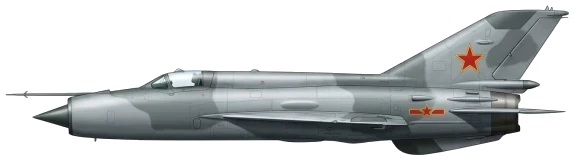
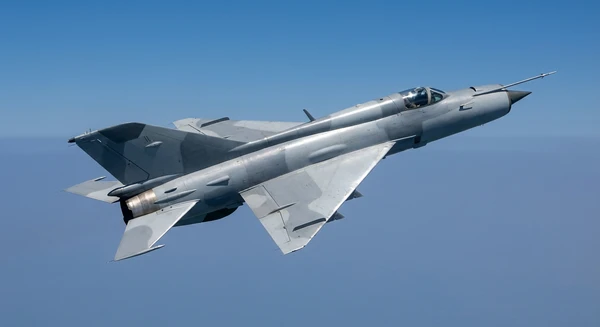
| Crew | 1 |
| Length | 14.0 m (45.8 ft) |
| Wingspan | 8.3 m (27.3 ft) |
| Height | 4.1 m (13.5 ft) |
| Wing area | 24.9 m² (267.8 sqft) |
| Empty weight | 5,292 kg (11,667 lbs) |
| Max. takeoff weight | 9,100 kg (20,062 lbs) |
| Powerplant | 1 × Liyang Wopen-13F afterburning turbojet 6,598 kgf each |
| Ejection seat | HTY-2 |
| Maximum speed | 2200 km/h (Mach 2.1) |
| Operational range | 2,200 km (1,367 mi) |
| Service ceiling | 17,500 m (57,415 ft) |
| Climb rate | 195.0 m/s (639.8 ft/s) |
-
 China
200
-
 Pakistan
73
-
 Bangladesh
46
-
 Myanmar
35
-
 North Korea
30
-
 Iran
28
- 🇹🇿 Tanzania 13
-
 Sudan
12
- 🇳🇦 Namibia 11
-
 Zimbabwe
11
-
 Nigeria
6
-
 Sri Lanka
5
Recent Events — J-7 Fishcan
8 events →-
MAY 202026
 Pakistan
FT-7PG advanced trainer crashed in Kamarmashani area near Mianwali during training sortie; both pilots ejected safely with injuries.
Crash
-
MAR 212026
 Iran
F-7 destroyed by US CENTCOM strike at Shahid Sadooghi Airport, Yazd.
Destroyed
-
MAR 92026
Iran
×9
Nine F-7N Airguard fighters destroyed at Isfahan Shahid Beheshti Airport by Israeli airstrikes; confirmed by satellite imagery.
Destroyed
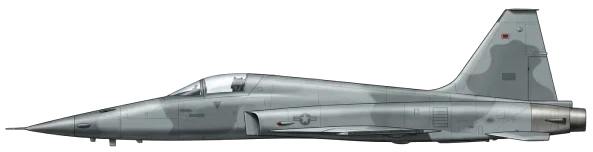
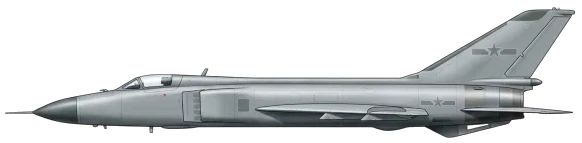
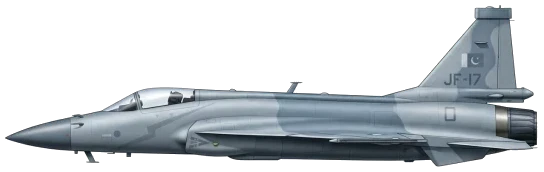
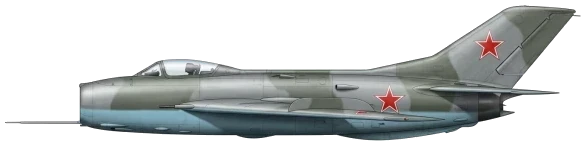
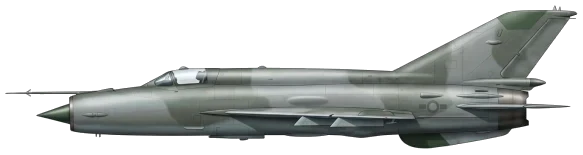
Description
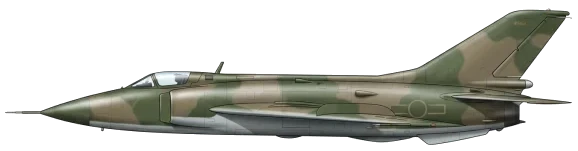
The Chengdu J-7 (NATO reporting name Fishcan, exported as the F-7) is a Chinese single-seat supersonic fighter derived from the Soviet MiG-21F-13. Licensed in 1962 and largely reverse-engineered after the Sino-Soviet split, it was built from 1964 to May 2013 — some 2,400 aircraft with more than 20 export variants — and became one of China's most widely exported combat aircraft. The People's Liberation Army Air Force (PLAAF) retired its last single-seat J-7s in 2023, but the type still flies with about a dozen air forces, Pakistan and Bangladesh the largest, and Iranian F-7s were destroyed on the ground in the 2026 Iran war.
Development
After the MiG-19 (built at Shenyang as the J-6 from 1958), the MiG-21 — cheap, fast and suited to the doctrine of mass "people's fighter" formations — was the obvious next step, but the Sino-Soviet split halted cooperation when Moscow withdrew its advisers in the summer of 1960. In February 1962 the Soviet leadership unexpectedly offered the MiG-21 again, and a technology transfer agreement was signed on 30 March 1962.
Complete aircraft, MiG-21F kits and documents reached Shenyang about five months later, but the documentation was incomplete and several components unusable, so Chinese engineers re-engineered the aircraft, resolving 249 major problems and reconstructing eight missing documents. The hydraulic system was a particular weakness, at one point grounding up to 70 per cent of some squadrons. The fuel system was rearranged — the MiG-21 became longitudinally unstable after about 45 minutes as its forward tanks emptied — and the Soviet ejection seat and forward-hinged canopy gave way to a rear-hinged canopy jettisoned before ejection.
Production began in March 1964, but the Cultural Revolution left early output slow and poor, and full domestic manufacture, engine included, came only in the 1980s, when the aircraft finally matched the Soviet original — by which time the F-16 considerably outclassed it. The programme's experience fed into the twin-engined Shenyang J-8 interceptor. Production ended in May 2013 with the last F-7BGI for Bangladesh, after almost 50 years.
Design
The J-7 keeps the MiG-21's layout: a tubular fuselage with a nose intake and radar-carrying shock cone, a tailed delta wing and a single afterburning turbojet. The late J-7MG/F-7MG generation uses the Liyang WP-13F rated at 14,500 lbf (64.7 kN) with afterburner, giving a Mach 2-class top speed, a service ceiling of 57,400 ft (17,500 m) and a ferry range of around 2,200 km (1,370 mi) with external tanks.
The J-7E of 1987 introduced the double-delta wing — reduced outboard sweep adding area and fuel — credited with roughly 45 per cent better manoeuvrability and much shorter field lengths. It was the first MiG-21 derivative with HOTAS controls, a multifunction display and a helmet-mounted sight, several of them British; the pilot cues the PL-8/Python 3 through either the sight or the radar, not both. Export avionics drove later development: the F-7M's Marconi radar suffered from ground clutter, and in 1984 Pakistani F-16 pilots helped Chinese engineers master ground-mapping radar. The F-7MP and F-7PG then adopted the Italian FIAR Grifo-7, more than tripling detection range, and the J-7G carries the Chinese KLJ-6E, thought to be developed from the Grifo 7.
Armament
Two 30 mm Type 30-1 cannon with 60 rounds each sit in the lower fuselage. Five hardpoints — four under the wings rated at 1,100 lb (500 kg) each and a centreline station usually taken by a drop tank — carry PL-2, PL-5, PL-7, PL-8 and PL-9 infrared-guided missiles; export aircraft have been wired for the R.550 Magic and AIM-9 Sidewinder. Air-to-ground stores are limited to 55 mm and 90 mm rocket pods and unguided bombs of 50 to 500 kg. There is no beyond-visual-range weapon.
Operational History
Chinese service
The J-7 entered PLAAF service in 1966 and was long one of its most numerous fighters, assigned to local air defence and tactical air superiority in large formations. From the mid-1990s the J-7B gave way to the J-7E, and the J-7G, the final Chinese version, entered service in 2003. Withdrawal began in 2018 and the last single-seat fighters left service in 2023, completing the PLAAF's transition to an all fourth- and fifth-generation combat fleet. The two-seat JJ-7 remains in the training inventory, about 200 as of 2026, and is the basis of the Guizhou JL-9.
Export customers and the Cold War
Albania flew 12 F-7As from 1969 to 2004; Tanzania's were the backbone of its fighter force in the 1978–79 war against Uganda. Iraq acquired about 100 F-7Bs and 60 F-7Ms through Jordan in the 1980s, used them only as trainers, and lost the fleet in 2003. Iran bought F-7s in the same decade despite Chinese denials of direct supply. Up to 21 went to the United States in 1982–87 as MiG-21 surrogates for the 4477th Test and Evaluation Squadron.
Africa and Asia since 1990
Myanmar formed four F-7 squadrons in the 1990s, later upgraded with Chinese and reportedly Israeli help; Sudan bought around 20 during its civil war. Zimbabwe's F-7s never fought in the Second Congo War for want of ground radar control; a January 2001 funeral flypast in Kinshasa cost one aircraft and damaged two. Sri Lanka, refused Western attack aircraft, took a small batch of F-7BS in 1991 for ground attack against the LTTE and six F-7Gs in 2008; on 9 September 2008 an F-7G was credited with downing a rebel Zlín-143 with an air-to-air missile. Namibia took 12 F-7NM/FT-7NM from 2006 and Nigeria 12 F-7NI and three FT-7NI in 2008. Pakistan, the largest foreign operator, flew the F-7P from 1989 and the Grifo-equipped F-7PG across numerous squadrons; the Sabre II redesign of the 1980s was abandoned, and the separately developed JF-17 Thunder is progressively replacing the F-7.
The 2020s
The decade has brought losses rather than combat use. A Myanmar Air Force F-7M crashed into a monastery in Pale Township, Sagaing Region, on 10 June 2025 while striking resistance positions, killing the pilot and five villagers; the military blamed engine failure, resistance forces claimed a shoot-down, and independent analysts could not settle the cause. In the 2026 Iran war Iranian F-7s were destroyed on the ground: Israeli strikes on Isfahan's Shahid Beheshti airport from 7 March destroyed nine F-7N Airguards alongside several F-14s, confirmed by satellite imagery on 9 March, and a US Central Command strike on Shahid Sadooghi airport at Yazd on 21 March destroyed one more — some 40 per cent of Iran's pre-war single-seat fleet.
Operators
As of 2026 Pakistan remains the largest user with about 53 F-7PG fighters and 21 FT-7 trainers. Bangladesh flies some 35 F-7BG/BGI and 12 FT-7, North Korea around 30 F-7s with poor serviceability, Myanmar 18 F-7 and 6 FT-7, Iran about 14 F-7 and 14 FT-7 after the 2026 losses, Sudan about 12, and Tanzania 11 J-7G and 2 FT-7TN. Namibia, Zimbabwe, Nigeria and Sri Lanka keep a squadron or less each. China, Albania, Iraq, Egypt and the United States are former operators of the single-seat fighter.
Accidents
Recent losses cluster in the trainer fleets: Pakistani FT-7s crashed near Mianwali in January 2020 (both pilots killed) and on 20 May 2026 (both ejected), an Iranian FT-7 killed two pilots near Anarak in May 2022, and a Zimbabwean J-7 was lost to an in-flight fire near Gweru on 30 May 2025. The deadliest came on 21 July 2025, when a Bangladesh Air Force FT-7BGI crashed into a school campus in Dhaka, killing at least 35 people, including the pilot, and injuring more than 170.
Variants
- J-7 / J-7I: Initial copies of the MiG-21F-13 with twin 30 mm cannon; the J-7I brought incremental airframe and ejection-seat improvements.
- J-7II / F-7B: Rear-hinged canopy, belly fuel tank and uprated WP-7B engine; the main export base of the 1980s. Exported as the F-7B, notably to Iraq.
- J-7E / F-7MG: 1987 double-delta wing, WP-13F engine, HOTAS and helmet-mounted sight; the main PLAAF version from the mid-1990s.
- J-7G: Final Chinese version with the KLJ-6E radar; exported to Tanzania.
- F-7M Airguard / F-7MP / F-7P: Export models with Western avionics — a Marconi radar on the F-7M, the Grifo-7 and Sidewinder on the Pakistani F-7MP/P.
- F-7PG / F-7NM / F-7NI / F-7BG: Double-delta export fighters with Grifo-series radar for Pakistan, Namibia, Nigeria and Bangladesh.
- F-7BGI: Last production variant and the most advanced of the family; 16 delivered to Bangladesh in 2012–13.
- JJ-7 / FT-7: Tandem two-seat trainer, exported in matching sub-variants (FT-7P, FT-7PG, FT-7MB, FT-7BGI, FT-7NI).
- Unmanned conversions: Target drones and decoys from retired J-7s, shown at Zhuhai in 2018.
Identified in 4 sorties in the official China-Taiwan Tensions activity reports between 2021 and 2021 — a floor, not a census: only sorties the source identified by type are counted, and how much it disclosed varies by year.
Frequently Asked Questions
What type of aircraft is the J-7 Fishcan?
What is the maximum speed of the J-7 Fishcan?
What is the range of the J-7 Fishcan?
When did the J-7 Fishcan first fly?
How many J-7 Fishcan have been built?
Which countries operate the J-7 Fishcan?
How much does a J-7 Fishcan cost?
What is the service ceiling of the J-7 Fishcan?
- OCT 52026 Updated Description overhauled: PLAAF retirement in 2023, end of production in 2013, export operators and 2026 losses in Iran
- AUG 122026 Updated Range corrected to the ferry range
- AUG 52026 Updated Thrust updated
- JUL 232026 Updated Sources and cross-references refreshed
- APR 72026 Updated Picture credits updated in a site-wide editorial pass
- APR 52026 Updated Ejection seat added
- OCT 222023 Updated Specifications and description reviewed