J-35 Draken vs JA 37 Viggen
J-35 Draken vs JA 37 Viggen at a glance — top speed 2,120 vs 2,231 km/h, range 2,750 vs 1,820 km, max takeoff weight 16,000 vs 20,000 kg, built 651 vs 329 units.
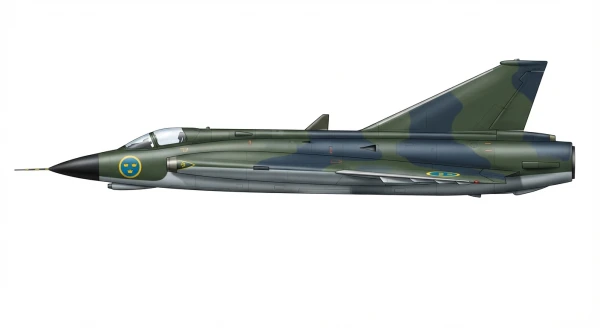
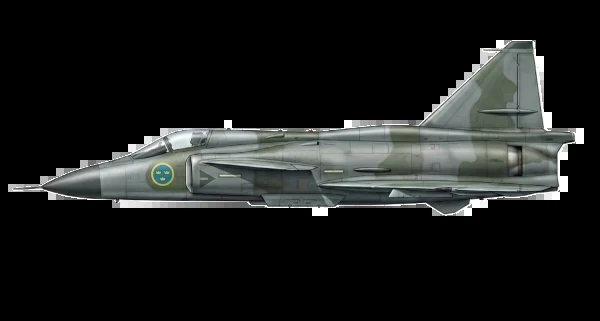
| J-35 Draken | JA 37 Viggen | |
|---|---|---|
| Origin country | 🇸🇪 Sweden | 🇸🇪 Sweden |
| Category | Combat Aircraft | Combat Aircraft |
| Manufacturer | Saab | Saab |
| First flight | 25 October 1955 | 8 February 1967 |
| Year introduced | 1959 | 1971 |
| Number produced | 651 units | 329 units |
| Average unit price | $2.5 million | $5 million |
| Wing area | 49.2 m² | 46.0 m² |
| Wingspan | 9.4 m | 10.6 m |
| Height | 3.9 m | 5.9 m |
| Length | 15.3 m | 16.4 m |
| Maximum speed | 2120 km/h | 2231 km/h |
| Operational range | 2,750 km | 1,820 km |
| Service ceiling | 20,000 m | 18,000 m |
| Max. takeoff weight | 16,000 kg | 20,000 kg |
| Empty weight | 7,865 kg | 9,500 kg |
| Total thrust | 1 x 7,995 kgf | 1 x 12,746 kgf |
Detailed Comparison
Sweden’s procurement of the J-35 Draken and the JA 37 Viggen charts a physical transition in Flygvapnet doctrine from pure high-altitude point defense to a digitally integrated interceptor force. The Draken was built to intercept Soviet bombers using a double-delta wing, while the Viggen was designed around the STRIL-60 air defense network, utilizing a canard-delta configuration and airborne digital computing.
Development and Design
Saab engineered both airframes to operate from dispersed highway strips under 1,000 meters. The J-35 utilized a double-delta wing—80° inner sweep for supersonic drag reduction and 57° outer sweep for low-speed lift. It relied on a braking parachute to meet the short-landing requirement. The Viggen advanced this concept by adopting a canard-delta layout with powered trailing flaps on the foreplanes. Combined with a thrust reverser on its RM8B engine, the Viggen achieved 500-meter landing rolls without flares. The Viggen integrated the CK 37 digital computer, shifting the pilot's role from manual interceptor flying to managing a weapon system tied to the STRIL-60 ground control network.
Specifications and Performances
The Viggen is a heavier platform, reflecting its multi-role attack origins compared to the Draken's pure interceptor design. At 20,000 kg maximum takeoff weight, the JA 37 is 25% heavier than the J-35. Saab equipped the Viggen with the Volvo RM8B turbofan, generating 7,348 kgf of thrust, yielding a climb rate of 203 m/s compared to the Draken’s 175 m/s. The J-35 offsets its lower thrust with a highly aerodynamic profile, achieving a 2,750 km range against the Viggen’s 1,820 km. Both achieve speeds over Mach 2, but their lethality diverges based on avionics and payload:
- Radar: The Draken's PS-01/A guided older AIM-4 Falcons, while the Viggen's Ericsson PS 46/A X-band radar enabled look-down/shoot-down capabilities.
- Munitions: The JA 37 integrated beyond-visual-range RB 71 Skyflash and AIM-120 AMRAAM missiles, whereas the Draken relied on short-range Sidewinders and Falcons.
- Payload capacity: The Draken maxed out at 4.5 tons; the Viggen accommodated 7.0 tons across nine hardpoints.
Deployment and usage
The Draken secured export contracts with Denmark, Finland, and Austria, totaling 651 airframes built. Danish RF-35s and Austrian J-35Ös served into the 2000s. The Viggen failed on the export market, halting at 329 units built solely for Sweden. A 1978 sale of Viggens to India was blocked by the United States, which refused export licenses for the RM8 engine's American components (derived from the commercial Pratt & Whitney JT8D). Operationally, neither aircraft fired weapons in combat. However, JA 37 pilots patrolling the Baltic Sea achieved radar lock-ons against U.S. SR-71 Blackbirds, an outcome enabled by the PS 46/A radar and ground-controlled interception vectors.
Conclusion
The JA 37 Viggen provides greater utility for complex, network-centric airspace defense. Its integration of digital processing, beyond-visual-range missile capability, and heavy payload capacity makes it a highly capable node in a decentralized air defense grid. The J-35 Draken holds the edge in procurement viability and sustained patrol efficiency. Its lighter airframe, lower operating costs, and lack of embargo-restricted commercial jet derivatives made it an export success, whereas the Viggen’s reliance on foreign components limited its international deployment. For a self-contained air force, the Draken delivered high-altitude interception at lower cost; for a high-threat, digitally integrated battlespace, the Viggen was the more capable platform.