Kfir vs MiG-21 Fishbed
Kfir vs MiG-21 Fishbed at a glance — top speed 2,440 vs 2,175 km/h, range 1,000 vs 793 km, max takeoff weight 16,200 vs 10,400 kg, built 220 vs 11,496 units.
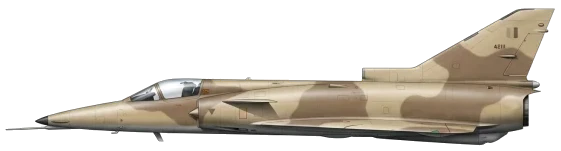
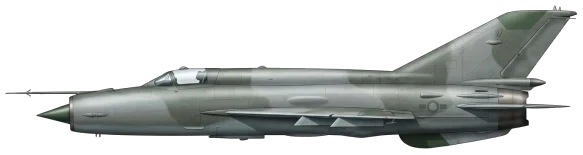
| Kfir | MiG-21 Fishbed | |
|---|---|---|
| Origin country | 🇮🇱 Israel | 🇷🇺 Ex-USSR |
| Category | Combat Aircraft | Combat Aircraft |
| Manufacturer | IAI | Mikoyan-Gurevich |
| First flight | 4 June 1973 | 16 June 1955 |
| Year introduced | 1974 | 1958 |
| Number produced | 220 units | 11496 units |
| Average unit price | $20 million | $2 million |
| Wing area | 34.8 m² | 23.0 m² |
| Wingspan | 8.2 m | 7.2 m |
| Height | 4.6 m | 4.1 m |
| Length | 15.7 m | 14.7 m |
| Maximum speed | 2440 km/h | 2175 km/h |
| Operational range | 1,000 km | 793 km |
| Service ceiling | 17,678 m | 17,500 m |
| Max. takeoff weight | 16,200 kg | 10,400 kg |
| Empty weight | 7,285 kg | 4,871 kg |
| Total thrust | 1 x 8,119 kgf | 1 x 7,095 kgf |
Detailed Comparison
The IAI Kfir and Mikoyan-Gurevich MiG-21 exemplify the disparity between a tailored, embargo-driven solution and a mass-produced global export platform. While the MiG-21 originated as a high-speed interceptor for Soviet doctrine in the 1950s, the Kfir emerged two decades later as an Israeli reconfiguration of the French Mirage airframe, adapted to integrate heavier American propulsion and electronics.
Development and Design
The Kfir was born from the 1967 arms embargo, compelling Israel to reverse-engineer the Dassault Mirage 5 and mate the airframe with the General Electric J79 turbojet. This integration required extensive structural strengthening with titanium and aerodynamic modifications—specifically the addition of nose canards and leading-edge devices—to stabilize the aircraft. Conversely, the MiG-21 was designed as a lightweight, supersonic point-defense interceptor. Its configuration, featuring a tailed delta wing and shock-cone intake, prioritized speed and climb rate over range or avionics complexity. While the MiG prioritized simplicity for mass production, the Kfir represented a high-tech hybridization of French aerodynamics and American power.
Specifications and Performance
The Kfir is a significantly heavier platform, with an empty weight of 7,285 kg compared to the MiG-21's 4,871 kg. Despite the weight penalty, the Kfir's J79 engine facilitates a superior maximum speed of 2,440 km/h versus the MiG's 2,125 km/h. The Israeli aircraft also offers an operational range of 1,000 km, surpassing the MiG-21's limited 660 km radius, which was a persistent design limitation of the Soviet interceptor. However, the MiG-21 maintains an advantage in service ceiling at 19,000 m, reflecting its pure interceptor lineage, whereas the Kfir's wing loading and hardpoint configuration were increasingly optimized for strike missions carrying up to 5,000 kg of ordinance in later variants.
Deployment and Usage
The MiG-21 saw ubiquitous service across Vietnam, the Middle East, and Africa, often utilized in attrition warfare. With over 11,000 units built, it served as the primary interceptor for the Eastern Bloc, though later variants like the MiG-21bis and upgrades (LanceR, Bison) expanded its role to ground attack. The Kfir's operational history was more specialized; displaced by the F-15 and F-16 shortly after entering service, the IAF rapidly repurposed it for ground-attack roles, utilizing its payload capacity effectively against Syrian SAM sites in Lebanon (1982). Paradoxically, the Kfir found greater longevity as an export fighter (Ecuador, Colombia, Sri Lanka) and as an aggressor aircraft for the US Navy (F-21A).
Conclusion
Ultimately, the MiG-21 represents the Soviet doctrine of quantity and accessibility, offering a cost-effective ($2.0 million) supersonic capability that became the standard for developing air forces. The Kfir, with a unit cost of $20.0 million, demonstrates the effectiveness of upgrading legacy airframes with advanced propulsion and avionics to meet specific strategic needs. While the MiG-21 defined the Cold War interceptor through sheer volume, the Kfir proved the viability of westernizing the Mirage lineage for multi-role supremacy.