English Electric Lightning vs MiG-21 Fishbed
English Electric Lightning vs MiG-21 Fishbed at a glance — top speed 2,414 vs 2,175 km/h, range 1,482 vs 793 km, max takeoff weight 20,752 vs 10,400 kg, built 337 vs 11,496 units.
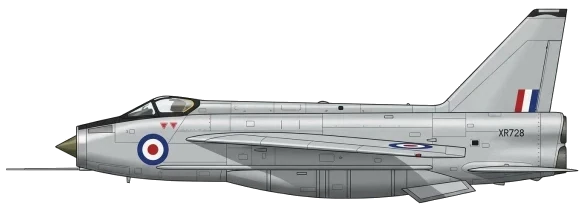
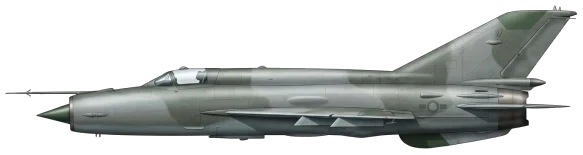
| English Electric Lightning | MiG-21 Fishbed | |
|---|---|---|
| Origin country | 🇬🇧 United Kingdom | 🇷🇺 Ex-USSR |
| Category | Combat Aircraft | Combat Aircraft |
| Manufacturer | English Electric | Mikoyan-Gurevich |
| First flight | 4 August 1954 | 16 June 1955 |
| Year introduced | 1960 | 1958 |
| Number produced | 337 units | 11496 units |
| Average unit price | $2 million | $2 million |
| Wing area | 44.1 m² | 23.0 m² |
| Wingspan | 10.6 m | 7.2 m |
| Height | 6.0 m | 4.1 m |
| Length | 16.8 m | 14.7 m |
| Maximum speed | 2414 km/h | 2175 km/h |
| Operational range | 1,482 km | 793 km |
| Service ceiling | 16,459 m | 17,500 m |
| Max. takeoff weight | 20,752 kg | 10,400 kg |
| Empty weight | 14,092 kg | 4,871 kg |
| Total thrust | 2 x 7,421 kgf | 1 x 7,095 kgf |
Detailed Comparison
The English Electric Lightning and the Mikoyan-Gurevich MiG-21 emerged during the mid-1950s as Mach 2 capable point-defense interceptors, designed to counter the threat of high-altitude strategic bombers. While both prioritized speed and climb rate, the Lightning represents a complex, specialized British engineering solution, whereas the MiG-21 embodies the Soviet doctrine of mass production, simplicity, and rugged utility.
Development and Design
The Lightning features a highly unconventional configuration with two vertically stacked Rolls-Royce Avon turbojets and a notched delta wing swept at 60°. This design minimized frontal area to reduce drag but necessitated a ventral tank arrangement, limiting endurance. Conversely, the MiG-21 utilizes a classic tailed delta wing planform with a single Tumansky turbojet and a nose shock cone. The Soviet design emphasized lightweight simplicity and high-speed maneuverability, though the delta wing compromised low-speed handling and required high landing speeds. The Lightning’s stacked engines provided redundancy and power, while the MiG’s configuration allowed for easier manufacturing and maintenance, contributing to its proliferation.
Specifications and Performance
Performance metrics reveal distinct engineering priorities. The Lightning is significantly heavier, with an empty weight of 14,092 kg compared to the MiG-21's extremely light 4,871 kg. Despite this mass, the Lightning’s twin engines generate superior total thrust (approx. 11,368 kgf combined vs. 4,689 kgf for the MiG), facilitating an exceptional climb rate of 100.0 m/s.
Key performance contrasts include:
- Speed: Both aircraft are comparable, with the MiG-21 reaching 2,125 km/h and the Lightning 2,092 km/h.
- Ceiling: The MiG-21 holds the advantage with a service ceiling of 19,000 m, compared to the Lightning's 16,459 m.
- Range: Both platforms suffer from limited operational range due to high fuel consumption and limited internal volume; the data indicates 1,367 km for the Lightning and 660 km for the MiG-21, severely restricting loiter time without external tanks.
Deployment and Usage
The Lightning saw limited export success, serving primarily with the Royal Air Force, Saudi Arabia, and Kuwait as a dedicated interceptor until its retirement in 1988. It was strictly an air-to-air platform armed with Firestreak missiles. In stark contrast, the MiG-21 became the most produced supersonic jet in history (11,496 units). It served in over 60 air forces and saw extensive combat in Vietnam, the Middle East, and the Indo-Pakistani wars. While the Lightning remained specialized, the MiG-21 evolved into a versatile multi-role platform capable of delivering FAB-500 bombs and unguided rockets. Its adaptability allowed for numerous modernization programs (e.g., MiG-21 LanceR, Bison), extending its service life well into the 21st century.
Conclusion
The Lightning was a pinnacle of British aeronautical engineering—unmatched in climb performance but operationally constrained by complexity, cost, and a singular mission profile. The MiG-21, while offering less raw thrust-to-weight performance in early variants, proved far more adaptable and sustainable. The Fishbed's longevity, driven by ease of maintenance and massive export numbers, demonstrates that in military aviation, logistical viability and multi-role adaptability often provide greater strategic value than pure kinematic performance.


