Mi-26 Halo vs Mi-6 Hook
Mi-26 Halo vs Mi-6 Hook at a glance — top speed 295 vs 300 km/h, range 500 vs 970 km, max takeoff weight 56,000 vs 44,000 kg, built 316 vs 500 units.

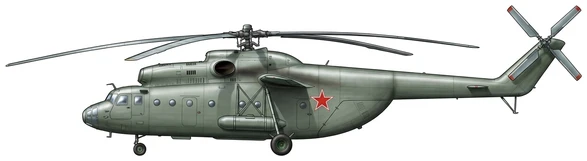
| Mi-26 Halo | Mi-6 Hook | |
|---|---|---|
| Origin country | 🇷🇺 Ex-USSR | 🇷🇺 Ex-USSR |
| Category | Military Helicopters | Military Helicopters |
| Manufacturer | Mil | Mil |
| First flight | 14 December 1977 | 5 June 1957 |
| Year introduced | 1983 | 1959 |
| Number produced | 316 units | 500 units |
| Average unit price | $25 million | -- |
| Wing area | 804.3 m² | 962.1 m² |
| Wingspan | 32.0 m | 35.0 m |
| Height | 8.1 m | 9.2 m |
| Length | 40.0 m | 33.2 m |
| Maximum speed | 295 km/h | 300 km/h |
| Operational range | 500 km | 970 km |
| Service ceiling | 4,600 m | 4,500 m |
| Max. takeoff weight | 56,000 kg | 44,000 kg |
| Empty weight | 28,200 kg | -- kg |
| Total thrust | 2 x 8,500 kW | 2 x 4,100 kW |
Detailed Comparison
The Mil Mi-26 Halo emerged directly from the operational limitations of the Mi-6 Hook. Where the late-1950s Mi-6 established the parameters of vertical heavy-lift for Soviet theater logistics, the late-1970s Mi-26 doubled the payload capacity without drastically increasing the aircraft's footprint. The transition between these airframes charts the Soviet shift from early heavy rotor designs, reliant on aerodynamic aids like stub wings, to advanced materials and complex transmission systems capable of handling extreme torque.
Development and Design
The Mi-6, developed in the late 1950s, was the first Soviet production helicopter to use turboshaft engines. To manage the output from its twin Soloviev D-25V engines, Mil incorporated variable-incidence winglets that provided 20% of the required lift during cruise flight. By the 1970s, Marat Tishchenko’s team approached the Mi-26 requirement with strict weight targets. The resulting design eliminated the Mi-6's stub wings, utilizing an eight-blade main rotor and a non-planetary, split-torque gearbox weighing 3,639 kg. This transmission safely absorbed 14,700 kW, allowing the Mi-26 to achieve an empty weight of 28,000 kg—exactly half of its maximum takeoff weight of 56,000 kg.
Specifications and Performances
While the Mi-6 set the early benchmark with a 44,000 kg maximum takeoff weight, its internal payload was capped at 12,000 kg. The Mi-26 expanded this to a 20,000 kg payload capacity, matching the tactical airlift capacity of a Lockheed C-130 Hercules, while retaining a similar dimensional footprint. The Mi-6 achieved a slightly higher top speed of 300 km/h and a longer unrefueled range of 970 km, aided by its wing-generated lift. The Mi-26 sacrifices absolute range, operating at a 500 km radius, for vertical lifting power. The Halo's engine load-sharing system also introduced single-engine survival capability, a factor absent in the Hook architecture.
Deployment and usage
The Mi-6 formed the backbone of Soviet heavy lift during the Cold War, deploying FROG-7 rockets and armored vehicles, and saw export combat use in Egypt and Iraq. Its service life ended in 2002 when the Interstate Aviation Committee revoked its type certificate following a fatal crash and the expiration of its wooden tail rotor blades. The Mi-26 took over theater logistics, operating during the 1986 Chernobyl disaster for precision drops and in the 2022 Russo-Ukrainian War for mechanized troop transfers. Combat operations exposed the Mi-26's vulnerability to man-portable air-defense systems (MANPADS); a 2002 shootdown in Chechnya killed 127 troops in an overloaded airframe. Unlike the Mi-6, which carried a 12.7mm machine gun, the Mi-26 relies entirely on escort and self-protection suites like the Vitebsk complex added to the T2V variant.
Conclusion
The Mi-26 possesses a definitive edge in theater logistics and platform survivability over the obsolete Mi-6. The Hook's reliance on wooden rotor components and stub wings restricted its long-term viability and directly caused its fleet-wide grounding. The Mi-26 succeeds by utilizing:
- A non-planetary, split-torque transmission capable of handling 14,700 kW
- Advanced composite rotor blades that eliminate the lifespan limits of the Mi-6's wooden components
- A 1:1 empty-to-payload weight ratio, allowing a 20,000 kg payload capacity
For moving mechanized armor or executing heavy vertical replenishment, the Mi-26 provides 66% more cargo capacity than the Mi-6 within a comparable physical footprint, replacing the Mi-6's early aerodynamic compromises with transmission engineering.