Mi-26 Halo vs Mi-8 Hip
Mi-26 Halo vs Mi-8 Hip at a glance — top speed 295 vs 250 km/h, range 500 vs 495 km, max takeoff weight 56,000 vs 12,000 kg, built 316 vs 17,000 units.

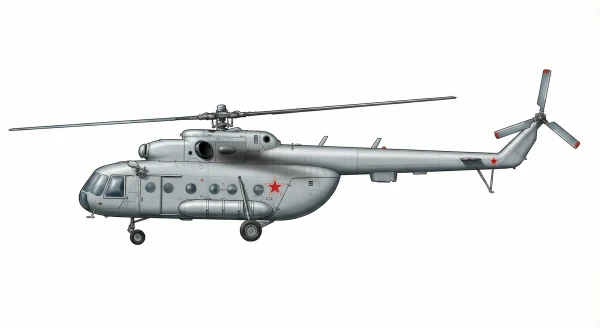
| Mi-26 Halo | Mi-8 Hip | |
|---|---|---|
| Origin country | 🇷🇺 Ex-USSR | 🇷🇺 Ex-USSR |
| Category | Military Helicopters | Military Helicopters |
| Manufacturer | Mil | Mil |
| First flight | 14 December 1977 | 24 June 1961 |
| Year introduced | 1983 | 1967 |
| Number produced | 316 units | 17000 units |
| Average unit price | $25 million | $4 million |
| Wing area | 804.3 m² | -- m² |
| Wingspan | 32.0 m | 21.3 m |
| Height | 8.1 m | 5.7 m |
| Length | 40.0 m | 25.2 m |
| Maximum speed | 295 km/h | 250 km/h |
| Operational range | 500 km | 495 km |
| Service ceiling | 4,600 m | 4,500 m |
| Max. takeoff weight | 56,000 kg | 12,000 kg |
| Empty weight | 28,200 kg | 7,160 kg |
| Total thrust | 2 x 8,500 kW | 2 x 1,119 kW |
Detailed Comparison
The Mil Mi-26 Halo and Mil Mi-8 Hip constitute the primary rotary-wing logistics capability for Russian-origin fleets, occupying distinct operational tiers. While the Mi-8 serves as a ubiquitous, mass-produced medium utility platform capable of armed assault, the Mi-26 is a specialized strategic heavy-lifter designed for singular high-load logistical challenges. Together, they cover the spectrum from squad-level insertion to the transport of ballistic missiles and armored vehicles.
Development and Design
The Mi-8 Hip, introduced in 1961, was engineered for versatility and ruggedness. Its design philosophy prioritized mass production and adaptability, resulting in a conventional layout with a five-blade main rotor and a spacious cabin capable of accepting various mission modules. It serves as a transport, gunship, and medical evacuation platform.
Conversely, the Mi-26 Halo, which first flew in 1977, was developed to replace the Mi-6 and Mi-12 with a focus on extreme lifting capacity. Its design is defined by the requirement that the empty weight be less than half its maximum takeoff weight. To achieve this, Mil engineers utilized a unique eight-blade main rotor and a lightweight, split-torque gearbox capable of absorbing 14,700 kW. While the Mi-8 is designed for tactical flexibility, the Mi-26 is engineered for pure power-to-weight efficiency.
Specifications and Performances
The performance gap between these aircraft is substantial, reflecting their differing roles. The Mi-26 boasts a Maximum Takeoff Weight (MTOW) of 56,000 kg, nearly five times the Mi-8's 12,000 kg MTOW. Crucially, the Mi-26's payload capacity of 20,000 kg allows it to transport heavy military equipment, such as 13-tonne amphibious armored personnel carriers, internally or externally. The Mi-8 is limited to significantly lighter loads, typically carrying up to 24 troops or light cargo.
While the Mi-26 is physically imposing at over 40 meters in length, limiting its landing zones, the Mi-8's compact 25-meter frame allows for operation in more confined environments. The Mi-26 is faster, with a top speed of 295 km/h compared to the Mi-8's 250 km/h, though both share a similar operational range of approximately 500 km.
Deployment and usage
The Mi-8 is the tactical workhorse of over 50 nations. With over 17,000 units built, it sees extensive combat usage, notably in the Soviet-Afghan War and the Russo-Ukrainian War. Its ability to mount rocket pods, anti-tank missiles, and machine guns allows it to function as an assault transport, bridging the gap between utility and attack helicopters.
The Mi-26 operates as a strategic enabler. It is rarely exposed to direct combat fire due to its size and value ($90 million vs. $4 million for the Mi-8). Instead, it performs heavy lift logistics behind lines, such as recovering damaged aircraft—including U.S. CH-47 Chinooks in Afghanistan—and disaster relief, famously deploying radiation shielding during the Chernobyl crisis.
Conclusion
The comparison highlights the difference between tactical ubiquity and strategic specialization. The Mi-8 remains indispensable due to its modularity, armed capability, and low cost, making it suitable for frontline combat operations. The Mi-26, however, provides a unique heavy-lift capability unmatched by any other production helicopter, justifying its high acquisition and operational costs through its ability to move assets that standard transport aircraft cannot.