CH-53 Sea Stallion vs Mi-26 Halo
CH-53 Sea Stallion vs Mi-26 Halo at a glance — top speed 315 vs 295 km/h, range 1,000 vs 500 km, max takeoff weight 33,300 vs 56,000 kg, built 284 vs 316 units.
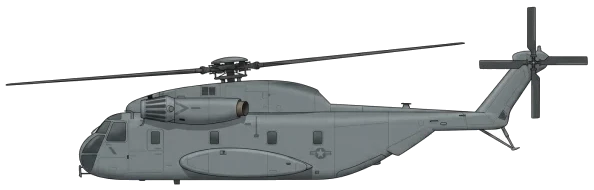
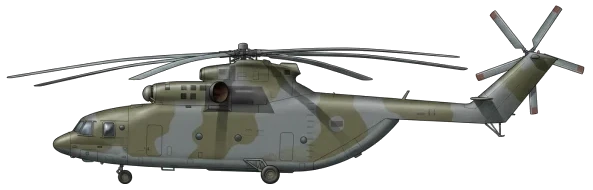
| CH-53 Sea Stallion | Mi-26 Halo | |
|---|---|---|
| Origin country | 🇺🇸 United States | 🇷🇺 Ex-USSR |
| Category | Military Helicopters | Military Helicopters |
| Manufacturer | Sikorsky | Mil |
| First flight | 14 October 1964 | 14 December 1977 |
| Year introduced | 1966 | 1983 |
| Number produced | 284 units | 316 units |
| Average unit price | $40 million | $25 million |
| Wing area | -- m² | 804.3 m² |
| Wingspan | 24.1 m | 32.0 m |
| Height | 8.5 m | 8.1 m |
| Length | 30.2 m | 40.0 m |
| Maximum speed | 315 km/h | 295 km/h |
| Operational range | 1,000 km | 500 km |
| Service ceiling | 5,639 m | 4,600 m |
| Max. takeoff weight | 33,300 kg | 56,000 kg |
| Empty weight | 15,071 kg | 28,200 kg |
| Total thrust | 3 x 3,270 kW | 2 x 8,500 kW |
Detailed Comparison
The Soviet-designed Mi-26 Halo and the American CH-53 Sea Stallion are both categorized as heavy-lift helicopters, but they serve fundamentally different operational roles defined by their distinct design philosophies. The Mi-26 is a strategic airlifter without peer in lift capacity, designed to move exceptionally heavy military hardware. The CH-53, developed for the U.S. Marine Corps, is a more tactical, multi-role platform that balances cargo and troop transport with greater speed, range, and operational flexibility for expeditionary warfare.
Development and Design
The Mi-26 was engineered to surpass its predecessors with a primary objective of lifting a 20-tonne payload, resulting in the world's largest production helicopter. Its design is centered on a unique single eight-blade main rotor and a robust split-torque gearbox, prioritizing raw power and lift capability. In contrast, the CH-53 was born from a specific USMC requirement to replace the CH-37 Mojave. It was a scaled-up version of existing Sikorsky designs, optimized for ship-to-shore movement. Key design features like the rear loading ramp for drive-on access and a cabin that can accommodate dozens of troops underscore its primary mission of assault support. While the Mi-26 is an unarmed transport, the CH-53 is typically armed with machine guns for self-defense.
Specifications and Performances
The performance metrics reflect their divergent purposes. The Mi-26's maximum takeoff weight of 56,000 kg and its 20,000 kg payload capacity are approximately double that of the CH-53. This immense lift capability is its defining characteristic. However, the CH-53 demonstrates superior tactical performance. It is faster (315 km/h vs. 295 km/h) and possesses a vastly greater range of 2,075 km compared to the Mi-26's 590 km. This extended range is a critical advantage for long-distance insertion or logistics missions. The CH-53 also operates at a higher service ceiling. The specified CH-53 variant's three-engine configuration offers greater engine-out redundancy over the Mi-26's twin-engine design.
Deployment and usage
Both helicopters have seen extensive service. The Mi-26's operational history highlights its unique capabilities in both military and civilian emergencies, from dropping insulating material on the Chernobyl reactor to delivering heavy construction equipment for disaster relief and transporting armored vehicles in conflict zones like Ukraine. The CH-53 family has been a cornerstone of U.S. military operations for decades, beginning in Vietnam. It has performed a wide array of missions, including combat search and rescue (HH-53), airborne mine countermeasures (RH-53D), and troop and equipment transport during major operations in Grenada, Iran, Iraq, and Afghanistan.
Conclusion
The Mi-26 Halo is a specialized strategic asset, its value measured by a 20-tonne payload that no other helicopter can match. It is the platform of choice for moving single, oversized objects that are otherwise immobile by air. The CH-53 Sea Stallion is a more versatile tactical workhorse. What it lacks in ultimate lift capacity, it compensates for with superior range, speed, and adaptability. It is a combat-proven platform designed for a broad spectrum of assault support and logistics missions. The selection between them is a clear choice between unparalleled heavy-lift capability and tactical, multi-mission flexibility.
-
 United States
175
United States
175
-
 Germany
81
Germany
81
-
 Israel
22
Israel
22
- All 4 operators →


