Mi-26 Halo
Soviet heavy transport helicopter, frequently utilized for cargo and troop transport, infamous for Chernobyl disaster relief mission. Key figures: top speed 295 km/h, range 500 km, service ceiling 4,600 m, max takeoff weight 56,000 kg, unit price $25M, built 316. In service with 10 air forces as of 2026 — Russia (45), Algeria (14), Jordan (4) and 7 others.

| Crew | 5 |
| Length | 40.0 m (131.3 ft) |
| Wingspan | 32 m (105.0 ft) |
| Height | 8.1 m (26.7 ft) |
| Wing area | 804.3 m² (8656.9 sqft) |
| Empty weight | 28,200 kg (62,170 lbs) |
| Max. takeoff weight | 56,000 kg (123,459 lbs) |
| Powerplant | 2 × turboshafts ZMKB Progress D-136 8,500 kW each |
| Maximum speed | 295 km/h (183 mph) |
| Operational range | 500 km (311 mi) |
| Service ceiling | 4,600 m (15,092 ft) |
-
 Russia
45 +15
Russia
45 +15
-
 Algeria
14
Algeria
14
-
 Jordan
4
Jordan
4
-
 North Korea
4
North Korea
4
-
 Belarus
3
Belarus
3
-
 Venezuela
3
Venezuela
3
-
 Kazakhstan
2
Kazakhstan
2
-
 Burkina Faso
1
Burkina Faso
1
- 🇨🇩 Congo Democratic Republic 1
- 🇬🇶 Equatorial Guinea 1
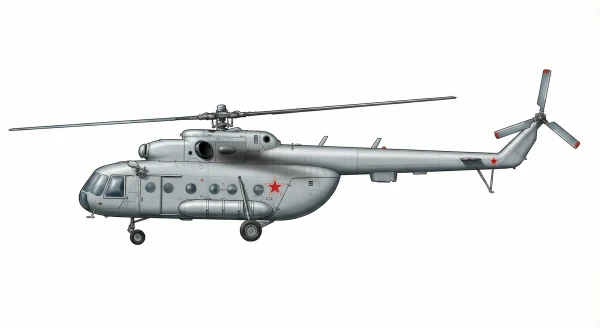
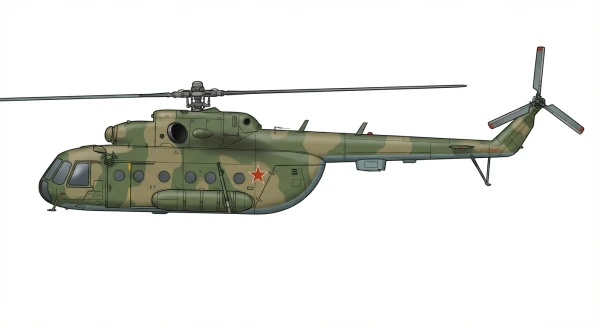
Description
The Mil Mi-26 (NATO reporting name: Halo) is a Soviet, later Russian, heavy transport helicopter designed by the Mil design bureau and produced by Rostvertol. Entering Soviet military and commercial service in 1985, it is the largest helicopter ever series-produced, with a 20-tonne payload and a single eight-bladed main rotor.
Development
The programme, designated Izdeliye 90, began in the early 1970s after the abandonment of the Mil Mi-12. The specification required an empty weight of less than half the maximum take-off weight. Design was led by Marat Tishchenko, successor to Mikhail Mil at OKB-329. The aircraft was to replace the Mi-6 and Mi-12 and carry equipment such as 13-tonne amphibious armoured vehicles or mobile ballistic missiles, previously delivered by An-22 or Il-76. The first flight took place on 14 December 1977, the first production example left the factory on 4 October 1980 and development was completed in 1983. In 1982, a Mi-26 set the FAI record for mass lifted to 2,000 metres, at 56,768.8 kg, still standing in 2024. Rostvertol delivered fourteen aircraft between 2012 and 2014, six in 2015, then further examples to the Russian Aerospace Forces in 2016, 2017 and 2019. Development of the PD-12V turboshaft, derived from the PD-14, began in 2016.
Design
The Mi-26 is the first production helicopter fitted with a single eight-bladed main rotor, 32 m in diameter. The tail rotor has a diameter comparable to that of the MD 500's main rotor. Power comes from two ZMKB Progress D-136 turboshafts of 8,500 kW each, coupled to a load-sharing system allowing single-engine flight depending on weight. The VR-26 main gearbox, designed in-house by Mil, weighs 3,639 kg for 14,700 kW absorbed, with a non-planetary split-torque architecture and quill shafts; its casing is of pressed aluminium. Maximum take-off weight reaches 56,000 kg for an empty weight of 28,200 kg. The crew numbers five and the cabin carries 90 troops or 60 stretchers.
Operational History
Thirty Mi-26s took part in the Chernobyl containment operations in 1986, carrying out radiation measurements and dropping insulating materials onto reactor No. 4. In October 1999, one aircraft carried a 23-tonne block containing the Jarkov mammoth. In 2002, civilian Mi-26s operated by Sportsflite recovered two US Army MH-47E and CH-47 helicopters in Afghanistan, the first contract amounting to $300,000. On 19 August 2002, an overloaded Mi-26 was shot down by a surface-to-air missile in Chechnya: 127 dead, the heaviest toll in the history of rotary-wing aviation. A Moldovan Mi-26 of Pecotox Air was shot down in Helmand in July 2009. The Indian Air Force withdrew its last three examples after an accident at Jammu on 14 December 2010. Russian Mi-26s transported reinforcements to Izium and Kupiansk in 2022.
Variants
- Mi-26: Production military transport version, NATO name "Halo-A".
- Mi-26S: Disaster-response version developed for Chernobyl, with a decontaminating-liquid tank and cabin armour.
- Mi-26T: Civil cargo transport version, produced from 1985.
- Mi-26T2: Version fitted with the BREO-26 avionics suite for all-weather, day and night flight, in production since 22 May 2015.
- Mi-26T2V: Russian military version with NPK90-2V avionics, Vitebsk protection system and blast-resistant seats, first flown in August 2018.
Frequently Asked Questions
What type of aircraft is the Mi-26 Halo?
What is the maximum speed of the Mi-26 Halo?
What is the range of the Mi-26 Halo?
When did the Mi-26 Halo first fly?
How many Mi-26 Halo have been built?
Which countries operate the Mi-26 Halo?
How much does a Mi-26 Halo cost?
What is the service ceiling of the Mi-26 Halo?
- AUG 302026 Updated Description updated
- AUG 52026 Updated Wing area, powerplant and 3 more fields added; empty weight updated
- JUL 232026 Updated Sources and cross-references refreshed
- APR 72026 Updated Sources and cross-references refreshed
- FEB 72026 Updated Wingspan added
- JAN 242026 Updated Price updated
- JAN 122026 Updated Range updated in a site-wide editorial pass