Mi-6 Hook
Soviet heavy transport helicopter, developed in the mid-1950s for civil and military logistics, extensively used for heavy-lift operations and troop transport until the early 21st century. Key figures: top speed 300 km/h, range 970 km, service ceiling 4,500 m, max takeoff weight 44,000 kg, built 500.
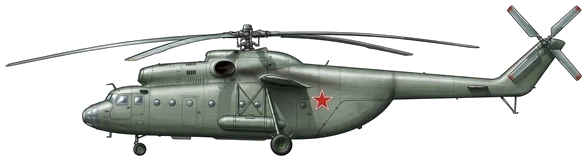
| Crew | 6 (pilot, co-pilot, navigator, flight engineer, radio operator, technician) |
| Length | 33.2 m (108.9 ft) |
| Wingspan | 35 m (114.8 ft) |
| Height | 9.2 m (30.0 ft) |
| Wing area | 962.1 m² (10355.9 sqft) |
| Max. takeoff weight | 44,000 kg (97,003 lbs) |
| Powerplant | 2 × Soloviev D-25V turboshaft 4,100 kW each |
| Maximum speed | 300 km/h (186 mph) |
| Operational range | 970 km (603 mi) |
| Endurance | 2 hours |
| Service ceiling | 4,500 m (14,764 ft) |
| Climb rate | 5.0 m/s (16.4 ft/s) |
- Rocket Pod ASW rockets
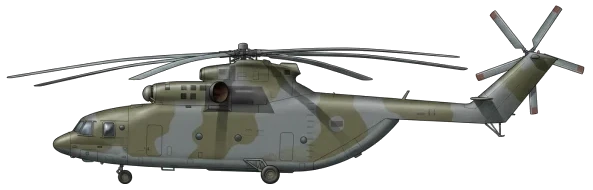
Description
The Mil Mi-6 (NATO reporting name Hook), designated izdeliye 50 by the manufacturer, is a Soviet heavy transport helicopter designed by the Mil design bureau. Developed to meet a joint civil-military requirement for a large vertical-lift aircraft, it was intended for military mobility and the development of the central and eastern regions of the USSR. The V-6 prototype flew for the first time on 5 June 1957, making the Mi-6 the first Soviet turboshaft-powered production helicopter. Between 1959 and 1972, at least 500 units were manufactured for transport, utility, firefighting, and flying-crane roles.
Design
The aircraft is powered by two Soloviev D-25V turboshaft engines, each producing 4,100 kW. The R-7 gearbox and rotor head have a combined weight of 3,200 kg. From 1960, 30 pre-series units and subsequent transport versions were fitted with variable-incidence winglets that provide approximately 20% of the lift required during cruise flight. The landing gear is non-retractable, featuring twin nose wheels and large low-pressure main wheels. The Mi-6 is operated by a crew of six, including a pilot, copilot, navigator, flight engineer, radio operator, and technician. The cabin is accessed via rear clamshell doors and can accommodate 12,000 kg of internal cargo, 90 passengers, 70 airborne troops, or 41 stretcher patients.
Armament
For defense, the navigator's station can be equipped with a 12.7 mm Afanasev A-12.7 machine-gun with 270 rounds. Specialized variants were designed to carry heavier munitions; the Mi-6M anti-submarine version was designed with four aerial torpedoes and ASW rockets. The aircraft's payload capacity allows for the transport of heavy equipment, including FROG-7 rockets on PT-76 tracked chassis, heavy artillery, and armored personnel carriers.
Operational History
The Mi-6 was utilized by the Soviet Air Force and Aeroflot, alongside export customers including Egypt, Vietnam, Iraq, Indonesia, and Peru. Notable missions included the delivery of weapons and vehicles during military exercises and the recovery of Vostok and Soyuz space modules. In October 2002, the Interstate Aviation Committee withdrew the type certificate following a crash in the Taimyr Peninsula and the expiration of the service life for the wooden tail rotor blades.
Variants
- Mi-6A: A revised baseline standard for troop and commercial transport with improved reliability and new avionics.
- Mi-6AYa (Mi-22): An airborne command post variant equipped with side-looking airborne radar (SLAR).
- Mi-6M: An anti-submarine warfare variant armed with four aerial torpedoes and ASW rockets.
- Mi-6P: A passenger transport version featuring accommodation for 80 passengers.
- Mi-6PZh: A firefighting variant equipped with a 12,000 L internal tank and six 1,500 L external bags.
Frequently Asked Questions
What type of aircraft is the Mi-6 Hook?
What is the maximum speed of the Mi-6 Hook?
What is the range of the Mi-6 Hook?
When did the Mi-6 Hook first fly?
How many Mi-6 Hook have been built?
Which countries operate the Mi-6 Hook?
What is the service ceiling of the Mi-6 Hook?
- MAY 102026 Created Page created: Mi-6 Hook