MQ-1 Predator vs MQ-1C Gray Eagle
MQ-1 Predator vs MQ-1C Gray Eagle at a glance — top speed 217 vs 309 km/h, range 1,250 vs 370 km, max takeoff weight 1,020 vs 1,633 kg, built 360 vs 204 units.
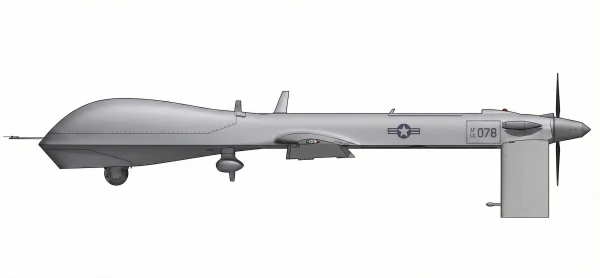
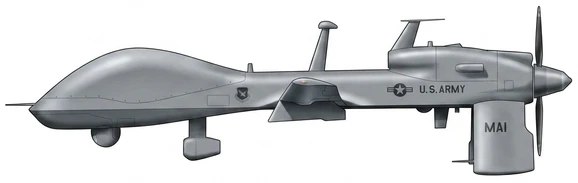
| MQ-1 Predator | MQ-1C Gray Eagle | |
|---|---|---|
| Origin country | 🇺🇸 United States | 🇺🇸 United States |
| Category | Military Drones | Military Drones |
| Manufacturer | General Atomics | General Atomics |
| First flight | 3 July 1994 | 1 October 2004 |
| Year introduced | 1995 | 2009 |
| Number produced | 360 units | 204 units |
| Average unit price | $4 million | -- |
| Wingspan | 14.8 m | 17.0 m |
| Height | -- m | 2.1 m |
| Length | 8.2 m | 8.5 m |
| Maximum speed | 217 km/h | 309 km/h |
| Operational range | 1,250 km | 370 km |
| Service ceiling | 7,620 m | 8,839 m |
| Max. takeoff weight | 1,020 kg | 1,633 kg |
| Empty weight | 512 kg | 1,318 kg |
| Total thrust | -- | 1 x 123 kW |
Detailed Comparison
The General Atomics MQ-1 Predator and MQ-1C Gray Eagle execute different operational doctrines. The MQ-1 was developed as an asset for centralized United States Air Force and CIA theater-level reconnaissance and strike. The MQ-1C is an organic United States Army aviation asset designed for decentralized, division-level support and direct integration with rotary-wing formations.
Development and Design
The MQ-1 Predator evolved from Abraham Karem’s Gnat 750, utilizing a commercial Rotax 912ULS gasoline engine. This powerplant required specialized aviation fuel, complicating logistics at forward operating bases. When the U.S. Army initiated the 2002 Extended-Range Multi-Purpose (ERMP) program to replace the RQ-5 Hunter, General Atomics scaled the Predator airframe to create the MQ-1C.
The primary design shift was the integration of a 165 hp Thielert Centurion 1.7 Heavy Fuel Engine. Burning standard JP-8 jet fuel aligns the Gray Eagle with standard Army logistical chains. Furthermore, the MQ-1C integrates an AN/ZPY-1 STARLite radar and native Manned-Unmanned Teaming (MUM-T) architecture, linking it directly to AH-64E Apache attack helicopters.
Specifications and Performances
The MQ-1C operates at a higher weight class, yielding direct kinetic and kinetic advantages over the baseline Predator:
- A Maximum Takeoff Weight (MTOW) of 1,633 kg for the MQ-1C, compared to the MQ-1’s 1,020 kg.
- A payload capacity of 360 kg across four hardpoints, allowing the Gray Eagle to carry four AGM-114 Hellfires—double the capacity of the MQ-1B.
- A maximum speed of 309 km/h and a service ceiling of 8,839 meters, outpacing the Predator's 217 km/h and 7,620-meter limit.
The Heavy Fuel Engine provides these increases, though early MQ-1C integration suffered poor reliability, averaging 25 hours between failures in 2011 testing against a 100-hour requirement. Both maintain baseline endurance in the 24- to 25-hour bracket, while the Gray Eagle ER variant extends this to 50 hours via a deeper belly fuselage.
Deployment and usage
The USAF deployed the RQ-1 to the Balkans in 1995 for ISR, later weaponizing it post-2001 in Afghanistan, Pakistan, and Yemen for targeted killings. The platform suffered from electronic vulnerabilities, notably unencrypted video downlinks intercepted by insurgents in Iraq, and lacked self-defense capabilities, demonstrated when an Iraqi MiG-25 shot one down in 2002.
The Army deployed the Gray Eagle to Iraq in 2010. Instead of flying via satellite from centralized bases in the United States, the Gray Eagle is assigned directly to Army aviation brigades and the 160th Special Operations Aviation Regiment to provide organic ground support. A 2022 proposal to transfer MQ-1Cs to Ukraine was blocked by the U.S. government due to technology security risks regarding the STARLite radar.
Conclusion
The MQ-1C Gray Eagle is superior in tactical, combined-arms environments, while the MQ-1 Predator is functionally obsolete and was retired by the USAF in 2018. The MQ-1C's superiority rests on its Heavy Fuel Engine and MUM-T data links. By burning standard JP-8 and passing sensor control directly to Apache pilots up to 70 miles away, the MQ-1C operates as a cohesive element of ground maneuver. The Predator established the MALE UAV concept, but its reliance on aviation gasoline and isolated command architecture render it inadequate for current military doctrine.