MQ-1C Gray Eagle
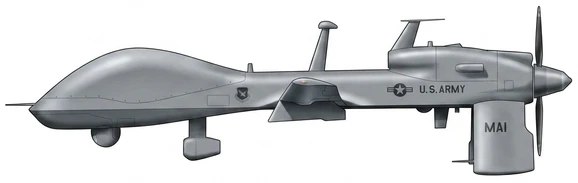
American medium-altitude, long-endurance unmanned combat aerial vehicle, introduced in the early 21st century and primarily utilized by the United States Army for reconnaissance and strike missions. Key figures: top speed 309 km/h, range 370 km, service ceiling 8,839 m, max takeoff weight 1,633 kg, built 204.
| Length | 8.5 m (28.0 ft) |
| Wingspan | 17 m (55.8 ft) |
| Height | 2.1 m (6.9 ft) |
| Empty weight | 1,318 kg (2,906 lbs) |
| Max. takeoff weight | 1,633 kg (3,600 lbs) |
| Powerplant | 1 × Thielert Centurion 1.7 Heavy-Fuel Engine 123 kW each |
| Maximum speed | 309 km/h (192 mph) |
| Operational range | 370 km (230 mi) |
| Endurance | 25 hours |
| Service ceiling | 8,839 m (28,999 ft) |
- Air-to-Ground AGM-114 Hellfire
- Air-to-Air Short-Range AIM-92 Stinger
- Guided Bomb GBU-44/B Viper Strike

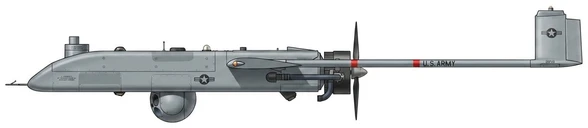

Description
The General Atomics MQ-1C Gray Eagle is a medium-altitude, long-endurance (MALE) unmanned combat aerial vehicle (UCAV) developed for the United States Army. Derived from the MQ-1 Predator, the aircraft originated from the 2002 Extended-Range Multi-Purpose (ERMP) competition to replace the RQ-5 Hunter. General Atomics Aeronautical Systems (GA-ASI) was awarded a $214 million development contract in August 2005. The aircraft conducted its first flight in October 2004 and entered service in 2009. Total production reached 204 units. In April 2025, the U.S. Secretary of Defense directed the Army to cease further procurement of the system.
Design
The Gray Eagle is powered by a 165 hp Thielert Centurion 1.7 Heavy Fuel Engine (HFE), a diesel piston engine that burns jet fuel. It has a wingspan of 56 feet, a service ceiling of 29,000 feet, and an endurance of approximately 25 hours. The nose fairing is enlarged to house an AN/ZPY-1 STARLite synthetic aperture radar/ground moving target indicator (SAR/GMTI) system, while an AN/AAS-52 Multi-spectral Targeting System (MTS) provides infrared and electro-optical targeting. Specialized systems include the Tactical Signals Intelligence Payload (TSP) for detecting electronic emitters and the Networked Electronic Warfare, Remotely Operated (NERO) system for jamming communications. Early flight testing in 2011 identified reliability issues, with the aircraft averaging 25 hours between failures against a requirement of 100 hours.
Armament
The aircraft features four hardpoints and a payload capacity of 800 pounds (360 kg). Armament consists of up to four AGM-114 Hellfire missiles or eight AIM-92 Stinger missiles. It can also carry GBU-44/B Viper Strike guided bombs. The system supports Manned-Unmanned Teaming (MUM-T), enabling AH-64E Apache pilots to control the aircraft’s sensors and weapons from the helicopter cockpit at ranges up to 70 miles.
Operational History
Operational deployment began in Iraq in June 2010 and Afghanistan in late 2010. The 160th Special Operations Aviation Regiment (Airborne) began receiving the MQ-1C in 2013 to provide independent reconnaissance and strike capabilities. By October 2013, the fleet had accumulated 80,000 flight hours. The U.S. Army permanently stationed 12 aircraft at Kunsan Air Base in South Korea starting in 2018. Operational losses include a 2015 crash in Iraq following a communications failure and two mechanical-related crashes in Agadez, Niger, in 2020 and 2021. A proposed 2022 transfer of four Gray Eagles to Ukraine was canceled by the U.S. government due to concerns over technology security and potential escalation.
Variants
- Improved Gray Eagle (IGE): Also designated Gray Eagle ER, this version incorporates a deep belly fuselage for increased fuel, a 205 hp Lycoming DEL-120 engine, and an endurance of up to 50 hours.
Frequently Asked Questions
What type of aircraft is the MQ-1C Gray Eagle?
What is the maximum speed of the MQ-1C Gray Eagle?
What is the range of the MQ-1C Gray Eagle?
When did the MQ-1C Gray Eagle first fly?
How many MQ-1C Gray Eagle have been built?
What is the service ceiling of the MQ-1C Gray Eagle?
- APR 72026 Updated Sources and cross-references refreshed
- JAN 172026 Updated Bombs and missiles updated
- JAN 162026 Created Page created: MQ-1C Gray Eagle