MQ-1 Predator
American unmanned aerial vehicle, operational since 1995, notable for its use in major conflicts like Iraq and Afghanistan wars. Key figures: top speed 217 km/h, range 1,250 km, service ceiling 7,620 m, max takeoff weight 1,020 kg, unit price $4M, built 360. In service with 1 air force as of 2026 — United Arab Emirates (8).
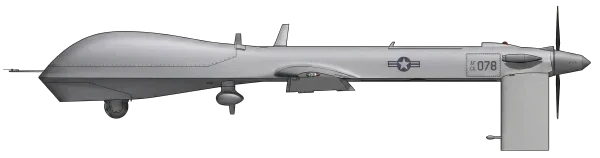
| Length | 8.2 m (27.0 ft) |
| Wingspan | 14.8 m (48.6 ft) |
| Empty weight | 512 kg (1,129 lbs) |
| Max. takeoff weight | 1,020 kg (2,249 lbs) |
| Powerplant | 1 × Rotax 912ULS |
| Maximum speed | 217 km/h (135 mph) |
| Operational range | 1,250 km (777 mi) |
| Endurance | 24 hours |
| Service ceiling | 7,620 m (25,000 ft) |
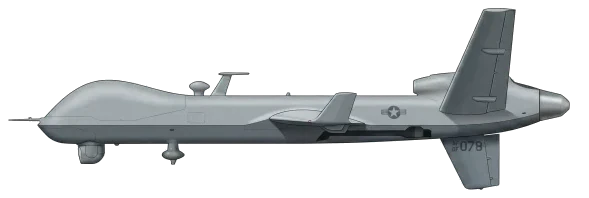
Description
The General Atomics MQ-1 Predator is an American remotely piloted aircraft (RPA) built by General Atomics Aeronautical Systems, used primarily by the US Air Force and the CIA for aerial reconnaissance, forward observation and later ground attack. Designed in the early 1990s, it entered service in 1995 and became the first armed remotely piloted aircraft used in offensive operations by the United States, firing AGM-114 Hellfire missiles in Afghanistan, Pakistan, Iraq, Yemen, Libya, Syria and Somalia. The USAF retired it from service in March 2018 in favour of the MQ-9 Reaper.
Development
The CIA and the Pentagon experimented with reconnaissance drones from the early 1980s. In the early 1990s, the CIA took an interest in the Amber drone developed by Leading Systems, Inc. of Abraham Karem, a former chief designer of the Israeli Air Force; after the company's bankruptcy, the agency secretly acquired five examples renamed Gnat. General Atomics received a development contract in January 1994 and the first flight took place on 3 July 1994 at El Mirage, in the Mojave Desert. The ACTD phase (January 1994 – June 1996) covered three systems, i.e. twelve aircraft and three ground control stations. The aircraft took part in the Roving Sands exercise in April-May 1995, then were deployed to Gjadër, Albania. The system, initially designated RQ-1, became MQ-1 in 2002 to reflect its armed role. The USAF ordered 259 Predators; 268 were delivered in total, the last on 3 March 2011. Predator A production ended in October 2015 with the last RQ-1 destined for Italy.
Design
Classed as a "Tier II" MALE system by the USAF, the system comprises four aircraft, a ground control station (GCS) and a primary satellite link. The airframe is powered by a 115 hp turbocharged Rotax 914F driving a two-blade pusher propeller; wingspan is 14.8 m (16.84 m on the Block 10/15), maximum weight 1,020 kg, ceiling 7,600 m and endurance 24 hours. Control is by C-band data link within line of sight or Ku-band satellite link beyond it, the ground crew comprising a pilot and two sensor operators. Equipment includes the AN/AAS-52 multi-spectral targeting system, a colour nose camera, a variable-aperture TV camera, a thermographic camera and, on early airframes, an AN/ZPQ-1 synthetic aperture radar later removed. Late versions receive a laser designator, an ARC-210 radio, an APX-100 IFF, glycol wing de-icing and two alternators. Each aircraft breaks down into six modules transportable in a container, the GCS being sized for a C-130.
Armament
The USAF's BIG SAFARI programme was tasked on 21 June 2000 with studying the arming of the aircraft, which led to reinforced wings, the addition of two pylons and a laser designator. The first firing of an inert AGM-114C took place on 16 February 2001 near Indian Springs, followed on 21 February by three direct hits on a static tank. The two hardpoints allow the carriage of two AGM-114 Hellfires, four Stinger ATAS air-to-air missiles or six AGM-176 Griffins. The USAF also studied the dropping of battlefield sensors and the carriage of the Finder mini-drone.
Operational History
The first overseas deployment, Operation Nomad Vigil, ran from July to November 1995 from Gjadër, Albania, with more than 70 intelligence personnel; one aircraft was lost near Brčko on 11 August 1995 and another destroyed on 14 August. Three Predators were lost during Operation Noble Anvil in 1999, including 95-3019, shot down by a Serbian Strela-1M on 13 May. After the "Afghan Eyes" reconnaissance flights of 2000, the first armed mission was flown on 7 October 2001; on 4 March 2002, a CIA Predator destroyed a Taliban bunker at Takur Ghar during Operation Anaconda. On 3 November 2002 in Yemen, a Hellfire killed Qaed Salim Sinan al-Harethi. On 23 December 2002, an Iraqi MiG-25 shot down a Predator in the first air-to-air engagement between an aircraft and a drone. In March 2009, the USAF fielded 195 MQ-1s and had lost 70 aircraft in accidents. The MQ-1/MQ-9 fleet reached two million flight hours on 22 October 2013. Users include Italy (six aircraft ordered in July 2002, retired on 19 December 2022), Morocco (four Predator As), the United Arab Emirates ($197 million contract in February 2013 for the XP version), the RAF, the US customs service and the Philippines.
Variants
- RQ-1A / RQ-1K: Pre-production designation of the system and of the individual airframe.
- RQ-1B / RQ-1L: Production designation of the system and of the individual airframe.
- MQ-1A: First airframes capable of carrying munitions, AN/ZPQ-1 nose radar removed.
- MQ-1B: Late airframes with a modified antenna fit, dorsal VHF fin and enlarged air intakes, produced as the Block 10/15 with updated avionics, modified V-tails and 0.91 m wing extensions.
- Predator XP: Export version unable to carry weapons, fitted with winglets, a 35-hour endurance and the Lynx radar, first flown on 27 June 2014.
Frequently Asked Questions
What type of aircraft is the MQ-1 Predator?
What is the maximum speed of the MQ-1 Predator?
What is the range of the MQ-1 Predator?
When did the MQ-1 Predator first fly?
How many MQ-1 Predator have been built?
Which countries operate the MQ-1 Predator?
How much does a MQ-1 Predator cost?
What is the service ceiling of the MQ-1 Predator?
- AUG 302026 Updated Description updated
- JUL 232026 Updated Sources and cross-references refreshed
- APR 72026 Updated Sources and cross-references refreshed
- JAN 122026 Updated Range updated in a site-wide editorial pass
- OCT 252023 Updated Specifications and description reviewed