E-3 Sentry AWACS vs Saab 340 AEW&C
E-3 Sentry AWACS vs Saab 340 AEW&C at a glance — top speed 853 vs 522 km/h, range 7,400 vs 1,300 km, max takeoff weight 147,417 vs 13,155 kg, built 68 vs 12 units.
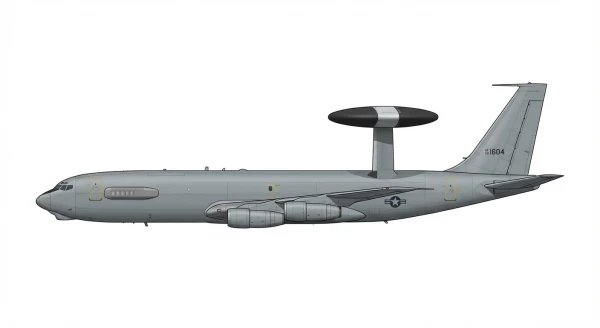
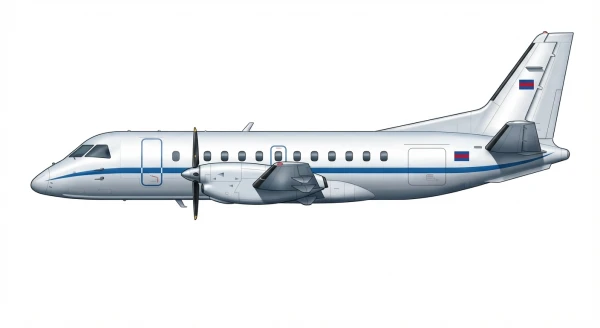
| E-3 Sentry AWACS | Saab 340 AEW&C | |
|---|---|---|
| Origin country | 🇺🇸 United States | 🇸🇪 Sweden |
| Category | Military Special Mission Aircraft | Military Special Mission Aircraft |
| Manufacturer | Boeing | Saab |
| First flight | 9 February 1972 | 1 January 1994 |
| Year introduced | 1977 | 1997 |
| Number produced | 68 units | 12 units |
| Average unit price | $270 million | -- |
| Wing area | 283.0 m² | 42.0 m² |
| Wingspan | 44.4 m | 21.4 m |
| Height | 12.6 m | 7.0 m |
| Length | 46.6 m | 20.6 m |
| Maximum speed | 853 km/h | 522 km/h |
| Operational range | 7,400 km | 1,300 km |
| Service ceiling | 10,668 m | 7,620 m |
| Max. takeoff weight | 147,417 kg | 13,155 kg |
| Empty weight | 83,915 kg | 10,300 kg |
| Total thrust | 4 x 9,752 kgf | 2 x 1,390 kW |
Detailed Comparison
The Boeing E-3 Sentry and Saab 340 AEW&C are airborne early warning and control aircraft from different generations and operational scales. The E-3 is a strategic asset derived from a four-engine jetliner, designed for large-scale command and control with a large crew and extensive on-station endurance. In contrast, the Saab 340 AEW&C is a tactical system based on a twin-turboprop regional airliner, offering a modern, cost-effective surveillance capability for smaller air forces or specific regional monitoring tasks.
Development and Design
The E-3 Sentry was developed in the late 1960s from the Boeing 707 airframe, a design choice that provided significant internal volume, range, and payload capacity. Its defining feature is the 30-foot diameter rotating radome (rotodome) housing the AN/APY-1/2 pulse-Doppler radar. This mechanical system provides continuous 360-degree surveillance coverage from the ground into the stratosphere. The aircraft required substantial structural and system modifications, including uprated hydraulics to power the one-rpm rotation of the dome.
The Saab 340 AEW&C, first flown in 1994, represents a more modern approach. It utilizes a fixed, dorsal-mounted Erieye Active Electronically Scanned Array (AESA) radar. This non-rotating "plank" antenna design reduces aerodynamic drag and mechanical complexity compared to a rotodome. However, it creates blind zones directly forward and aft, providing a 120-degree field of view on each side of the aircraft. This AESA technology offers inherent advantages in electronic countermeasures and rapid beam steering.
Specifications and Performances
The disparity in scale is the most significant performance differentiator. The E-3 has a maximum takeoff weight of 147,417 kg, more than ten times that of the Saab's 13,155 kg. This allows the Sentry to carry a larger crew (17 vs. 6), 14 mission consoles for battle management, and achieve a transcontinental range of 9,250 km. Its higher service ceiling (10,668 m) extends the radar's line-of-sight horizon. Crucially, the E-3 is capable of air-to-air refueling, giving it virtually unlimited endurance limited only by crew and system fatigue. The Saab 340 has a much shorter range, listed at 300 km (likely a mission radius, not ferry range), and an endurance of approximately five hours, operating at a lower ceiling of 7,620 m.
Deployment and usage
The E-3 Sentry has been a cornerstone of major air operations for decades. Operated by the USAF, NATO, and other major powers, it functions as a high-level command post. During the Gulf War, E-3s managed the entire coalition air campaign, directing thousands of sorties. Its role is strategic, providing persistent, wide-area surveillance and battle management for complex, large-scale conflicts.
The Saab 340 AEW&C is employed as a tactical asset. Operators like Sweden, Thailand, and now Poland and Ukraine use it for national air defense, border surveillance, and contributions to coalition operations where a full-scale E-3 is not required or available. Its lower acquisition and operational costs make it an accessible AEW&C platform for a wider range of nations. Its transfer to Ukraine highlights its utility as a modern, capable sensor package that can be integrated to bolster regional air defense networks.
Conclusion
The E-3 Sentry and Saab 340 AEW&C are not direct competitors but represent two distinct solutions for airborne surveillance. The E-3 is a strategic, Cold War-era platform designed for global power projection, offering unmatched endurance and command and control capacity. The Saab 340 AEW&C is a modern, tactical system that leverages more recent AESA technology in a smaller, more efficient airframe. It provides a highly capable, albeit more localized, surveillance picture for nations with different budgetary constraints and strategic objectives. The choice between them reflects a fundamental difference in operational requirements: large-scale, expeditionary air dominance versus cost-effective, regional air space control.