Short 330 vs Short 360
Short 330 vs Short 360 at a glance — top speed 350 vs 404 km/h, range 1,695 vs 1,595 km, max takeoff weight 10,387 vs 12,292 kg, built 141 vs 165 units.
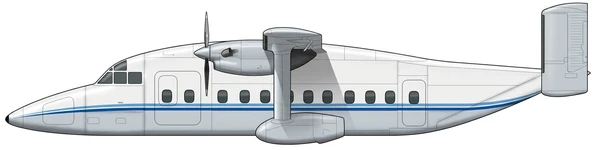
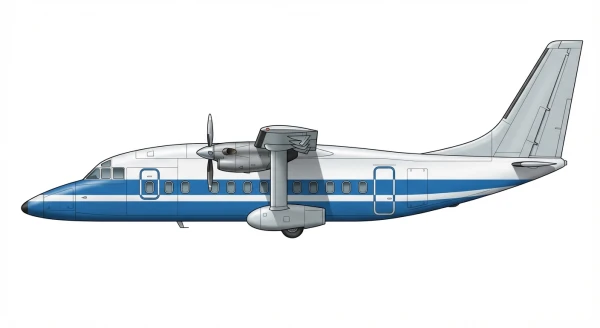
| Short 330 | Short 360 | |
|---|---|---|
| Origin country | 🇬🇧 United Kingdom | 🇬🇧 United Kingdom |
| Category | Military Transport Aircraft | Military Transport Aircraft |
| Manufacturer | Short Brothers | Short Brothers |
| First flight | 22 August 1974 | 1 June 1981 |
| Year introduced | 1976 | 1982 |
| Number produced | 141 units | 165 units |
| Average unit price | -- | $6.2 million |
| Wing area | 42.1 m² | 42.1 m² |
| Wingspan | 22.8 m | 22.8 m |
| Height | 5.0 m | 7.2 m |
| Length | 17.7 m | 21.6 m |
| Maximum speed | 350 km/h | 404 km/h |
| Operational range | 1,695 km | 1,595 km |
| Service ceiling | 6,100 m | 6,100 m |
| Max. takeoff weight | 10,387 kg | 12,292 kg |
| Empty weight | 6,680 kg | 7,870 kg |
| Total thrust | 2 x 895 kW | 2 x 1,062 kW |
Detailed Comparison
The Short 330 and its derivative, the Short 360, are utility transports defined by function over form, earning the shared industry moniker "The Shed." While the 330 established the unpressurized, square-fuselage concept for short-haul civilian and military logistics, the 360 refined the platform with aerodynamic improvements and increased capacity. Both aircraft served as the basis for the United States military's C-23 Sherpa fleet, filling a niche logistics role below the C-130 Hercules that few other fixed-wing assets could address efficiently.
Development and Design
Short Brothers developed the 330 from the Skyvan to meet U.S. commuter regulations, utilizing a braced high-wing and a twin-fin tail to maximize low-speed stability and ramp clearance. The square fuselage cross-section allows upright seating or standard pallet loading, a distinct advantage over tube-fuselage competitors. The 360, introduced in 1981, shifted priorities from pure STOL performance to cruise efficiency. It abandoned the twin-fin configuration for a conventional single swept tail and added a 3-foot fuselage plug. While the 330 utilized the PT6A-45R, the 360 adopted the powerful PT6A-65/67 series to manage the increased maximum takeoff weight (MTOW). The 360 retained the unpressurized cabin, a decision that limited its civilian marketability but simplified maintenance for military operators.
Specifications and Performances
The 360 offers a clear kinematic advantage, with a maximum speed of 404 km/h compared to the 330's 350 km/h. This speed increase, combined with a 1,900 kg increase in MTOW (12,292 kg vs 10,387 kg), allows the 360 to generate higher sortie rates in logistics loops. However, the 360 sacrifices some of the 330’s extreme short-field performance due to the aerodynamic changes and higher wing loading. Both airframes suffer from a service ceiling of 6,100 m (20,000 ft) due to the lack of pressurization, forcing them to fly through weather rather than over it—a significant operational limitation in theaters with adverse meteorological conditions.
Deployment and usage
The 330 found its primary military niche as the C-23A Sherpa with the USAF, operating the European Distribution System Aircraft (EDSA) network to shuttle spare parts between bases in Cold War Europe. This relieved high-value tactical airlifters from trivial logistics runs. The platform saw a resurgence during Operation Iraqi Freedom, where the U.S. Army procured surplus civil 360s, converting them into C-23B+ and C variants. These aircraft provided "last tactical mile" support, moving personnel and cargo—specifically helicopter engines and aircraft parts—between forward operating bases. The C-23’s rear ramp allowed for rapid forklift loading, a capability lacking in pressurized competitors like the Beechcraft 1900.
Conclusion
The Short 360 represents the mature realization of the concept introduced by the 330. While the 330 proved the utility of the "flying box" design, the 360’s increased payload and superior cruise speed make it the more effective theater logistics asset. The 330's twin-tail configuration offers marginal handling benefits in extreme STOL scenarios, but the 360's ability to carry heavier loads faster over regional distances dictates its superiority. In the intra-theater lift role, specifically for the C-23 variants, the converted Short 360 airframes provided a rugged, cost-effective bridge between rotary-wing assets and the C-27J or C-130.