Tu-16 Badger vs Tu-95 Bear
Tu-16 Badger vs Tu-95 Bear at a glance — top speed 1,050 vs 920 km/h, range 7,200 vs 15,000 km, max takeoff weight 79,000 vs 188,000 kg, built 1,509 vs 500 units.
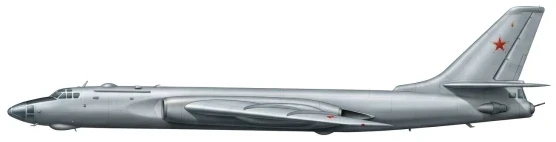
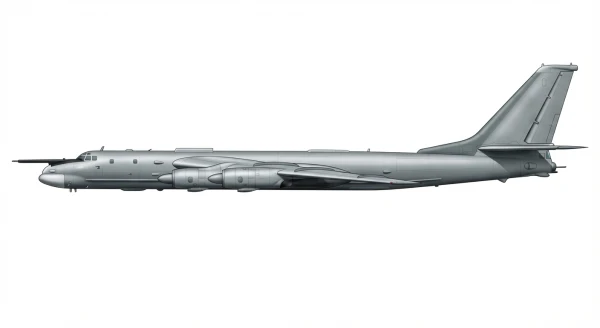
| Tu-16 Badger | Tu-95 Bear | |
|---|---|---|
| Origin country | 🇷🇺 Ex-USSR | 🇷🇺 Ex-USSR |
| Category | Bombers | Bombers |
| Manufacturer | Tupolev | Tupolev |
| First flight | 27 April 1952 | 12 November 1952 |
| Year introduced | 1954 | 1956 |
| Number produced | 1509 units | 500 units |
| Average unit price | $6 million | $60 million |
| Wing area | 165.0 m² | 310.0 m² |
| Wingspan | 33.0 m | 50.1 m |
| Height | 10.4 m | 12.1 m |
| Length | 34.8 m | 46.2 m |
| Maximum speed | 1050 km/h | 920 km/h |
| Operational range | 7,200 km | 15,000 km |
| Service ceiling | 12,800 m | 13,716 m |
| Max. takeoff weight | 79,000 kg | 188,000 kg |
| Empty weight | 37,200 kg | 90,000 kg |
| Total thrust | 2 x 9,525 kgf | 4 x 8,950 kW |
Detailed Comparison
Tupolev developed the Tu-16 Badger and Tu-95 Bear simultaneously in the early 1950s to meet divergent Soviet nuclear delivery requirements. The Tu-16 was built as a theater-level medium bomber utilizing twin turbojets to threaten European and maritime targets, while the Tu-95 answered the demand for an intercontinental strike platform capable of reaching the continental United States.
Development and Design
Soviet engine technology in 1950 dictated the propulsion architecture of both airframes. Jet engines of the era consumed fuel at rates that made intercontinental flight impossible without aerial refueling. Tupolev accepted this limitation for the Tu-16, optimizing its swept-wing, 79,000 kg airframe around twin Mikulin AM-3 turbojets for high subsonic speeds over regional distances.
For the Tu-95, Tupolev rejected early turbojets entirely. To meet an 8,000 km unrefueled range requirement, the bureau integrated four Kuznetsov NK-12 turboprops driving eight-bladed contra-rotating propellers. The supersonic tips of these propellers generate massive thrust and extreme acoustic signatures, resulting in an airframe that achieves jet-like speeds (920 km/h) while maintaining turboprop fuel efficiency. Over decades, the Tu-95 evolved into a standoff missile carrier equipped with PESA radars and internal rotary launchers, while the original Tu-16 airframe reached its modernization limits by the 1990s.
Specifications and Performances
The physical metrics divide these aircraft strictly by echelon. The Tu-95 is more than twice as heavy, with a maximum takeoff weight of 188,000 kg compared to the Tu-16's 79,000 kg. This mass directly dictates endurance and payload:
- The Tu-95 loiters for up to 21 hours and covers 15,000 km, allowing transpolar patrols and deep standoff launches of Kh-101 stealth cruise missiles.
- The Tu-16 maxes out at a 7,200 km range and a 9,000 kg payload, restricting it to theater strikes using gravity bombs or bulky early-generation anti-ship missiles like the AS-6 Kingfish.
While the Tu-16 is marginally faster (1,050 km/h vs. 920 km/h), this 130 km/h speed advantage is tactically irrelevant in modern contested airspace, where survival depends entirely on standoff distance rather than penetration speed.
Deployment and usage
The Tu-16 functioned as an export commodity and tactical workhorse, with 1,509 units built. It saw combat with Egyptian and Iraqi forces in Middle Eastern conflicts and was utilized heavily as a maritime strike platform. Its requirement to penetrate enemy airspace led to high vulnerability against surface-to-air missiles, causing its retirement in Russia by the 1990s.
Conversely, the Soviet Union never exported the Tu-95. The Bear spent the Cold War executing nuclear deterrence patrols and weapon tests, dropping the 1961 Tsar Bomba. It did not see combat until 2015, launching Kh-555 missiles into Syria. Since 2022, Tu-95MS and MSM variants have executed standoff strikes against Ukraine. Their reliance on fixed bases like Engels-2 and Olenya has exposed them to long-range Ukrainian drone strikes, resulting in multiple ground losses.
Conclusion
The Tu-95 holds the definitive edge as a strategic asset purely due to its intercontinental range and integration with modern standoff munitions. The Tu-16 was a volume-production bomber ($6.0 million per unit versus the Tu-95's $60.0 million) tailored for a European theater conflict. Because the Tu-95 can launch stealth cruise missiles from deep within friendly airspace, it remains a viable delivery system today. The Tu-16's requirement to close on its targets rendered it obsolete against late-20th-century integrated air defense systems.