CH-5 Rainbow vs Wing Loong II
CH-5 Rainbow vs Wing Loong II at a glance — top speed 480 vs 370 km/h, range 2,000 vs 1,000 km, max takeoff weight 3,300 vs 4,200 kg.
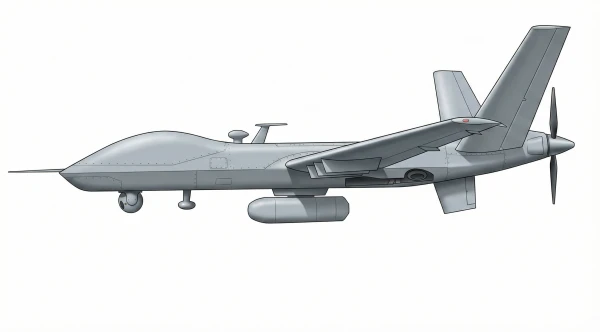
| CH-5 Rainbow | Wing Loong II | |
|---|---|---|
| Origin country | 🇨🇳 China | 🇨🇳 China |
| Category | Military Drones | Military Drones |
| Manufacturer | CASC | Chengdu |
| First flight | 1 August 2015 | 1 February 2017 |
| Year introduced | 2015 | 2018 |
| Number produced | N/A | 100 units |
| Average unit price | $8 million | $2 million |
| Wingspan | 21.0 m | 20.5 m |
| Length | -- m | 11.0 m |
| Maximum speed | 480 km/h | 370 km/h |
| Operational range | 2,000 km | 1,000 km |
| Service ceiling | 9,000 m | 9,000 m |
| Max. takeoff weight | 3,300 kg | 4,200 kg |
| Empty weight | 2,225 kg | 1,500 kg |
Detailed Comparison
China’s dominance in the non-ITAR restricted drone market is driven by fierce internal competition between CASC’s CH-5 Rainbow and AVIC’s Wing Loong II. While both platforms emulate the General Atomics MQ-9 Reaper in configuration, they diverge in operational doctrine: the CH-5 prioritizes sheer endurance and magazine depth for suppression, while the Wing Loong II offers a balanced multi-role profile that has endured more aggressive kinetic tasking in foreign service.
Development and Design
CASC developed the CH-5 as a massive evolution of the CH-4, expanding the wingspan to 21 meters to maximize lift and internal volume. The design philosophy is that of an airborne arsenal; it utilizes a shared data link with smaller CH-3/4 units, allowing it to act as a command node or heavy striker in a networked swarm. Conversely, AVIC’s Wing Loong II, built by the Chengdu aerospace cluster responsible for the J-10 and J-20 fighters, reflects a pedigree of high-performance aerodynamics. With a Maximum Takeoff Weight (MTOW) of 4,200 kg—significantly heavier than the CH-5's 3,300 kg—the Wing Loong II is built on a more robust, heavier airframe designed to withstand higher operational stresses.
Specifications and Performance
The defining capabilities contrast starkly: persistence versus airframe density. The CH-5 offers 60 hours of endurance, nearly double the Wing Loong II’s 32 hours. This allows the CH-5 to maintain orbit for two and a half days, ideal for persistent surveillance over porous borders. The CH-5 also claims a superior payload of 1,000 kg with hardpoints for up to 16 missiles, fitting its description as a "bomb truck." However, the Wing Loong II's heavier MTOW despite a lower cited payload suggests a prioritization of fuel load, sensors, and structural survivability over raw munition quantity. Economically, the data suggests a paradox: the CH-5 is listed at $8 million, positioning it as a premium asset, while the $2 million Wing Loong II targets volume procurement, undercutting even the cheapest manned alternatives.
Deployment and Usage
The Wing Loong II cemented its reputation in the Libyan Civil War. Operated by the UAE, these aircraft conducted high-tempo precision strikes against GNA forces, effectively interdicting logistics lines and neutralizing Turkish-backed assets. This combat stress-testing proved the platform's lethality in semi-permissive environments. The Rainbow series possesses a wider but more troubled footprint. While CH-4s saw volume use by Iraq and Saudi Arabia, operators like Jordan and Nigeria have reported dissatisfaction regarding reliability, maintenance quality, and datalink vulnerabilities. The CH-5 is CASC's attempt to rectify the payload limitations of the CH-4, but it inherits the mixed logistical reputation of its predecessors.
Conclusion
The Wing Loong II holds the tactical edge for active combat operations. Its combat record in North Africa demonstrates a level of reliability and kill-chain integration that CASC products have struggled to maintain consistently. It is the superior choice for air forces requiring a rugged strike platform. The CH-5, however, is the preferred solution for uncontested ISR (Intelligence, Surveillance, Reconnaissance). If the mission requires loitering over a target box for 50+ hours to track patterns of life, the CH-5 offers capability that the Wing Loong II cannot match. The choice is between a kinetic workhorse (Wing Loong II) and a persistent sentinel (CH-5).