CH-4 Rainbow
Chinese unmanned combat aerial vehicle, significant for deployments in Iraq and Saudi Arabia, utilized extensively for surveillance and strike missions. Key figures: top speed 435 km/h, range 250 km, service ceiling 7,620 m, max takeoff weight 1,330 kg, unit price $2M. In service with 5 air forces as of 2026 — Pakistan (12), Indonesia (6), China (5) and 2 others.
| Length | 8.5 m (27.9 ft) |
| Wingspan | 18 m (59.1 ft) |
| Empty weight | 1,600 kg (3,527 lbs) |
| Max. takeoff weight | 1,330 kg (2,932 lbs) |
| Powerplant | 1 × piston engine |
| Maximum speed | 435 km/h (270 mph) |
| Operational range | 250 km (155 mi) |
| Endurance | 38 hours |
| Service ceiling | 7,620 m (25,000 ft) |
Recent Events — CH-4 Rainbow
1 event →


Description
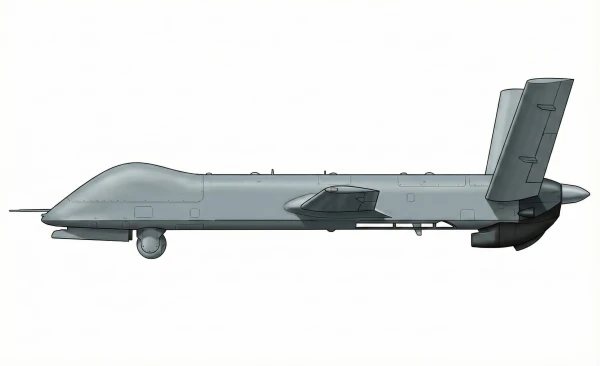
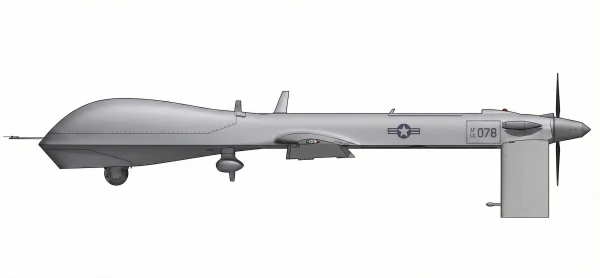
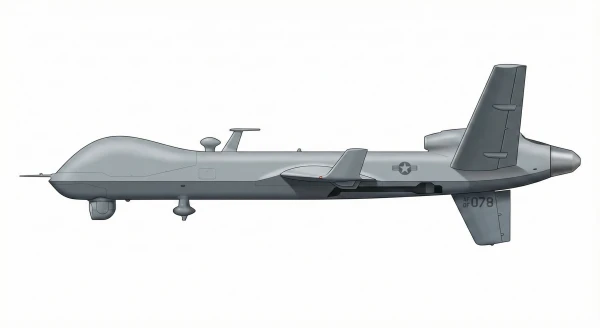
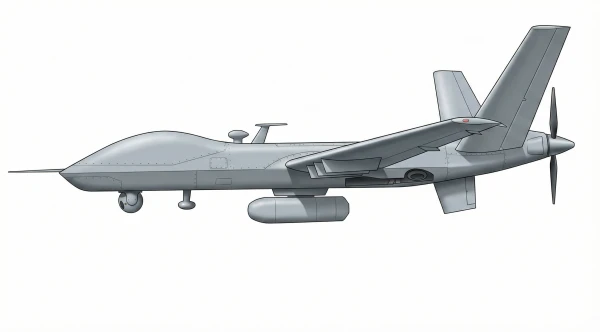
The CH-4 Rainbow is a medium-altitude long-endurance unmanned aerial vehicle produced by the China Academy of Aerospace Aerodynamics (CAAA), a subsidiary of the China Aerospace Science and Technology Corporation (CASC), and marketed as part of the Rainbow (Caihong) UAV series. Configured for reconnaissance and strike missions, it is externally near-identical to the General Atomics MQ-9 Reaper, the only obvious difference being the absence of the ventral fin below the V-tail. It has been widely exported and saw combat use in Iraq and Yemen.
Development
The CH-4 follows the CH-3 UCAV, which first flew in 2007, within the CASC Rainbow line. Two versions were developed: the CH-4A reconnaissance variant, with a 3,500–5,000 km range and 30–40 hour endurance, and the CH-4B strike-reconnaissance variant. A CASC-linked factory in Myanmar produces the type under licence. The Saqr-1 is thought to be derived largely from the CH-4.
Design
The CH-4 has a length of 8.5 m, a wingspan of 18 m and a maximum take-off weight of 1,300 kg. It is powered by a single 100 hp piston engine driving a pusher propeller, giving a maximum speed of 235 knots (435 km/h) and a cruise speed of 180 knots (330 km/h). Endurance reaches 40 hours. Control is exercised via line-of-sight datalink out to approximately 150 km from the ground control station, or by satellite communications beyond 1,000 km, extended to 1,500–2,000 km on the CH-4B.
Armament
The CH-4B carries up to six weapons on underwing hardpoints with a payload of 250 to 345 kg. Munitions include the AR-1 and AR-2 missiles, the latter weighing 20 kg with a 5 kg armour-piercing warhead, inertial guidance and a terminal semi-active laser seeker with a maximum range of 8 km, as well as the AKD-10 anti-tank missile and the BRM-1 90 mm guided rocket. Guided bombs comprise the FT-7 130 kg glide bomb, the FT-9/50 50 kg and FT-10/25 25 kg bombs, and the GB-7/50 and GB-4/100 precision-guided munitions. The aircraft can launch air-to-ground missiles from 5,000 m, placing it above the effective envelope of most anti-aircraft guns.
Operational History
Iraq employed CH-4s against the Islamic State during the 2013–2017 war; deliveries began by 2015, the fleet was placed in storage in 2017, and by 2019 only one aircraft was reported fully mission capable, the remainder grounded by maintenance problems. Saudi Arabia and the United Arab Emirates deployed CH-4s against the Houthi movement in the Yemeni civil war, with more than twelve Saudi aircraft lost by July 2022. Other operators include Armenia, which displayed three CH-4Bs with AR-1 and AR-2 missiles during a parade in 2026, Algeria, the People's Liberation Army Ground Force (5+ CH-4B as of 2023), the Democratic Republic of the Congo (3 of 9 ordered), Ethiopia, Indonesia (six CH-4B), Myanmar, Pakistan (five received in 2021), Sudan and Zambia. Jordan operated the CH-4B before withdrawing it.
Variants
- CH-4A: Reconnaissance version with 3,500–5,000 km range and 30–40 hour endurance.
- CH-4B: Armed reconnaissance-strike version with six hardpoints, up to 345 kg payload and 1,500–2,000 km satellite communications range.
- KVD002: Chinese reconnaissance and precision-strike derivative operated by the PLA Ground Force.
Identified in 30 sorties in the official China-Taiwan Tensions activity reports between 2022 and 2023 — a floor, not a census: only sorties the source identified by type are counted, and how much it disclosed varies by year.
Frequently Asked Questions
What type of aircraft is the CH-4 Rainbow?
What is the maximum speed of the CH-4 Rainbow?
What is the range of the CH-4 Rainbow?
When did the CH-4 Rainbow first fly?
Which countries operate the CH-4 Rainbow?
How much does a CH-4 Rainbow cost?
What is the service ceiling of the CH-4 Rainbow?
- AUG 302026 Updated Description updated
- JUL 232026 Updated Sources and cross-references refreshed
- APR 82026 Updated Empty weight added
- APR 72026 Updated Sources and cross-references refreshed
- JAN 242026 Updated Top speed updated