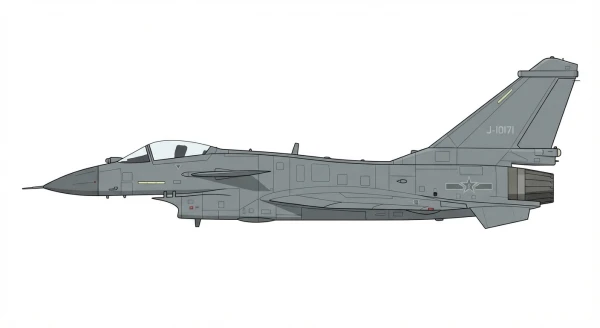
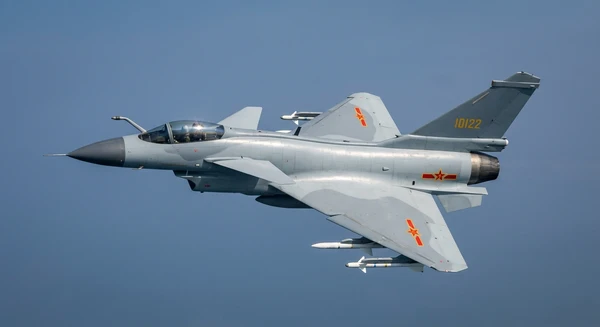
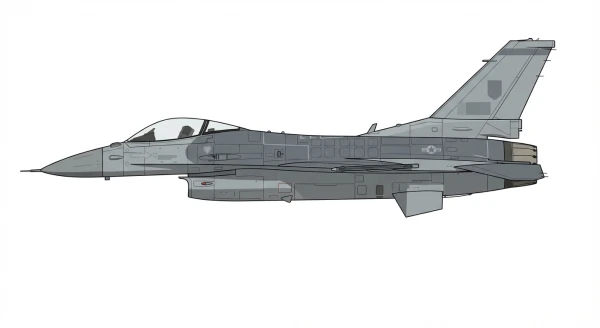
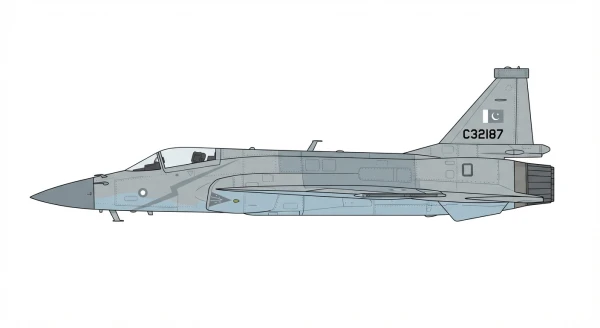
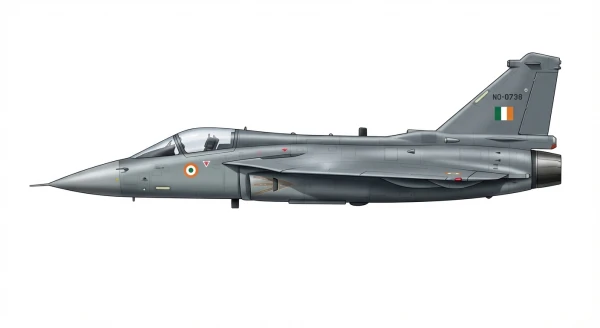
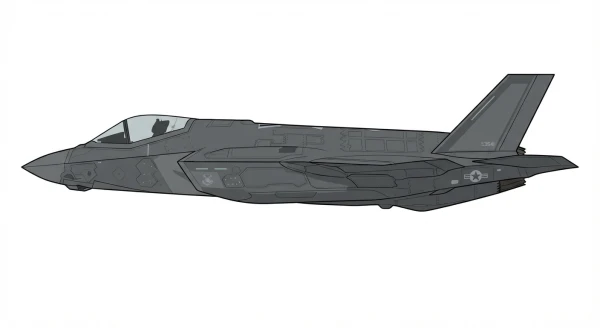
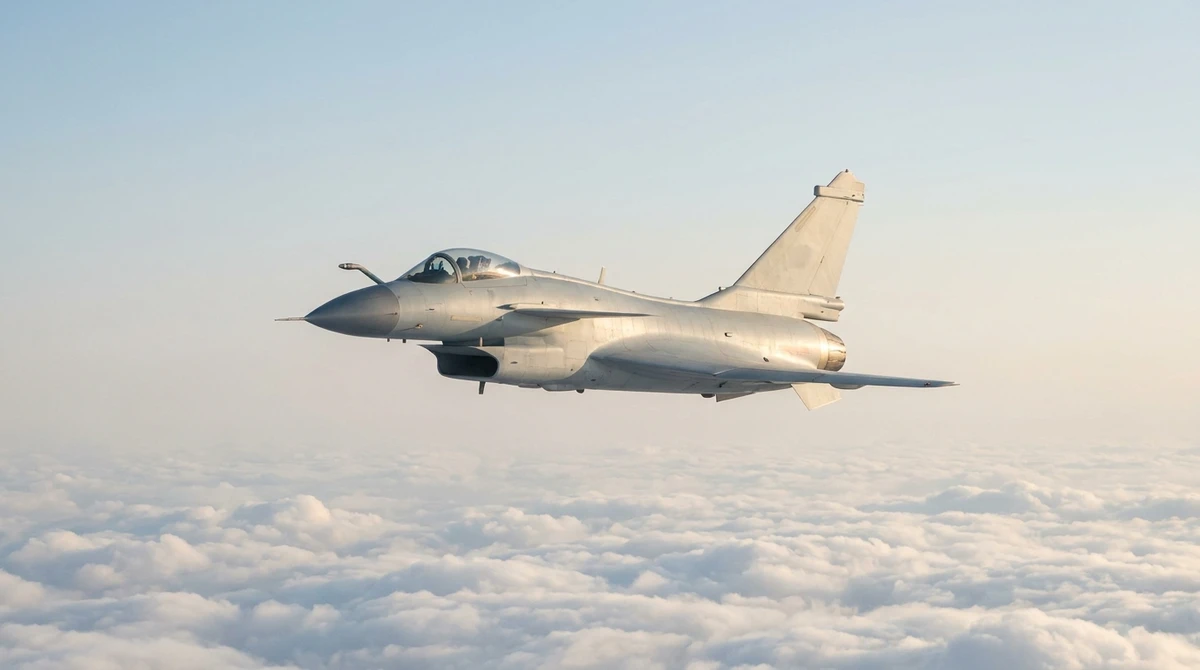
The Chengdu J-10 Vigorous Dragon (NATO code “Firebird”) is a multirole fighter jet developed by the Chengdu Aircraft Industry Group for the People's Liberation Army Air Force (PLAAF) of China. Its development began in the 1980s with the aim of creating an indigenous Chinese fighter that could match Western counterparts like the F-16. The project was reportedly influenced by the Israeli IAI Lavi program, although Chinese authorities have not officially confirmed this. The J-10 was officially introduced into service in 2005 and represents a significant step in China's efforts to modernize its air force.
Development
The development of the Chengdu J-10 was a lengthy and complex process, taking over two decades from its conceptualization in the 1980s to its formal introduction in 2005. Initially intended as a domestic answer to advanced Western fighters, the J-10 aimed to fill the technological gap that existed in the Chinese military aviation sector at the time. About 60% of the aircraft required new technology and parts, instead of a usual 30% for new aircraft.
Design
The aircraft features a canard-delta wing configuration, which is somewhat unusual for a multirole fighter. This design aids in agility and maneuverability, allowing the J-10 to perform well in various combat scenarios including air-to-air and air-to-ground missions. Its aerodynamic design was reportedly influenced by the Israeli IAI Lavi program, though this has never been officially confirmed by Chinese authorities.
Under the hood, the J-10 is equipped with a Russian AL-31 or a Chinese WS-10 turbofan engine, depending on the variant. Its avionics are considered advanced, incorporating an indigenous radar system and a variety of Chinese and Russian-made weapons systems.
Armament
The Chengdu J-10 is equipped to carry a wide array of weapons, allowing it to perform multiple roles including air-to-air combat, air-to-ground strikes, and anti-ship missions. It comes with a built-in internal 23mm Type 23-3 twin-barrel cannon for close-range combat. For external ordnance, it has 11 hardpoints: five under the fuselage and three under each wing. These can be armed with a variety of munitions, making the J-10 a versatile platform.
For air-to-air combat, the J-10 can be outfitted with short to medium-range missiles such as the PL-8, PL-9, PL-10, and PL-12. The PL-12 is particularly noteworthy for its beyond-visual-range (BVR) capabilities, allowing the aircraft to engage targets at distances of up to 100 km.
In air-to-ground roles, the J-10 can carry laser-guided bombs, satellite-guided bombs, and unguided bombs. It can also carry anti-ship missiles and anti-radiation missiles for suppression of enemy air defenses (SEAD) missions. The J-10C variant adds the ability to carry stand-off weapons, increasing its effectiveness in attacking fortified or well-defended targets.
For electronic warfare, some J-10 variants are also capable of carrying electronic countermeasures (ECM) pods and advanced targeting pods to improve both its defensive and offensive capabilities.
Operational History
The Chengdu J-10 entered service with the People's Liberation Army Air Force (PLAAF) in 2005 and has since been a core component of China's fighter fleet. It was initially deployed to replace older models like the J-7 and J-8, offering a quantum leap in capabilities in comparison.
While the J-10 has not seen extensive combat, it has been involved in various exercises and patrols, often in close proximity to contested areas. For example, it has been deployed in air patrol missions over the South China Sea and the Taiwan Strait, both politically sensitive areas. Its presence in these areas serves as a demonstration of China's growing air power and its ability to assert its territorial claims.
The aircraft has also participated in multiple international air exercises, showing off its capabilities on the world stage. These exercises serve as both diplomatic tools and opportunities for the PLAAF to gauge the J-10's performance relative to other countries' aircraft.
Exports were slow to materialise. Pakistan became the first export customer, receiving its first J-10CE fighters in March 2022 for the Pakistan Air Force. Uzbekistan followed as the second: state television footage confirmed at least six J-10CE at Karshi-Khanabad in late August 2026, the country's first Chinese-built combat aircraft.
Variants
-
J-10A: The original production version, equipped with a Russian AL-31 turbofan engine and mechanical flight control system. Primarily configured for air-to-air combat but retains multirole capabilities.
-
J-10B: An improved version featuring a diverterless supersonic inlet (DSI), reduced radar cross-section, and advanced avionics. Often equipped with a Chinese WS-10 engine.
-
J-10C: A further advancement over the J-10B, the J-10C incorporates an AESA radar and is compatible with advanced air-to-air and air-to-ground munitions. It also features improved electronic warfare systems.
-
J-10S: A two-seat trainer version, which retains combat capabilities. Designed for training purposes but can be adapted for multirole missions.
-
J-10AH/SH: Naval versions of J-10A and J-10S.
-
J-10CE: The export version of the J-10C, delivered to Pakistan from 2022 and to Uzbekistan in 2026; the FC-20 designation referred to the earlier proposed export variant.